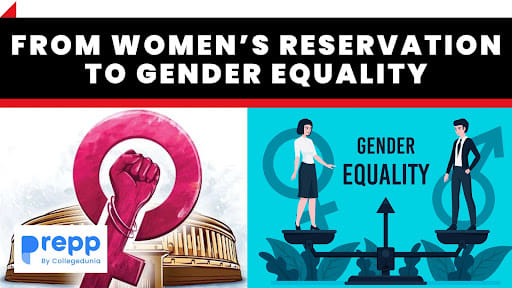
From Women’s Reservation To Gender Equality
Relevance: GS1 - Role of women and women’s organization; GS2 - Parliament and State legislatures—structure, functioning, conduct of business, powers & privileges and issues arising out of these.
(Source: The Hindu, 09/28/2023)
Click here for Daily Current Affairs
Why in the news?
- Recently, Parliament passed the Women’s Reservation Bill which aims to provide one-third reservation for women in the Lok Sabha and Legislative Assemblies.
- According to data from the Inter-Parliamentary Union, India ranked 141st out of 193 countries in terms of women's representation with the share of women in Parliament being only 15%.
- India is ranked 127th out of 146 nations in terms of gender parity in the annual Gender Gap Report, 2023.
Table of Contents
Increasing women's participation in governance
- The introduction of reservations for women in local body elections has a positive impact on their participation in governance.
- Studies suggest that elected women representatives have asserted their influence over time, despite resistance from male family members.
- This success could be replicated across higher elected bodies such as the state legislative assemblies and the Parliament.
Women’s Reservation Bill
Significance
|
What are the challenges in implementation?
- Delimitation: The successful implementation of the Women's Reservation Bill depends on the Census and subsequent delimitation exercises.
- However, these processes have been frozen since 1976 to ensure a level playing field for states in population control efforts.
- States with better indicators of women’s empowerment, particularly the Southern states, may lose seats in Parliament when delimitation is conducted.
- Legality: Constitutional courts will have to examine if a constitutional amendment or law can be made contingent on uncertain future events.
- The Bill mentions that it shall be contingent on the next delimitation exercise and census.
- This means that the provisions of the bill may only come into effect from the 2029 General Elections.
- Capacity building: There are concerns over whether higher elected bodies are prepared and capable of handling the increase in the proportion of women.
- OBC reservation: The Bill does not specify a quota for women from the OBC communities.
- In 1996, the Geeta Mukherjee Committee recommended the extension of women's reservation to OBCs.
Societal Transformation
- Alongside legislative reforms, it is necessary to reform societal attitudes related to gender roles in order to ensure gender justice in society.
- Care work: Unpaid care work is disproportionately borne by women in India, which is a major reason for the country’s low female labor force participation rate.
- Women spend 134 minutes on average daily on unpaid caregiving services for household members as compared to the 76 minutes spent by men.
- Domestic responsibilities: According to the Ministry of Statistics and Programme Implementation’s Time Use Survey (2019), women spend 299 minutes for every 97 minutes spent daily by men on unpaid domestic services for household members.
- Household responsibilities must be shared equitably among all members to ensure gender equality.
- The female labor force participation can be improved only through reforming the patriarchal mindset in Indian society.
Magalir Urimai Thogai scheme
- The Tamil Nadu government's Magalir Urimai Thogai scheme is a monthly cash transfer programme that has been designed as an obligation to women, who bear the burden of unpaid care work.
- Aim: It aims to recognize the unquantified contribution of women in both domestic responsibilities and external work which if valued would allow them to hold equal status in family properties, without the need for specific laws.
- Provisions:
- 1.06 crore women, recognized as heads of families and enrolled as beneficiaries, would get monthly rights grants or a basic income of ₹1,000 each.
- The entitlement is meant to improve women’s livelihood, enhance their standard of living, and enable them to live with self-respect in society”.
- Eligible beneficiaries: A woman who has completed 21 years of age and hails from an eligible family i.e.
- Families with annual income less than ₹2.5 lakh
- Families with less than five acres of wetland or less than ten acres of dryland holdings
- Families consuming less than 3,600 units of electricity per year for domestic use
- According to experts, the Magalir Urimai Thogai scheme and the provision of free bus passes to women will help improve the active labor force participation rate.
Way Forward
- Capacity building initiatives: India can replicate initiatives such as the U.S.A.’s EMILYs List which provides campaign guidance, mentorship, and capacity building for women in politics.
- Government role: The government must play a proactive role in the capacity building of women representatives.
- Institutional: The National Commission for Women and the Parliamentary Committee on Empowerment of Women must be redefined and strengthened to actively support women in politics.
Conclusion
- The Women's Reservation Bill is a significant milestone in addressing gender inequality in Indian politics. However, its success depends on overcoming implementation challenges, transforming societal attitudes, and building the capacity of women representatives. Achieving substantive gender equality requires not only legislative reforms but also a concerted effort to recognize and rectify the disparities in unpaid labor and household responsibilities.
Inter-Parliamentary Union
|
(*Click this link to read prelims specific weekly current affairs articles)
FAQs
Question: What is delimitation?
Answer:
Delimitation refers to the act or process of fixing limits or boundaries of territorial constituencies for a legislative body in a country or province. It is performed to reflect the demographic changes in the country or region and ensure that all parts of a population are equally represented.
Question: What is gender justice?
Answer:
Gender Justice represents equality among women and men, boys and girls across all sectors, and is an important benchmark for development, poverty reduction, and progress.
Question: What is the Gender Gap Report?
Answer:
It is an annual benchmark of the current state and evolution of gender parity across four key dimensions - Economic Participation and Opportunity, Educational Attainment, Health and Survival, and Political Empowerment. It is published annually by the World Economic Forum (WEF). It measures scores on a 0 to 100 scale with scores interpreted as the distance covered towards parity.
UPSC Mains Practice Question:
|
MCQs
Question: Given below are two statements, one labeled as Assertion(A) and the other labeled as Reason (R).
Assertion (A): Reservation of thirty-three percent of seats for women in Parliament and State Legislature does not require any Constitutional amendment:
Reason (R): Political parties contesting elections can allocate thirty-three percent of seats they contest to women candidates without any Constitutional amendment.
In the context of the above two statements which one of the following is correct? (UPSC CSE 1997)
(a) Both A and R are true and R is the correct explanation of A
(b) Both A and R are true but R is not the correct explanation of A
(c) A is true but R is false
(d) A is false but R is true
Answer: (d) See the Explanation
- Reservation of 33% of seats for women in Parliament and state legislatures requires a Constitutional amendment.
- Recently the Parliament passed the 128th Constitutional Amendment Bill to grant 33% reservation to women in Parliament and state legislative bodies. Hence assertion is incorrect.
- However, political parties are not constitutional bodies and can grant 33% of seats to women candidates without the need for a Constitutional amendment. Hence the reason is correct.
Therefore, option (d) is the correct answer.
Download the PREPP App and attempt FREE IAS Exam Mock Tests and get complete study material!

Full Test - 04: UPSC CSE Prelims CSAT (Paper-II)
Full Test - 03: UPSC CSE Prelims CSAT (Paper-II)
UPSC CSE Prelims 2026 GS Paper 1 Question Paper (24-May-2026)
UPSC CSE Prelims 2026 CSAT Paper 2 Question Paper (24-May-2026)

17 February 2025 | The Hindu Must Read Articles | Current Affairs

16 February 2026 | The Hindu Must Read Articles | Current Affairs

13 February 2026 | The Hindu Must Read Articles | Current Affairs









Comments