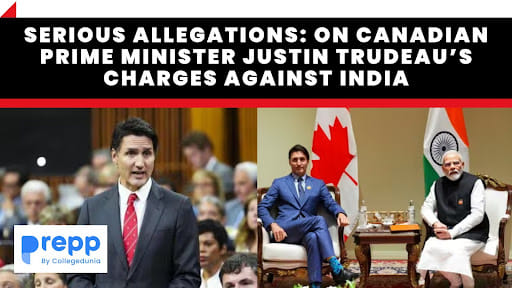
Serious Allegations: On Canadian Prime Minister Justin Trudeau’s Charges Against India
Relevance: GS2 - Effect of policies and politics of developed and developing countries on India’s interests, Indian diaspora.
(Source: The Hindu, 09/20/2023)
Click here for Daily Current Affairs
Why in the news?
- The article discusses the developments in Indo-Canadian ties following the allegations raised by Canadian Prime Minister Justin Trudeau against India related to the killing of Khalistani separatist leader, Hardeep Singh Nijjar.
- India also expelled a Canadian diplomat in response to Canada’s expulsion of an Indian diplomat.
Table of Contents
What has the Canadian Prime Minister alleged?
- The Canadian Prime Minister, Justin Trudeau has alleged that agents of the Government of India had ties in the killing of Canadian Khalistani leader Hardeep Singh Nijjar in June.
- He also claimed that Canada had shared the relevant evidence with India and raised its concerns in a bilateral meeting with Prime Minister Modi in September 2023.
Fallout of the allegations
- Expulsion of diplomats: In a tit-for-tat move, India and Canada expelled top diplomats to indicate their displeasure.
- Escalation of confrontation: The concerns raised by both countries could lead to further confrontation.
- Canadian politics: Domestic political considerations could have influenced the decision to criticize India.
- International concern: Canada’s partners in the Five Eyes Alliance - U.S.A, and Australia - have also expressed concern.
- Diaspora: Canada is home to a significantly large Indian diaspora and many Indian-origin Canadians, who could be impacted by strained bilateral ties.
Challenges in Indo-Canadian ties
- Uniting for Consensus: Uniting for Consensus (UfC), or the Coffee Club, is a movement that aims to oppose the expansion of permanent seats in the UNSC which has been proposed by the G4 countries.
- India is a member of the G4 while Canada is a member of the Coffee Club.
- Khalistan: India has criticized Canada for its soft approach towards Khalistani supporters in Canada.
- India has raised concerns about the vandalism and desecration of temples in Canada and the recent aggravations such as glorifying the assassination of Indira Gandhi and the defacement of Bharat Mata.
Way Forward
Canada
- The Canadian Prime Minister will either have to provide proof of his allegations or admit that the allegations cannot be proved.
India
- India will have to reassess its strategic approach to Canada with which it has had a tense relationship owing to the Khalistan issue.
- In 2015, Prime Minister Narendra Modi became the first Indian Prime Minister to visit Canada since 1973.
- Similarly, India and Canada attempted to improve their bilateral ties through the visit of Canadian Foreign Minister Melanie Joly, and fast-tracked talks on the Free Trade Agreement.
Conclusion
- The reported bitter meeting between Trudeau and Modi on the sidelines of the G-20 summit in New Delhi in September 2023 and the pausing of talks on the FTA indicates the negative turn of the relationship.
India-Canada ties
Strategic
Economic
Science and Technology
Education
Security
|
(*Click this link to read prelims specific weekly current affairs articles)
FAQs
Question: What is Khalistan?
Answer:
The Khalistan movement is a Sikh separatist movement that aims to establish a sovereign state in modern-day Punjab with the aim of serving as a Sikh homeland, both in India and Pakistan. The demand for a separate Khalistan state increased in the 1980s during the height of the insurgency in the state of Punjab.
Question: What is the GIAN programme?
Answer:
The Global Initiative of Academic Networks (GIAN) in Higher Education was launched in 2015 by the Ministry of Human Resource and Development. It aims to encourage the engagement of scientists and entrepreneurs with Indian Higher Education institutes in order to augment academic resources, ensure quality reform, and global excellence.
UPSC Mains Practice Question:
|
MCQs
Question: Consider the following countries:
- Australia
- Canada
- China
- India
- Japan
- USA
Which of the above are among the 'free-trade partners' of ASEAN? (UPSC CSE 2018)
(a) 1, 2, 4 and 5
(b) 3, 4, 5 and 6
(c) 1, 3, 4 and 5
(d) 2, 3, 4 and 6
Answer: (c) See the Explanation
- ASEAN has five free trade agreements (FTAs) with six Dialogue Partners i.e. China, Japan, the Republic of Korea, India, Australia, and New Zealand.
- Canada and the USA are not FTA partners of ASEAN. Hence 2 and 6 are incorrect.
Therefore, option (c) is the correct answer.
Question: In which one of the following groups are all four countries members of G20? (UPSC CSE 2020)
(a) Argentina, Mexico, South Africa and Turkey
(b) Australia, Canada, Malaysia and New Zealand
(c) Brazil, Saudi Arabia, and Vietnam
(d) Indonesia, Japan, Singapore, and South Korea
Answer: (a) See the Explanation
- The members of the G20 are - Argentina, Australia, Brazil, Canada, China, France, Germany, India, Indonesia, Italy, Japan, Republic of Korea, Mexico, Russia, Saudi Arabia, South Africa, Turkey, United Kingdom, United States, and the European Union.
- Malaysia, New Zealand, Vietnam, and Singapore are not members of the G-20.
Therefore, option (a) is the correct answer.
Download the PREPP App and attempt FREE IAS Exam Mock Tests and get complete study material!

Full Test - 04: UPSC CSE Prelims CSAT (Paper-II)
Full Test - 03: UPSC CSE Prelims CSAT (Paper-II)
UPSC CSE Prelims 2026 GS Paper 1 Question Paper (24-May-2026)
UPSC CSE Prelims 2026 CSAT Paper 2 Question Paper (24-May-2026)

17 February 2025 | The Hindu Must Read Articles | Current Affairs

16 February 2026 | The Hindu Must Read Articles | Current Affairs

13 February 2026 | The Hindu Must Read Articles | Current Affairs









Comments