Three Hoysala Temples Declared World Heritage Sites
Relevance: Prelims; GS1 - Indian Heritage Sites
(Source: The Hindu, 09/20/2023)
Click here for Daily Current Affairs
Why in the news?
- Recently, the Sacred Ensembles of the Hoysala, the famed Hoysala temples of Belur, Halebid and Somananthpura in Karnataka have been added to the United Nations Educational, Scientific and Cultural Organization (UNESCO) World Heritage Site.
- This inclusion marks the 42nd UNESCO World Heritage Site in India.
- All three temples are protected by the ASI and the nominations were entered as ‘The Sacred Ensembles of Hoysalas’.
- They have been on UNESCO's tentative list since 2014.
- The monuments were officially inscribed as UNESCO World Heritage Sites during the 45th session of the World Heritage Committee at Riyadh, Saudi Arabia, just a day earlier, Santiniketan in West Bengal was inscribed as a UNESCO site.
- As of 2023, there are 42 World Heritage Sites located in India. Out of these, 34 are cultural, 7 are natural, and one, the Khangchendzonga National Park, is of mixed type. India has the sixth-largest number of sites in the world.
Table of Contents

About Hoysala Architecture
- The sacred ensembles of the Hoysalas, constructed during the 12th and 13th centuries are represented here by the three components of Belur, Halebid, and Somnathapura.
- While the Hoysala temples maintain a fundamental Dravidian morphology, they exhibit substantial influences from the Bhumija style prevalent in Central India, the Nagara traditions of northern and western India, and the Karnataka Dravida modes favoured by the Kalyani Chalukyas.
- Hoysala temples are sometimes called hybrid or vesara as their unique style seems neither completely dravida nor nagara, but somewhere in between.
- They are easily distinguishable from other medieval temples by their highly original star-like ground-plans and a profusion of decorative carvings.
- The Hoysala temples contain multiple shrines grouped around a central pillared hall and laid out in the shape of an intricately-designed star.
- They are made out of soapstone which is a relatively soft stone.
- They are easily distinguishable from other medieval temples by their highly original star-like ground-plans and a profusion of decorative carvings.
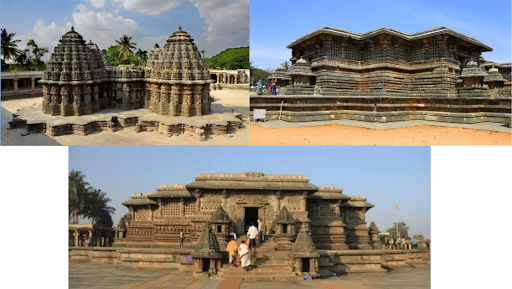
Three important Sacred Ensembles of the Hoysala
Chennakeshava Temple at Belur
- Chennakeshava Temple is also referred to as Vijayanarayana Temple of Belur.
- It is a 12th-century Hindu temple in Karnataka.
- The temple was commissioned by King Vishnuvardhana in 1117 CE, on the banks of the Yagachi River in Belur also called Velapura, an early Hoysala Empire capital.
- The temple is devoted to Vishnu.
- The richly sculptured exterior of the temple narrates scenes from the life of Vishnu and his reincarnations and the epics, Ramayana, and Mahabharata. However, some of the representations of Shiva are also included.
Hoysaleswara Temple at Halebidu
- The Hoysaleswara Temple on the banks of Dwarasamudra tank in Halebidu (Hassan district), a town which has many protected and unprotected temples, archaeological ruins and mounds.
- It is dedicated to the Hindu god Shiva, and it is known for its exquisite soapstone carvings.
- The temple was built in 1121CE during the reign of the Hoysala King, Vishnuvardhana Hoysaleshwara.
- The temple is most well-known for the more than 240 wall sculptures that run all along the outer wall.
Keshava Temple - Somanathapura
- Keshava Temple is a Vaishnava temple on the banks of River Kaveri at Somanathapura, Karnataka.
- The temple was consecrated in 1258 CE by Somanatha Dandanayaka, a general of the Hoysala King Narasimha III.
- The temple is enclosed in a courtyard with a pillared corridor of small shrines (damaged).The main temple in the centre is on a high star-shaped platform with three symmetrical sanctums (garbha-griha).
- The western sanctum was for a statue of Kesava (missing), the northern sanctum of Janardhana and the southern sanctum of Venugopala, all forms of Vishnu.
What does it signify when a site is listed on the World Heritage List?
- According to UNESCO, when a nation becomes a signatory to the World Heritage Convention and successfully inscribes its sites on the World Heritage List, it typically leads to heightened awareness and appreciation for the importance of heritage preservation, not only among its populace but also within its government.
- Such a designation opens the door for potential financial support and expert guidance from the World Heritage Committee.
- This assistance can be instrumental in strengthening the efforts dedicated to safeguarding and conserving these invaluable cultural and natural treasures.
List of UNESCO World Heritage Sites in India
| Sr. No. | Name of Sites | Year | Location |
|---|---|---|---|
| 1 | Ajanta Caves | 1983 | Maharashtra |
| 2 | Ellora Caves | 1983 | Maharashtra |
| 3 | Agra Fort | 1983 | Agra |
| 4 | Taj Mahal | 1983 | Agra |
| 5 | Sun Temple | 1984 | Orissa |
| 6 | Mahabalipuram Monuments | 1984 | Tamil Nadu |
| 7 | Kaziranga National Park | 1985 | Assam |
| 8 | Keoladeo National Park | 1985 | Rajasthan |
| 9 | Manas Wildlife Sanctuary | 1985 | Assam |
| 10 | Churches and Convents of Goa | 1986 | Goa |
| 11 | Monuments of Khajuraho | 1986 | Madhya Pradesh |
| 12 | Monuments of Hampi | 1986 | Karnataka |
| 13 | Fatehpur Sikri | 1986 | Agra |
| 14 | Elephanta Caves | 1987 | Maharashtra |
| 15 | Great Living Chola Temples | 1987 | Tamil Nadu |
| 16 | Pattadakal Monuments | 1987 | Karnataka |
| 17 | Sundarbans National Park | 1987 | West Bengal |
| 18 | Nanda Devi & Valley of Flowers National Park | 1988 | Uttarakhand |
| 19 | Monuments of Buddha | 1989 | Sanchi, Madhya Pradesh |
| 20 | Humayun’s Tomb | 1993 | Delhi |
| 21 | Qutub Minar | 1993 | Delhi |
| 22 | Mountain Railways of Darjeeling, Kalka Shimla & Nilgiri | 1999 | Darjeeling |
| 23 | Mahabodhi Temple | 2002 | Bihar |
| 24 | Bhimbetka Rock Shelters | 2003 | Madhya Pradesh |
| 25 | Chhatrapati Shivaji Terminus | 2004 | Maharashtra |
| 26 | ChampanerPavagadh Archaeological Park | 2004 | Gujarat |
| 27 | Red Fort | 2007 | Delhi |
| 28 | Jantar Mantar | 2010 | Delhi |
| 29 | Western Ghats | 2012 | Karnataka, Kerala, Tamil Nadu, Maharashtra |
| 30 | Hill Forts | 2013 | Rajasthan |
| 31 | Rani Ki Vav (The Queen’s Stepwell) | 2014 | Gujarat |
| 32 | Great Himalayan National Park | 2014 | Himachal Pradesh |
| 33 | Nalanda | 2016 | Bihar |
| 34 | Khangchendzonga National Park | 2016 | Sikkim |
| 35 | Architectural Work Of Le Corbusier (Capitol Complex) | 2016 | Chandigarh |
| 36 | The Historic City | 2017 | Ahmedabad |
| 37 | Victorian Gothic and Art Deco Ensembles | 2018 | Mumbai |
| 38 | The Pink City | 2019 | Jaipur |
| 39 | Kakatiya Rudreshwara (Ramappa) Temple | 2021 | Telangana |
| 40 | Dholavira | 2021 | Gujarat |
| 41 | Santiniketan | 2023 | West Bengal |
| 42 | Sacred Ensembles of Hoysalas | 2023 | Karnataka |
(*Click this link to read prelims specific weekly current affairs articles)
FAQs
Question: What is a World Heritage Site?
Answer:
World Heritage Sites are cultural and/or natural sites considered to be of outstanding universal value, which has been inscribed on the World Heritage List by the World Heritage Committee. They are representative of unique, or the most significant or best, examples of the world’s cultural and/or natural heritage.
Question: What are Sacred Ensembles of Hoysala?
Answer:
Sacred Ensembles of Hoysala were built in the 12th-13th century. They are represented here by the three components of Belur, Halebid and Somnathpur.
Question: What is UNESCO?
Answer:
The United Nations Educational, Scientific and Cultural Organization is a specialized agency of the United Nations aimed at promoting world peace and security through international cooperation in education, arts, sciences and culture.
MCQs
Question: Consider the following statements regarding Hoysala Temples:
- It is designated as a World Heritage Site.
- It is sometimes called hybrid or vesara as their unique style seems neither completely dravida nor nagara.
Which of the statements given above is/are correct?
(a) 1 only
(b) 2 only
(c) Both 1 and 2
(d) Neither 1 nor 2
Answer: (c) See the Explanation
Recently, the Sacred Ensembles of the Hoysala, the famed Hoysala temples of Belur, Halebid and Somananthpura in Karnataka have been added to the United Nations Educational, Scientific and Cultural Organization (UNESCO) World Heritage Site. Hoysala temples are sometimes called hybrid or vesara as their unique style seems neither completely dravida nor nagara, but somewhere in between.
Therefore, option (c) is the correct answer.
Download the PREPP App and attempt FREE IAS Exam Mock Tests and get complete study material!

Full Test - 04: UPSC CSE Prelims CSAT (Paper-II)
Full Test - 03: UPSC CSE Prelims CSAT (Paper-II)
UPSC CSE Prelims 2026 GS Paper 1 Question Paper (24-May-2026)
UPSC CSE Prelims 2026 CSAT Paper 2 Question Paper (24-May-2026)

17 February 2025 | The Hindu Must Read Articles | Current Affairs

16 February 2026 | The Hindu Must Read Articles | Current Affairs

13 February 2026 | The Hindu Must Read Articles | Current Affairs









Comments