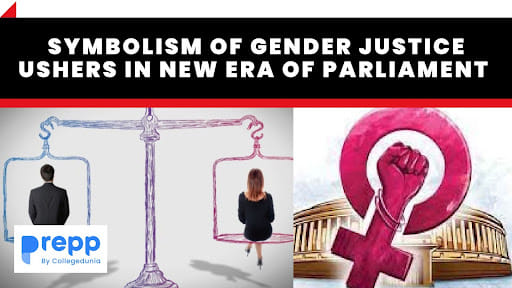
Symbolism Of Gender Justice Ushers In New Era Of Parliament
Relevance: GS1 - Role of women and women’s organization, Social empowerment; Population and Associated Issues; GS2 - Government policies and interventions for development in various sectors and issues arising out of their design and implementation; Indian Constitutional Amendments; Issues relating to development and management of Social Sector/Services
(Source: The Hindu, 09/20/2023)
Why in the news?
- Recently, the Union government introduced Women's Reservation Bill (128th amendment Bill), to provide one-third reservation to women in the Lok Sabha and State Assemblies as the historic first legislation in the new Parliament
- In addition to being the first Bill presented in the new building, it also proudly showcased art that commemorates the invaluable contributions of women at the grassroots level.
- The bill faces several challenges before becoming law. It requires broad political support and hinges on a census and delimitation process.
- The bill stipulates that women's reservation in legislative seats will only be implemented after the completion of constituency redrawing based on census data, following the bill's enactment.
Table of Contents
- What is Gender Justice?
- About Women’s Reservation Bill
- Status of India’s Gender Gap
- Empowering Women Artisans in the New Parliament
- A Unique Artistic Endeavor by Women Artisans
- Why is there a delay in decennial census exercise?
- How is the census conducted?
- Implications of Census Delay
- Some Women Empowerment Schemes in India
- FAQs
- MCQs
What is Gender Justice?
- Gender justice refers to the fair and equitable treatment of individuals of all genders, with a focus on addressing historical and systemic inequalities and discrimination that disproportionately affect women and marginalized gender identities.
- It often involves advocating for changes in laws and policies to ensure that they are gender-sensitive and promote equality, while also working to eliminate laws that perpetuate gender-based discrimination.
About Women’s Reservation Bill
- The bill seeks to reserve one-third (33%) of the total number of seats in state legislative Assemblies and Parliament for women.
- The bill has proposed that the reservation would continue for a period of 15 years and there will be a quota for SC/STs within the reserved seats for women.
- Reserved seats may be allotted by rotation to different constituencies in the state or union territory.
- Objective: It is a progressive step towards promoting and ensuring women's representation in politics. This proposed amendment is designed with the primary objective of enhancing women's participation in decision-making roles and offering them a more significant voice in the sphere of politics.
Status of India’s Gender Gap
- According to Government data, it states that women MPs account for nearly 15% of Lok Sabha strength while their representation is below 10% in many State Assemblies.
- In a research conducted by the Inter-Parliamentary Union, earlier this year, India was ranked 149th out of 193 nations in terms of the percentage of women who serve in the lower house of parliament.
- India ranks low in terms of women's political representation, standing at 143rd out of 187 countries.
- Gender Gap Report: India has ranked 127 out of 146 countries in terms of gender parity in the World Economic Forum's annual Gender Gap Report for 2023.
- On political empowerment, India has registered 25.3% parity, with women representing 15.1% of parliamentarians, which is the highest for the country since the inaugural report in 2006.
Empowering Women Artisans in the New Parliament
- Jan Janani Janmabhoomi wall: The Central Foyer of Parliament features a distinctive wall known as 'Jan Janani Janmabhoomi,' painstakingly crafted by a team of 75 skilled women artisans hailing from various regions of India.
- Shilpa Dirgha (Crafts Gallery): Similarly, the 'Shilpa Dirgha' within Parliament showcases themes that pay tribute to womanhood and their invaluable daily contributions to society.
- Madhubani's Artistic Legacy: Remarkably, the 'Jan Janani Janmabhoomi' wall was meticulously crafted during a dedicated workshop held at the 'Nari Shishu Kalyan Parishad' situated on Stadium Road in Madhubani, Bihar.
- The city of Madhubani, renowned for its art, hosted a remarkable gathering of 75 grassroots women artisans from across India.
A Unique Artistic Endeavor by Women Artisans
- Innovative Use of Banana Pulp: The project introduced the innovative use of banana pulp to create the papier-mache wall. Banana pulp's special adhesive quality played a crucial role in holding the artwork together.
- Natural Ingredients and Artistic Techniques: Various natural ingredients were employed in crafting the wall, including tamarind seed powder, Multani mitti, fenugreek seed powder, cow dung, acacia glue, and other natural gums.
- Artwork utilized natural colors prepared from materials like Red oxide (geru/lal mitti), Yellow ocher (pili mitti), Black soil (kaali mitti), White Clay (doodhi mitti), and different types of flowers and leaves.
Why is there a delay in decennial census exercise?
- The decennial census exercise that was to be conducted in 2021 was postponed indefinitely due to the Covid pandemic.
- Ideally, the delimitation process must be undertaken every 10 years, in line with the Census timeline.
How is the census conducted?
- A census is a comprehensive process aimed at gathering, organizing, analyzing, and disseminating vital demographic, economic, and social information pertaining to a specific population.
- It serves as a valuable tool for creating a detailed profile of the population, encompassing various aspects such as age, gender, educational attainment, employment status, income levels, housing conditions, and more.
- The responsibility for conducting the decennial census lies with the Office of the Registrar General and Census Commissioner, operating under the Ministry of Home Affairs and governed by the Census Act of 1948.
- The census procedure comprises two distinct phases:
- Housing Census: During this initial phase, data pertaining to housing conditions, household amenities, and the assets owned by households are systematically gathered and documented.
- Population Census: The second phase involves the collection of a wide range of data, including population statistics, educational attainment, religious affiliations, economic activities, information about Scheduled Castes and Tribes, language preferences, literacy rates, migration patterns, and fertility rates among others.
Implications of Census Delay
- Outdated Census information (available from the last Census in 2011) often becomes unreliable and affects those who do and do not receive the benefits of welfare schemes.
- For example, National Food Security Act, 2013 which provides subsidised foodgrains to poor & vulnerable uses the census data to identify the beneficiaries.
- Challenges for Research and Analysis: Researchers and policymakers often face issues with outdated or less accurate data sources when conducting studies due to the unavailability of current information.
- Impact on Sample Surveys: Census data serves as a crucial reference point for various sample surveys in the country.
- For example, the recent National Family Health Survey (NFHS-5) relied on 2011 census data, impacting the accuracy and relevance of the survey results.
- Impact on Political Representation: Census data is vital for constituency demarcation and seat allocation in Parliament and State Assemblies. The delay in conducting a new Census results in continued reliance on 2011 data, which doesn't capture recent population changes accurately.
- This can lead to either overrepresentation or underrepresentation of Scheduled Castes, Scheduled Tribes, and women in different regions when determining seat reservations.
- Impact on Migration Data: The Census data delay hampers the availability of current migration information, limiting its use in policy making and planning. This lack of data, as seen during the COVID-19 pandemic, can hinder the government's ability to effectively address issues related to stranded migrant laborers and their needs.
- Missed Opportunities and Delayed Decision-making: A delayed census hinders the ability to identify emerging trends, assess needs, and make timely targeted interventions, economic plans, and business decisions, leading to missed opportunities.
What is Delimitation?
|
Some Women Empowerment Schemes in India
- SWADHAR Greh
- Mahila Shakti Kendras (MSK)
- Nari Shakti Puraskar
- Mahila E-Haat
- Beti Bachao Beti Padhao Scheme
- One-Stop Centre Scheme
- Sukanya Samriddhi Yojna
- Skill Development Programmes
(*Click this link to read prelims specific weekly current affairs articles)
FAQs
Question: What is Gender Justice?
Answer:
Gender justice refers to the fair and equitable treatment of individuals of all genders, with a focus on addressing historical and systemic inequalities and discrimination that disproportionately affect women and marginalized gender identities.
Question: What is Madhubani art?
Answer:
Madhubani art (also Mithila art) is a style of painting practiced in the Mithila region of India and Nepal. It is named after the Madhubani district of Bihar, India, which is where it originated. The paint is created using natural dyes and pigments.
Question: What is Delimitation?
Answer:
Delimitation means the act or process of fixing limits or boundaries of territorial constituencies in a country or a province having a legislative body. It is done to reflect the demographic changes in a state, Union Territory or at the national-level.
UPSC Mains Practice Question:
|
MCQs
Question: With reference to the Delimitation Commission, consider the following statements: (UPSC 2012)
- The orders of the Delimitation Commission cannot be challenged in a Court of Law.
- When the orders of the Delimitation Commission are laid before the Lok Sabha or State Legislative Assembly, they cannot effect any modifications in the orders.
Which of the statements given above is/ are correct?
(a) 1 only
(b) 2 only
(c) Both 1 and 2
(d) Neither 1 nor 2
Answer: (c) See the Explanation
The Commission is a strong entity whose decisions are not subject to legal dispute. The orders are presented to the Lok Sabha as well as the state legislatures. Modifications, on the other hand, are not permitted. Hence both the statements are correct.
Therefore, option (c) is the correct answer.
Download the PREPP App and attempt FREE IAS Exam Mock Tests and get complete study material!

Full Test - 04: UPSC CSE Prelims CSAT (Paper-II)
Full Test - 03: UPSC CSE Prelims CSAT (Paper-II)
UPSC CSE Prelims 2026 GS Paper 1 Question Paper (24-May-2026)
UPSC CSE Prelims 2026 CSAT Paper 2 Question Paper (24-May-2026)

17 February 2025 | The Hindu Must Read Articles | Current Affairs

16 February 2026 | The Hindu Must Read Articles | Current Affairs

13 February 2026 | The Hindu Must Read Articles | Current Affairs









Comments