The Largest Climate Action Lawsuit Against 32 Countries
Relevance: GS3 - Environment; Climate Change
(Source: The Hindu, 10/03/2023)
Click here for Daily Current Affairs
Why in the news?
- Recently, six young climate activists from Portugal took 32 European governments (including the U.K., Russia and Turkey) to court over climate change.
- It was argued that governments across Europe aren’t doing enough to protect people from climate change at the European Court of Human Rights (ECHR) in France’s Strasbourg.
- According to the United Nations’s Global Climate Litigation Report, as of December 2022, 2,180 climate-related cases were filed in 65 countries across international and regional courts, tribunals and quasi-judicial bodies.
- Presently, the European Union is the sixth-largest emitter globally, with an average of 7.2 tons of CO2 per capita, while the world average stands at 6.3 tons per capita.
Table of Contents
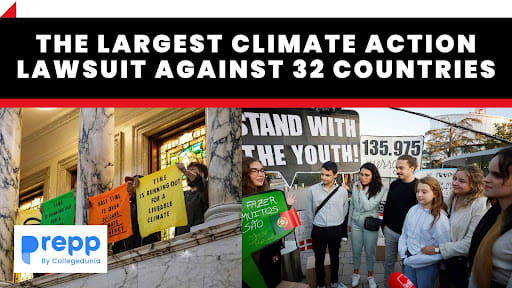
Lawsuit Against European Nations Over Climate Crisis
- In September 2020, a lawsuit titled "Duarte Agostinho and Others v. Portugal and Others" was filed by Portuguese youths in the aftermath of the devastating 2017 wildfires in Leiria, Portugal.
- The lawsuit alleges that European nations have failed to meet their climate emissions goals, exceeding global carbon budgets consistent with the Paris Agreement's target of limiting global warming to 1.5°C.
- It was stated that if current trends continue, global heating could reach 3°C within the lifetime of these young plaintiffs, violating their fundamental rights under the European Convention on Human Rights, including the right to life, freedom from inhuman treatment, privacy, family life, and freedom from discrimination.
Government Response to Climate Change and Human Health Concerns
- Denial of Relationship between Climate Change and Human Health: Greece has rejected any direct relationship between climate change and its impact on human health, despite experiencing devastating wildfires that affected both lives and livelihoods.
- Dismissal of Immediate Risk: Both Portugal and Ireland have dismissed concerns related to climate change's immediate threat to human lives, categorizing them as "future fears" based on insufficient evidence.
- Claims of Proactive Climate Action: The U.K. has asserted its commitment to addressing climate change, citing a 10-point plan and specific measures to achieve net-zero emissions by 2050. However, the recent scrapping of policies such as the 2030 ban on petrol and diesel car sales has raised concerns about the government's commitment to its climate goals.
About European Court of Human Rights (ECHR) and the Age of Climate Lawsuits
- The European Court of Human Rights (ECtHR) is a regional human rights judicial body based in Strasbourg, France, created under the auspices of the Council of Europe.
- The Court began operating in 1959 and has delivered more than 10,000 judgments regarding alleged violations of the European Convention on Human Rights.
- It has jurisdiction to decide complaints submitted by individuals and States concerning violations of the Convention for the Protection of Human Rights and Fundamental Freedoms (commonly referred to as the “European Convention on Human Rights“), which principally concerns civil and political rights.
- The European Convention on Human Rights, covering 47 member states, faces two pending climate-related cases:
- Verein Klimaseniorinnen Schweiz and Others v. Switzerland: Over 2,000 Swiss women claimed their lives and health were threatened by climate change and that the state must protect their human rights. The case recognizes the urgency of assessing if states violate elderly women's human rights by not taking climate protection measures.
- Carême v. France: The former mayor of Grande-Synthe, France, alleges that France's inadequate response to climate change violates the right to life (Article 2 of the Convention) and respect for private and family life (Article 8 of the Convention).
Other Youth-Led Climate Trials
- In Montana, a court ruled that the state's use of fossil fuels violates people's constitutional rights and in Austria, 12 children argued for stricter government climate goals.
- Students from Vanuatu are pursuing a legal case at an international court to codify countries' obligations regarding climate change and environmental protection for present and future generations.
- Nathan Baring, a 23-year-old plaintiff who participated in a U.S. federal lawsuit in 2015, emphasized the importance of trials in establishing factual records and exposing government falsehoods, stating that they are necessary for achieving justice.
Challenges
- While the legal validity of these trials remains unclear, experts recognize their transformative impact. Such lawsuits highlight that unchecked carbon emissions infringe upon fundamental rights, threaten young people's prospects for a healthy future, and emphasize the role of climate science in countering misinformation and denialism.
UN recognition
- The United Nations has noted that the increasing climate litigation underscores the strong link between human rights and climate change, potentially leading to greater accountability, transparency, and justice.
- This, in turn, can push governments and corporations to adopt more ambitious climate change mitigation and adaptation goals.
International Agreements Regarding Climate ChangeUNFCCC
Kyoto Protocol
Paris Agreement
|
What are the concerns?
- The lawsuit stated that the mental and physical health of young people worldwide is being adversely affected by the climate crisis, making this legal action a call for action to protect their future.
- UNICEF has declared the climate crisis a "child rights crisis" as uncontrolled carbon emissions and extreme weather events threaten children's access to education, health, nutrition, and their future.
- Research indicates that air pollution is linked to adverse birth outcomes and increased risks of cardiovascular and respiratory diseases, while heatwaves are causing mental health issues and disrupting academic performance due to missed school days.
- The United Nations Committee on the Rights of the Child highlights that water scarcity, food insecurity, physical trauma from climate change-related events, and diseases like vector-borne and water-borne illnesses disproportionately affect children. This underscores the urgent need to prioritize child rights and well-being in climate action.
Recommendations
- The current portugal lawsuit calls on the 32 implicated countries to urgently increase emissions reductions efforts and align with scientific evidence.
- It also suggests measures such as reducing fossil fuel production and addressing global supply chain emissions.
- The European Scientific Advisory Board on Climate Change (ESABCC) recommends that countries target a 75% reduction in emissions below 1990 levels, surpassing the EU's current goal of 55%.
- This suggests that the EU has already exceeded its fair share of the global emissions budget, aligning with claims made by the youth plaintiffs in their lawsuit.
(*Click this link to read prelims specific weekly current affairs articles)
FAQs
Question: What is Climate Change?
Answer:
Climate change refers to long-term changes in temperature and weather patterns. These shifts could be natural, such as variations in the solar cycle. However, human activities have been the primary cause of climate change since the 1800s, owing primarily to the use of fossil fuels such as coal, oil, and gas.
Question: What is the Paris Agreement?
Answer:
It is a multilateral agreement signed under the United Nations Framework Convention on Climate Change (UNFCCC) that 196 nations adopted in December 2015 at the Conference of the Parties (COP 21) in Paris to reduce and mitigate greenhouse gas emissions.
MCQ
Question: With reference to ‘Global Climate Change Alliance’, which of the following statements is/are correct? (UPSC 2017)
- It is an initiative of the European Union.
- It provides technical and financial support to targeted developing countries to integrate climate change into their development policies and budgets.
- It is coordinated by World Resources Institute (WRI) and World Business Council for Sustainable Development (WBCSD).
Select the correct answer using the code given below:
(a) 1 and 2 only
(b) 3 only
(c) 2 and 3 only
(d) 1, 2 and 3
Answer: (a) See the Explanation
- The European Union (EU) established the Global Climate Change Alliance (GCCA) in 2007 to strengthen dialogue and cooperation with developing countries, particularly least developed countries (LDCs) and small island developing states (SIDS). Hence, statement 1 is correct.
- The GCCA also provides partner countries with technical and financial assistance in integrating climate change into their development policies and budgets, as well as in implementing projects that address climate change on the ground, promoting climate resilient, low-emission development. Hence, statement 2 is correct.
- By fostering effective climate change dialogue and cooperation, the Alliance contributes to ensuring that poor developing countries most vulnerable to climate change increase their capacity to adapt to the effects of climate change, thereby supporting the achievement of the Millennium Development Goals (MDGs).
- There is no mention of WRI or WBCSD on the GCCA's official partner's page, despite the fact that many other institutions, such as FAO and UNDP, are mentioned. Hence, statement 3 is incorrect.
Therefore, option (a) is the correct answer.
Download the PREPP App and attempt FREE IAS Exam Mock Tests and get complete study material!

Full Test - 04: UPSC CSE Prelims CSAT (Paper-II)
Full Test - 03: UPSC CSE Prelims CSAT (Paper-II)
UPSC CSE Prelims 2026 GS Paper 1 Question Paper (24-May-2026)
UPSC CSE Prelims 2026 CSAT Paper 2 Question Paper (24-May-2026)

17 February 2025 | The Hindu Must Read Articles | Current Affairs

16 February 2026 | The Hindu Must Read Articles | Current Affairs

13 February 2026 | The Hindu Must Read Articles | Current Affairs









Comments