Bihar Caste Survey Data Released
(Source: The Hindu, 10/01/2023)
Click here for Daily Current Affairs
Why in the news?
- Recently, The Bihar government has published the data of caste based survey conducted in the state.
- According to data released by the Development Commissioner, Bihar’s total population is little over 13.07 crore. The EBCs make up 36.01% of this, and OBCs an additional 27.13%.
Table of Contents

Key finding of the Survey
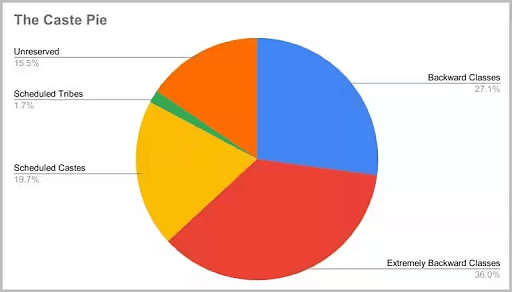
- According to the data EBCs are 4,70,80,514 (36%). There are about 20% (2.6 crore) Scheduled Castes (SCs), and just 1.6% (22 lakh) Scheduled Tribes (STs).
- The survey also found that Yadavs are the largest group, accounting for 14.27% of the total population.
- The table below(before FAQs) shows the percentage-wise breakup of some prominent sub-castes as per Bihar government’s data.
Issues around the survey conducted
- Litigation on the basis of state’s authority:
- Five PILs were filed challenging the survey, as a violation of privacy and on the argument that only the Centre had the authority to conduct a “census”.
- The matter went to the Supreme Court, which asked the Patna High Court to look into the matter in July.
- Judgement of High court:
- The High Court finally upheld the survey in August, finding the “action of the state to be perfectly valid, initiated with due competence, with the legitimate aim of providing development with justice”.
- Term ‘Census’ vs ‘Survey’
- The state government, which argued that it was conducting a “survey” and not a “census”, completed the exercise by mid-September.
- Procedural query:
- Apart from this, there are many questions raised on the procedure followed to collect data.
- Exclusion:
- Many people are still to be encountered because of the lack of the availability of documents.
About Census
|
The Socio Economic Caste Census (SECC) in India
- It is a study of socio economic status of rural and urban households and allows ranking of households based on predefined parameters.
- It is also expected to generate information on a large number of social and economic indicators relating to households across the country.
- Caste Census is under the administrative control of the Ministry of Home Affairs: Registrar General of India (RGI) and Census Commissioner of India.
- It was conducted in 2011 in rural india.
Criteria used in SECC 2011
- SECC follows the rules established by the S R Hashim committee, which was constituted by the erstwhile Planning Commission of India. Specifically, automated exclusion based on 14 parameters, automatic inclusion based on 5 parameters, and deprivation grading based on 7 criteria.
14 parameters of Automatic Exclusion
- motorised 2/3/4 wheeler/fishing boat.
- Mechanised 3-4 wheeler agricultural equipment.
- Kisan credit card with a credit limit of over Rs. 50,000/-.
- Household member government employee.
- Households with non-agricultural enterprises are registered with the government.
- Any member of the household earning more than Rs. 10,000 per month.
- Paying income tax.
- Paying professional tax.
- 3 or more rooms with pucca walls and roof.
- owns a refrigerator.
- Owns landline phone.
- Owns more than 2.5 acres of irrigated land with 1 irrigation equipment.
- 5 acres or more of irrigated land for two or more crop seasons.
- Owning at least 7.5 acres of land or more with at least one irrigation equipment.
5 parameters of Automatic inclusion:
- Households without shelter.
- Destitute, living on alms.
- Manual scavenger families.
- Primitive tribal groups.
- Legally released bonded labour.
Households based on 7 markers of deprivation:
- Households with Kutcha house
- No adult member in working age
- A household headed by female and no working age male member
- Households with handicapped members and no able bodied adult
- Household with no literate over 25 years
- Landless households engaged in manual labour
- SC/ST households.
Benefits of doing Caste Census
- In accordance with the constitution: Our Constitution too favours conducting a caste census. Article 340 mandates the appointment of a commission to investigate the conditions of socially and educationally backward classes and make recommendations as to the steps that should be taken by governments.
- Helps in Policy Making: A caste census, which will generate exhaustive data will allow policymakers to develop better policies, implementation strategies, and will also enable a more rational debate on sensitive issues.
- Transparency in data: It will reveal true data of economic status of a family so that governance and implementation of beneficiaries based schemes can be smoothen.
- Help in addressing inequalities: Unequal distribution of wealth, resources and education has meant an acute shortage of purchasing power among the majority of Indians. Hence, the caste census helps to address these issues in a democratic, scientific and objective manner.
- Reduce exclusion: Some have benefited so much across the years, while there are people in this country who have not benefited at all. To solve this problem, the SECC will be very much helpful.
What is the difference between Census and SECC?
- The Census gives a picture of the Indian people, whereas the SECC is used to identify recipients of state assistance.
- Due to the fact that the Census is governed by the Census Act,1948, all data is considered confidential, however, the SECC website states that “all personal information provided in the SECC is available for use by Government agencies to grant and/or restrict benefits to households.”
Key highlights of data from recent caste survey of Bihar
| Backward Classes | |
|---|---|
| Yadav | 14.26% |
| Khushwaha | 4.21% |
| Kurmi | 2.87% |
| Bania | 2.31% |
| Extremely Backward Classes | |
| Kevart | 0.2% |
| Kevat | 0.71% |
| Mallah | 2.6% |
| Teli | 2.81% |
| Nai | 1.59% |
| Dhanuk | 2.13% |
| Gangota | 0.4% |
| Chandravanshi (Kahar) | 1.64% |
| Nonia | 1.91% |
| Prajapati (Kumhar) | 1.40% |
| Badhai | 1.45% |
| Bind | 0.98% |
| Scheduled Castes | |
| Chamar/ Mochi/ Ravidas/ Charmkar | 5.25% |
| Dusadh/ Dhari/ Darahi | 5.31% |
| Mushahar | 3.08% |
| Pasi | 0.98% |
| Mehtar | 0.19% |
| Unreserved | |
| Brahmin | 3.65% |
| Rajput | 3.45% |
| Bhumihar | 2.87% |
| Kayastha | 0.60% |
(*Click this link to read prelims specific weekly current affairs articles)
FAQs
Question: What is SECC?
Answer:
It is a study of socio economic status of rural and urban households and allows ranking of households based on predefined parameters. It is also expected to generate information on a large number of social and economic indicators relating to households across the country.
MCQs
Question: Consider the following statements.
- Census has been conducted 6 times in India science independence.
- Caste Census has been conducted 2 times in India since independence.
Which of the above statements is/are correct?
(a) Only 1
(b) Only 2
(c) Both
(d) None
Answer: (d) See the Explanation
- Census has been conducted 5 times and the caste census has been conducted once since independence.
- Refer the table given below.

- So both the statements are incorrect.
- Therefore the correct answer is Option d.
Download the PREPP App and attempt FREE IAS Exam Mock Tests and get complete study material!
*The article might have information for the previous academic years, please refer the official website of the exam.
How likely are you to recommend Prepp.in to a friend or a colleague?
Not so likely
Highly likely
UPSC CSE (IAS) 2027 Prelims Mock Test Series
Live Quizzes
Quizzes
Live Tests
Full Tests

Full Test - 04: UPSC CSE Prelims CSAT (Paper-II)
120 Minutes
80 Questions
200 Marks
English, Hindi
MEDIUM
Attempted by 18 aspirants in 12 hours
Full Test - 03: UPSC CSE Prelims CSAT (Paper-II)
120 Minutes
80 Questions
200 Marks
English, Hindi
MEDIUM
Attempted by 20 aspirants in 12 hours
Previous Year Papers
UPSC CSE Prelims 2026 GS Paper 1 Question Paper (24-May-2026)
120 Minutes
100 Questions
200 Marks
3,048 Attempted
English, Hindi
MEDIUM
Attempted by 12 aspirants in 12 hours
UPSC CSE Prelims 2026 CSAT Paper 2 Question Paper (24-May-2026)
120 Minutes
80 Questions
200 Marks
3,234 Attempted
English, Hindi
MEDIUM
Attempted by 13 aspirants in 12 hours
Videos

17 February 2025 | The Hindu Must Read Articles | Current Affairs
7,206 Views
•4
•7 months ago

16 February 2026 | The Hindu Must Read Articles | Current Affairs
6,963 Views
•4
•7 months ago

13 February 2026 | The Hindu Must Read Articles | Current Affairs
8,765 Views
•5
•7 months ago

12 February 2026 | The Hindu Must Read Articles | Current Affairs
5,789 Views
•4
•7 months ago






Also Check
IAS Exam Overview
IAS Exam Admit Card
IAS Exam Question Paper 2026
IAS Exam Mains Syllabus
IAS Exam Application Process
IAS Exam Eligibility
IAS Exam Result
IAS Exam Exam Pattern
IAS Exam CSAT Syllabus
IAS Exam Answer Key
IAS Exam Previous Year Paper
IAS Exam Current Affairs
IAS Exam Mains Question Paper
IAS Exam IAS Courses
IAS Exam UPSC Study Notes
IAS Exam Foundation Course 2024
IAS Exam Prelims Question Paper
IAS Exam Exam Center
IAS Exam Foundation Course 2025
IAS Exam Notification 2026
IAS Exam IAS Success Stories
IAS Exam Salary
IAS Exam Cutoff
IAS Exam Mock Tests
IAS Exam News


Comments