GHG Emission Through Maritime Transport
Relevance: GS3- GS3- environmental pollution and degradation, environmental impact assessment
(Source: DTE, 09/28/2023)
Click here for Daily Current Affairs
Why in the news?
- According to the recently published ‘Review of Maritime Transport 2023’ by the United Nations Conference on Trade and Development (UNCTAD), greenhouse gas (GHG) emissions from international shipping were 20 per cent higher than 10 years earlier.
- In this article we will take a look at - Findings of this report; to know about UCTAD and IMO; how marine transport is emitting GHG; what are the solutions to reduce GHG from shipping; what are the challenges in this etc.
Table of Contents
Key findings of the report
- Shipping industry contributes to nearly 3 percent of global greenhouse gas emissions.
- The GHG emission from marine transport has increased by 20 percent compared to last decade.
- Global maritime shipping volumes are projected to grow by 2.4 per cent in 2023, which can further boost the GHG emission.
- More than half of the world’s ships are over 15 years old which resulted in more emissions due to older and poor performing engines.
What is UNCTAD?
|
How is marine transport responsible for GHG Emission?
- Along with CO2, ships emit various global warming pollutants, including black carbon (BC), nitrogen oxides (NOx) and nitrous oxide (N2O) produced by combustion of marine fuel.
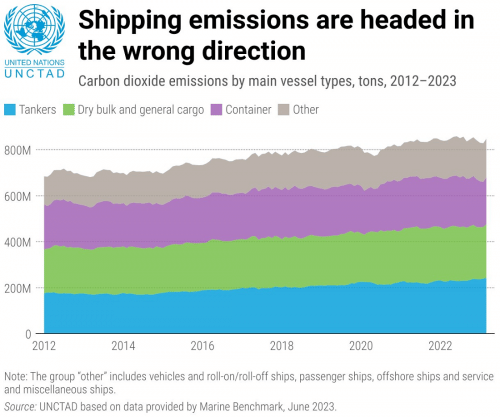
- Vessels released more than 1.12 billion metric tons of carbon dioxide in a year.
- The highest amounts of black carbon particles are produced by ships burning heavy fuel oil.
- Black carbon accounts for 21% of CO2-equivalent emissions from ships, making it the second most important driver of shipping’s climate impacts after carbon dioxide.
- A Graph on various aspects of Shipping emission can be seen below.
What are the solutions to reduce GHG Emission from Marine Transport?
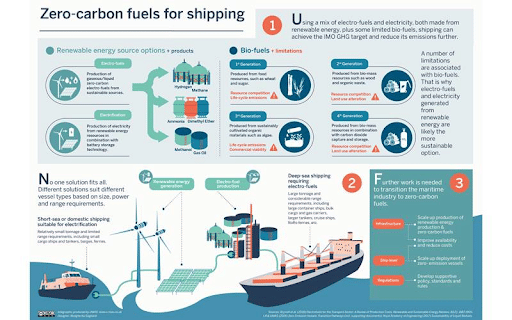
- Alternative fuels, mainly liquified natural gas (LNG), and to a lesser extent, battery/hybrid, liquified petroleum gas (LPG), Biofuels and methanol.
- 21 percent of vessels currently on order are designed to run on alternative fuels according to the report.
- Renewable ammonia is more suitable for the newer ships that have dual-fuel engines.
- Other fuel based solutions can be found in the below image.
![global maritime technology network (GMN) project]()
- The global maritime technology network (GMN) project, funded by the European Union, has established a network of five Maritime Technology Cooperation Centres (MTCCs) in Africa, Asia, the Caribbean, Latin America and the Pacific. To help countries develop national maritime energy-efficiency policies and measures.
- GreenVoyage-2050 project, a collaboration between IMO and the Government of Norway. The project, launched in 2019, will initiate and promote global efforts to demonstrate and test technical solutions for reducing shipping emissions.
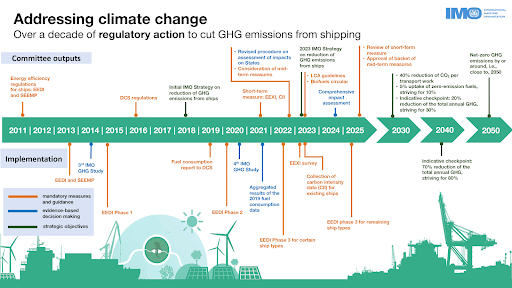
- The International Maritime Organization(IMO) set a target to achieve near net-zero GHG emissions(70% reduction) by around 2050.
- IMO is revising its existing carbon intensity regulations
- Energy Efficiency Existing Ship Index (EEXI): It limits the technical carbon intensity of the ship by limiting how much carbon dioxide the ship is designed to emit based on its size and ship type.
- Carbon Intensity Indicator (CII): It grades ships from A-E based on their operational carbon intensity, based on how much fuel the ships use each year.
- IMO is developing new regulations that the organisation is calling “mid-term measures.”
- These measures will include a technical element, most likely a Greenhouse Gas Fuel Standard (GFS), as well as an economic element, such as a carbon levy, a feebate system, or cap-and-trade etc.
- IMO GHG strategy can be seen in the below image.
What is IMO?
|
What are the issues in switching to Green Fuel?
- Only 1.2 per cent are using alternative fuels because of lack of availability and very high cost.
- Ship owners face the conundrum of renewing their fleet without clarity on technology and regulatory regimes.
- Port terminals also face similar challenges regarding technological upgradation and investment requirements.
- Decarbonising the world’s fleet by 2050 could require $8 billion to $28 billion annually, so to collect such a huge fund is the major concern.
(*Click this link to read prelims specific weekly current affairs articles)
FAQs
Question: What are GHGs emitted in Marine transportation?
Answer:
Along with CO2, ships emit various global warming pollutants, including black carbon (BC), nitrogen oxides (NOx) and nitrous oxide (N2O) produced by combustion of marine fuel. According to a recent report by UNCTAD this emission has increased by 20 percent compared to last decade.
Question: Which are the reports published by UNCTAD?
Answer:
Following are the major reports published by the UNCTAD.
- Trade and Development Report
- World Investment Report
- The Least Developed Countries Report
- Information and Economy Report
- Technology and Innovation Report
- Commodities and Development Report
MCQs
Question: Consider the following statements with respect to IMO GHG strategy.
- It aims to achieve net zero emission from shipping by 2070.
- It is in accordance with the Paris Agreement of the UNFCCC.
(a) Only 1
(b) Only 2
(c) Both
(d) None
Answer: (b) See the Explanation
- IMO GHG Strategy has 3 major goals
- carbon intensity of the ship to decline through implementation of further phases of the energy efficiency design index (EEDI) for new ships
- carbon intensity of international shipping to decline
- .GHG emissions from international shipping to peak and decline
- The initial GHG strategy envisages, in particular, a reduction in carbon intensity of international shipping to reduce CO2 emissions per transport work, as an average across international shipping, by at least 40% by 2030, pursuing efforts towards 70% by 2050, compared to 2008.
- So statement 1 is incorrect.
- The strategy includes a specific reference to “a pathway of CO2 emissions reduction consistent with the Paris Agreement temperature goals”.
- So statement 2 is correct.
- Therefore the correct answer is option (b).
Download the PREPP App and attempt FREE IAS Exam Mock Tests and get complete study material!

Full Test - 04: UPSC CSE Prelims CSAT (Paper-II)
Full Test - 03: UPSC CSE Prelims CSAT (Paper-II)
UPSC CSE Prelims 2026 GS Paper 1 Question Paper (24-May-2026)
UPSC CSE Prelims 2026 CSAT Paper 2 Question Paper (24-May-2026)

17 February 2025 | The Hindu Must Read Articles | Current Affairs

16 February 2026 | The Hindu Must Read Articles | Current Affairs

13 February 2026 | The Hindu Must Read Articles | Current Affairs









Comments