In SC Case On Agama, The Contested History Of Temple Priesthood
Relevance: GS2 - Government policies and interventions for development in various sectors and issues arising out of their design and implementation GS1 - Salient features of Indian Society, Diversity of India, Social empowerment.
(Source: Indian Express, 09/30/2023)
Click here for Daily Current Affairs
Why in the news?
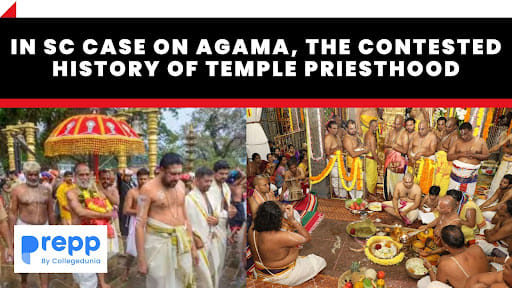
- Recently, the Supreme Court ordered a status quo on the appointment of archakas i.e. priests in Agamic temples in Tamil Nadu.
- The Tamil Nadu government had introduced reforms that allowed individuals trained in Agama Sastra to become priests irrespective of caste and gender.
Table of Contents
What is the case before the Supreme Court?
Petitioners
- The Srirangam Koil Miras Kainkaryaparagal Matrum Athanai Sarntha Koilgalin Miraskain-karyaparargalin Nalasangam, an association of archakas, has challenged the reforms introduced by the DMK government to change the hereditary system of appointing archakas in Agama temples.
- The petitioners claimed that the state had illegally infringed on the Constitutionally-protected rights of religious freedom by enabling the appointment of unbelievers as priests.
- It also claimed that the secular state interfered with essential religious practices.
- According to them, it was not possible to attain the necessary knowledge about the Agamas through the government-run course certificate course.
State government
- In 1971, the state government of Tamil Nadu amended the Tamil Nadu Hindu Religious & Charitable Endowment (HR & CE) Act to abolish the hereditary appointment of priests, and to allow individuals from all castes to be priests.
- The HR & CE Act of 1951 restricted the government's role to just administration and finance.
- In 2006, the government declared all qualified persons eligible to be priests.
- In 2023, the state issued orders enabling individuals trained in Agama Sastra to become priests irrespective of caste and gender.
Archakas
|
Previous Court rulings
- Seshammal & others vs. State of Tamil Nadu (1972): The SC held that the appointment of an Archaka (temple priest) is a secular function, and the performance of religious service by the priests is an integral part of the religion.
- It differentiated between the secular and religious aspects and stated that the prescription provided by the Agamas (scriptures) is significant only for the performance of the religious service.
- Therefore, any individual, regardless of caste or creed, can be appointed as an Archaka if they are well-versed and qualified in the Agamas and the rituals required for temple worship.
- N. Adithayan vs. Travancore Devaswom Board (2002): The SC rejected the customary claim that only Brahmins can perform rituals in temples.
- No custom prior to the Constitution could exclude non-Brahmins from performing puja in temples provided they were trained and qualified.
- Guruvayoor Devaswom case (2004): The SC upheld the appointment of non-believers to the temple trust board.
- In 2015, the Supreme Court struck the 2006 order of the state government and underlined the adherence to Agama Sastras, while ensuring that constitutional rights were not violated.
- In 2009, the Madras High Court ruled in favor of a woman priest from Usilampatti who was facing opposition from male priests regarding her inherited right to conduct puja at the Arulmigu Durgai Amman temple.
- The court highlighted the irony of objecting to puja by a woman in a temple with a female deity and the historical precedents of women conducting rituals and rejected the unwarranted application of Agama Sastras and norms of the Manusmriti in this context.
- Gender bias has to be eliminated from temples to realize the constitutional vision of Articles 15 and 51A(e).
Divine contradictions
- The Agama tradition still influences temple administration in Tamil Nadu despite Constitutional provisions and the removal of hereditary priest appointments.
- Control over temples:
- During British colonial rule, concerns were raised over British oversight of Hindu rituals at temples, which led to the transfer of temple control to local communities.
- Similar concerns have been raised about the state control of temples in Tamil Nadu and Kerala.
- Tradition vs. modernity:
- There has been a difference in opinion between traditional and modern influences as evidenced by the row over hereditary priest rights and the Sabarimala temple entry case.
- Priesthood is not a job: Critics of the Tamil Nadu government decision have claimed that priesthood must not be viewed merely as employment but a spiritual exercise as well.
- Diverse traditions: There is great diversity among different Hindu temples on various issues,
- Consider two temples in Kerala such as Sabarimala where there is considered to be a ban on women's entry, and temples like Kondungallur which celebrate menstrual days monthly with special rituals.
Agama
|
(*Click this link to read prelims specific weekly current affairs articles)
FAQs
Question: What are the Agama shastras?
Answer:
The Agama Shastra is a manual for worship, rituals, and construction of temples in Hinduism. It was written in Tamil and Sanskrit and is considered authoritative. It describes topics such as cosmology, epistemology, philosophical doctrines, meditation, yoga, mantras, temple construction, the appointment of priests, and deity worship.
Question: What is the doctrine of essential religious practices?
Answer:
The essential religious practice test is a contentious doctrine evolved by the Supreme Court in the Shirur Mutt case, in 1954. It was developed to ensure the protection of only such religious practices that were essential and integral to the religion.
UPSC Mains Practice Question:
|
MCQs
Question: Consider the following statements:
- Article 15 of the Constitution prohibits discrimination on the grounds of religion, race, caste, sex, or place of birth.
- Article 51A (e) renounces practices derogatory to the dignity of women.
Which of the above statements is/are correct?
(a) 1 only
(b) 2 only
(c) Both 1 and 2
(d) None of the above
Answer: (c) See the Explanation
- According to Article 15 of the Indian constitution, discrimination on the grounds of religion, race, caste, sex, or place of birth is prohibited in India.
- It also states that the State shall not discriminate against any citizen in matters of employment or access to public places on these grounds. Hence statement 1 is correct.
- Article 51A (e) states that it is the fundamental duty of each citizen to promote harmony and the spirit of common brotherhood amongst all the people of India transcending religious, linguistic, and regional or sectional diversities, and to renounce practices derogatory to the dignity of women. Hence statement 2 is correct.
Therefore, option (c) is the correct answer.
Download the PREPP App and attempt FREE IAS Exam Mock Tests and get complete study material!

Full Test - 04: UPSC CSE Prelims CSAT (Paper-II)
Full Test - 03: UPSC CSE Prelims CSAT (Paper-II)
UPSC CSE Prelims 2026 GS Paper 1 Question Paper (24-May-2026)
UPSC CSE Prelims 2026 CSAT Paper 2 Question Paper (24-May-2026)

17 February 2025 | The Hindu Must Read Articles | Current Affairs

16 February 2026 | The Hindu Must Read Articles | Current Affairs

13 February 2026 | The Hindu Must Read Articles | Current Affairs









Comments