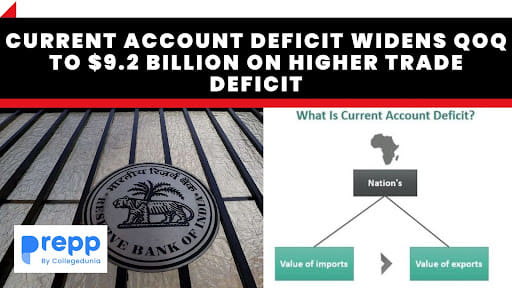
Current Account Deficit Widens QoQ To $9.2 Billion On Higher Trade Deficit
Relevance: GS3 - Indian Economy and issues relating to planning, mobilization of resources; Growth and Development
(Source: The Hindu, 09/29/2023)
Click here for Daily Current Affairs
Why in the news?
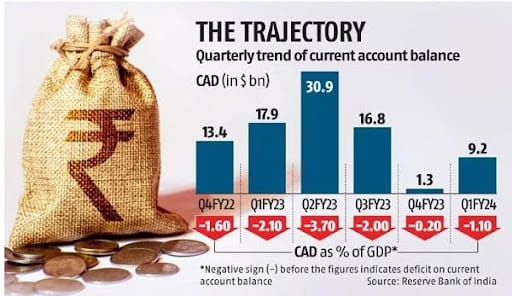
- Recently, the data released by the Reserve Bank of India (RBI) revealed that India’s Current Account Deficit (CAD) expanded significantly to $9.2 billion, equivalent to 1.1% of GDP, during the April-June quarter.
- The CAD was $17.9 billion (2.1% of GDP) in the year-earlier quarter of fiscal 2022-23.
- Current Account Deficit (CAD) is a key indicator of the balance of payment of a country.
Table of Contents
Key Highlights of RBI’s Data
- The widening of CAD on a quarter-on-quarter basis was primarily on account of a higher trade deficit coupled with a lower surplus in net services and decline in private transfer receipts.
- Trade deficit increased sequentially to $56.6 billion in Q1FY24, up from $52.6 billion in Q4FY23.
- Net services receipts decreased sequentially, primarily due to a decline in exports of computer, travel and business services, though remained higher on a year-on-year (y-o-y) basis.
- Private transfer receipts, mainly representing remittances by Indians employed overseas, moderated to US$ 27.1 billion in Q1(2023-24) from US$ 28.6 billion in Q4 (2022-23) but witnessed an increase on a y-o-y basis.
- Net outgo on the income account, primarily reflecting payments of investment income, declined to $10.6 billion in Q1FY24 from $12.6 billion in Q4FY23.
- Net foreign direct investment: In the financial account, net foreign direct investment decreased to $5.1 billion from $13.4 billion a year ago.
- Net foreign portfolio investment recorded inflows of $15.7 billion, compared with net outflows of $14.6 billion in the year-earlier quarter.
- Net external commercial borrowings to India recorded an inflow of $5.6 billion in Q1FY24 as against an outflow of $2.9 billion a year ago.
- Non-resident deposits recorded net inflows of $2.2 billion as compared with $0.3 billion in Q1FY23.
- Foreign exchange reserves on a Balance of Payments basis increased by $24.4 billion in the first quarter of the current fiscal year, up from $4.6 billion in the previous year.
What is the Current Account Deficit (CAD)?
- The current account tracks the inflows and outflows of goods, services, and investments into and out of a country. It keeps track of the country's transactions with other countries.
- If the value of goods and services imported exceeds the value of those exported, the country runs a deficit.
- When an economy runs a current account deficit, it consumes more than it produces (consumption = domestic consumption + investment + government spending).
- This can only happen if other economies lend their savings to it (via debt or direct/portfolio investment in the economy) or if the economy is depleting its foreign assets, such as its official foreign currency reserve.
- A rising CAD indicates that a country has become uncompetitive, and investors may be unwilling to invest there.
- A current account deficit isn't always a bad thing. A current account deficit is irrelevant if it is driven by the private sector because it is caused by private sector agents engaging in mutually beneficial trade.
- Current Account = Trade gap + Net current transfers + Net income abroad (Trade gap = Exports – Imports)
Components of CAD
- Trade Deficit: It is a situation in which a nation's imports of goods and services exceed its exports, indicating an imbalance in trade. This results in the country spending more on foreign goods and services than it earns from selling its own, leading to an outflow of domestic currency to foreign markets.
- Net Income: It is derived from the income earned by multinational corporations (MNCs) from their investments within India. When the income from foreign investments exceeds the savings of a country’s residents, a net income deficit occurs. This measure includes payments to foreign entities in the form of dividends from domestic stocks, interest payments on bonds, and wages disbursed to foreign individuals employed within the country.
- Net Transfers: It involves financial flows between countries, including money sent by foreign residents to their home nations (remittances), government grants to foreigners, and various cross-border financial inflows like gifts and donations.
Impact of Rising Oil Prices on India's Current Account Deficit (CAD)
- Increased Import Costs: India is a major importer of oil and petroleum products. Rising global oil prices increase India's import costs for oil, worsening the trade deficit and contributing to a larger current account deficit (CAD).
- Inflationary Pressure: Rising oil prices can trigger inflation by increasing transportation costs, leading to higher prices for goods and services, affecting India's purchasing power and potentially impacting the trade balance and current account deficit (CAD).
- Exchange Rate Effects: Rising oil prices can strain the Indian rupee's exchange rate. Increased oil import costs force India to sell more rupees for foreign currency, leading to rupee depreciation, pricier imports, and trade balance effects. A weaker rupee can attract foreign investment, impacting the current account deficit, positively or negatively depending on the circumstances.
Measures to moderate Current Account Deficit
- Encourage Exports: The government should focus on promoting and supporting export-oriented industries. This can be done by providing financial incentives, simplifying export procedures and regulations, and negotiating favorable trade agreements with other countries.
- Promote Import Substitution: Encouraging domestic production of goods that are currently being imported can help reduce the trade deficit. The government can provide incentives to domestic manufacturers, implement policies that support domestic production, and impose tariffs or import duties on certain goods to make them less attractive compared to domestically produced alternatives.
- Improve Productivity and Competitiveness: Enhancing the productivity and competitiveness of the domestic economy is crucial for increasing exports and reducing the trade deficit. Investments in infrastructure, technology, and education can help upgrade industries and improve overall productivity.
- Attract Foreign Direct Investment (FDI): Attracting FDI can help bridge the current account deficit by bringing in capital and technology. The government should create a conducive environment for foreign investors by simplifying regulations, improving infrastructure, ensuring policy stability, and offering incentives for priority sectors.
(*Click this link to read prelims specific weekly current affairs articles)
FAQs
Question: What is the Current Account Deficit (CAD)?
Answer:
The current account tracks the inflows and outflows of goods, services, and investments into and out of a country. If the value of goods and services imported exceeds the value of those exported, the country runs a deficit.
Question: What are the components of India’s Current Account Deficit (CAD)?
Answer:
The components of India’s CAD include the Trade Deficit, which is the difference between exports and imports; Net Income, which covers earnings from investments and payments to foreign entities; and Net Transfers, that include remittances, gifts, and government grants across borders.
Question: What is Trade Deficit?
Answer:
A Trade deficit occurs when the cost of a country's imports exceeds the cost of its exports. It's also known as a negative balance of trade, and it's one way of measuring international commerce. A trade deficit is calculated by subtracting the total value of a country's exports from its total value of imports.
MCQ
Question: Consider the following actions which the Government can take: (UPSC 2011)
- Devaluing the domestic currency.
- Reduction in the export subsidy.
- Adopting suitable policies which attract greater FDI and more funds from FIIs.
Which of the above action/actions can help in reducing the current account deficit?
(a) 1 and 2
(b) 2 and 3
(c) 3 only
(d) 1 and 3
Answer: (d) See the Explanation
The current account is a key component of a country's balance of payments, along with the capital account. It consists of the balance of trade (exports minus imports of goods and services), net factor income (such as interest and dividends), and net transfer payments (such as foreign aid). A current account surplus increases a country's net foreign assets, while a deficit reduces them. The balance of trade specifically refers to the difference between a nation's exports and imports of goods and services, excluding other financial transactions. A trade deficit occurs when imports exceed exports.
Therefore, option (d) is the correct answer.
Download the PREPP App and attempt FREE IAS Exam Mock Tests and get complete study material!

Full Test - 04: UPSC CSE Prelims CSAT (Paper-II)
Full Test - 03: UPSC CSE Prelims CSAT (Paper-II)
UPSC CSE Prelims 2026 GS Paper 1 Question Paper (24-May-2026)
UPSC CSE Prelims 2026 CSAT Paper 2 Question Paper (24-May-2026)

17 February 2025 | The Hindu Must Read Articles | Current Affairs

16 February 2026 | The Hindu Must Read Articles | Current Affairs

13 February 2026 | The Hindu Must Read Articles | Current Affairs









Comments