Cauvery Turmoil: Bengaluru City, Old Mysuru Region Hold Total Bandh; Little Or No Effect Elsewhere In Karnataka
Relevance: GS1 - Distribution of key natural resources; GS2 - Dispute redressal mechanisms and institutions, Functions and responsibilities of the Union and the States
(Source: Down to Earth; 09/30/2023)
Click here for Daily Current Affairs
Why in the news?
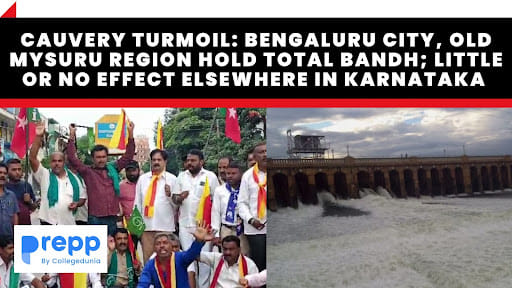
- Recently, Karnataka's regional organizations had called for a statewide shutdown on September 29, 2023, over Cauvery water issue.
- It was stated that ten thousand people will go to Delhi on October 5 to drive home a point with the President of India on Karnataka’s claim over Cauvery water.
Table of Contents
What is the issue?
- Protests have erupted in Karnataka due to escalating tensions over the sharing of Cauvery River water with neighboring Tamil Nadu.
- This conflict has reignited following a recent Supreme Court decision not to intervene in water-sharing agreements between the two states, as well as decisions made by the Cauvery Water Management Authority (CWMA) and Cauvery Water Regulation Committee (CWRC).
- The Cauvery Water Management Authority (CWMA), instructed the Karnataka government to release 5,000 cusecs of water to Tamil Nadu for 15 days. It was indicated that there is an inadequate water supply to fulfill this requirement.
About Cauvery Water Dispute
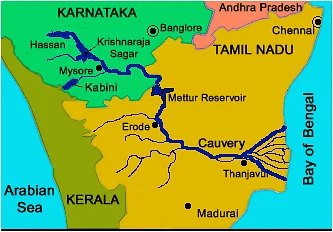
- The Cauvery River, which flows through the southern Indian states of Karnataka, Tamil Nadu, Kerala, and the Union Territory of Puducherry, has been a focal point of one of the most contentious water disputes.
- This long-standing conflict, known as the Cauvery water dispute, has its roots in historical agreements and differing demands.
- Both Karnataka and Tamil Nadu have historically staked claims to substantial portions of the river’s water, primarily to meet their agricultural and irrigation requirements.
- Regrettably, this contention has often escalated into tensions, protests, and, regrettably, even instances of violence in the affected regions.
- The Cauvery River, often referred to as the "Ganges of the South," is a vital water resource for the southern states. Its waters are used primarily for irrigation, providing sustenance to millions of farmers.
- The dispute revolves around how the river water should be distributed among these states for various uses, including irrigation, drinking water, and industrial purposes.
Background
- The Cauvery River water dispute has its origins dating back to 1892 during British colonial times, involving the Madras Presidency and the princely state of Mysore.
- In 1924, they reached an agreement that was valid for 50 years, but it ceased to be enforced in 1974. Following the expiration of this agreement, Karnataka began diverting water into its newly constructed reservoirs without the consent of Tamil Nadu. This action led to a post-independence dispute between the two Indian states over the sharing of Cauvery River water.
- In 2018, the SC declared the River Cauvery a national asset and upheld the water-sharing arrangements which had been finalized by the Cauvery Water Disputes Tribunal (CWDT).
- It ruled that Karnataka would get 284.75 TMC, Tamil Nadu 404.25 TMC, Kerala 30 TMC and Puducherry 7 TMC.
- The Union Government was directed to notify the Cauvery Management Scheme.
- The Cauvery Water Management Authority (CWMA) and the Cauvery Water Regulation Committee (CWRC) was established to implement the decision of the Court and the tribunal.
About Cauvery River
|
(*Click this link to read prelims specific weekly current affairs articles)
FAQs
Question: What is Cauvery water dispute?
Answer:
The Cauvery Water Dispute is a prolonged conflict between the Indian states of Tamil Nadu and Karnataka concerning the distribution of water resources from the Cauvery River, with its origins tracing back to the British colonial era.
Question: What is Cauvery Water Disputes Tribunal (CWDT)?
Answer:
The Cauvery Water Disputes Tribunal (CWDT) was formed in 1990 and was aimed at addressing water disputes involving Tamil Nadu, Karnataka, Kerala, and Puducherry.
Question: What is the Cauvery Water Regulation Committee (CWRC)?
Answer:
The Cauvery Water Regulation Committee (CWRC) was established to implement and monitor the CWDT's award and regulate the distribution of water according to its provisions. The committee's responsibilities include monitoring water releases from Karnataka's reservoirs and ensuring that the allocated amounts of water are delivered to Tamil Nadu, Kerala, and Puducherry as per the established formula.
UPSC Mains Practice Question:
|
MCQ
Question: Which of the following Protected Areas are located in Cauvery basin? (UPSC 2020)
- Nagarhole National Park
- Papikonda National Park
- Sathyamangalam Tiger Reserve
- Wayanad Wildlife Sanctuary
Select the correct answer using the code given below:
(a) 1 and 2 only
(b) 3 and 4 only
(c) 1, 3 and 4 only
(d) 1, 2, 3 and 4
Answer: (c) See the Explanation
Papikonda National Park is located near Rajamahendravaram in the Papi Hills in East Godavari and West Godavari districts of Andhra Pradesh. It is an Important Bird and Biodiversity Area and home to some endangered species of flora and fauna. No part of Papikonda remains outside East and West Godavari districts after 2014 and after the construction of Polavaram Dam. It means it is not in the cauvery basin.
Therefore, option (c) is the correct answer.
Question: In which of the following regions of India are shale gas resources found? (UPSC 2016)
- Cambay Basin
- Cauvery Basin
- Krishna-Godavari Basin
Select the correct answer using the code given below.
(a) 1 and 2 only
(b) 3 only
(c) 2 and 3 only
(d) 1, 2 and 3
Answer: (d) See the Explanation
According to the Ministry of Petroleum and Natural Gas (MoPNG) there are six potential shale gas bearing basins in the country. These include the Cambay, Assam-Arakan, Gondwana, Krishna-Godavari, Kaveri, and the Indo-Gangetic plain. Shales are fine-grained sedimentary rocks that can be rich resources of petroleum and natural gas.
Therefore, option (d) is the correct answer.
Download the PREPP App and attempt FREE IAS Exam Mock Tests and get complete study material!

Full Test - 04: UPSC CSE Prelims CSAT (Paper-II)
Full Test - 03: UPSC CSE Prelims CSAT (Paper-II)
UPSC CSE Prelims 2026 GS Paper 1 Question Paper (24-May-2026)
UPSC CSE Prelims 2026 CSAT Paper 2 Question Paper (24-May-2026)

17 February 2025 | The Hindu Must Read Articles | Current Affairs

16 February 2026 | The Hindu Must Read Articles | Current Affairs

13 February 2026 | The Hindu Must Read Articles | Current Affairs









Comments