Johnson & Johnson Not To Enforce Patents On TB Drug
Relevance: GS2 - Issues relating to development and management of Social Sector/Services relating to Health, Government policies and interventions for development in various sectors and issues arising out of their design and implementation.
(Source: The Hindu, 10/03/2023)
Click here for Daily Current Affairs
Why in the news?
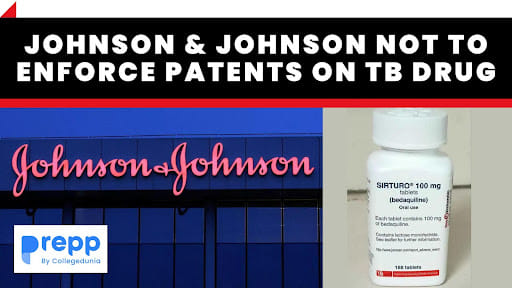
- Recently, Johnson & Johnson announced that it would not enforce patents on Sirturo, its drug to treat multi-drug resistant TB in 134 low- and middle-income countries.
- In March 2023, the Indian Patent Office rejected Johnson & Johnson’s application to extend its patent on Bedaquiline, whose brand name is Sirturo.
Table of Contents
What is bedaquiline?
- Bedaquiline is a critical drug used in the treatment of multi-drug-resistant TB (DR-TB).
- It is not a first-line drug for the standard treatment of drug-sensitive TB and is used when the first-line treatment such as soniazid (INH), rifampin (RIF), ethambutol (EMB), and pyrazinamide (PZA) has stopped being effective.
- It is an oral medication with minimal side effects such as nausea, headache, joint pain, and chest discomfort.
- It belongs to a class of antibiotics known as diarylquinolines
- It was first developed in 2002 by a subsidiary of J&J and was approved in 2012.
- It has been recommended by the WHO as part of a comprehensive TB treatment regimen for drug-resistant cases.
- Mechanism: It has a unique mechanism of action in which the adenosine triphosphate (ATP) synthase enzyme of the TB mycobacteria is targeted.
- ATP is crucial for the production of energy in Mycobacterium tuberculosis.
- It thus effectively kills or inhibits the growth of the TB bacteria by inhibiting energy production.
- Significance:
- It has better efficacy and safety than older drugs used for DR-TB.
- It has less serious side effects and higher cure rates.
How is the decision significant?
- Access: It will enable unrestricted access to affordable generic versions of bedaquiline.
- This will help drug-resistant TB-affected patients in low- and middle-income countries who require the drug.
- Cheaper alternatives: According to a study, bedaquiline can be produced by generic manufacturers in India for around $48-$102 per six-month course in comparison to the $272 charged by J&J for drugs acquired through the Global Drug Facility.
- Indian companies — Lupin, Natco, and Macleods — have claimed that they are prepared to produce generic versions of bedaquiline.
- Competition investigation: In September 2023, the Competition Commission of South Africa claimed that it would investigate Johnson & Johnson for the high price charged for bedaquiline and the extension of its 20-year patent which restricted the entry of cheaper generics.
- South Africa has one of the highest TB disease rates in the world and is the country’s leading cause of death.
- Impact on other countries: Following the Indian Patent Office’s rejection of J&J’s request, other countries such as Ukraine and Belarus have requested the company to drop their secondary patent requests.
- According to the Access Campaign, a part of the Médecins Sans Frontières (MSF), the decision is an outcome of the efforts of TB activists and civil society the prioritization of public health over corporate interests.
Next key target
- Activists have claimed that Japanese pharmaceutical firm Otsuka should not enforce any secondary patents in low- and middle-income countries for its critical new TB drug Delamanid.
- The corporation’s primary patent will expire in the next ten days in India and other countries.
- Delamannid is primarily used in the treatment of drug-resistant TB in combination with bedaquiline.
- It is an important drug used in the treatment of children infected by TB.
J&J’s application
- J&J had sought a patent extension based on the claim that it had invented the method for making a derivative of quinoline in its salt form.
- Since 2007, J&J had indulged in ‘evergreening’ by making multiple claims in its applications for patent extensions.
- In 2023, the Indian Patent Office rejected Johnson & Johnson’s (J&J) attempt to extend its patent and monopoly on the manufacture of bedaquiline.
Evergreening
- Evergreening of patents is a practice of making small changes in drugs to extend their patent term and the profits that can be.
- Sections 3(d), 53(4) and 107A have been introduced in the Indian Patents Act 1970 to prevent the mischievous practice of “evergreening” of patents.
- The Patent Bargain is based on the assumption that it will have a trickle-down beneficial impact on the general population i.e. private risk is rewarded and incentivised for a limited private monopoly right.
- However, the Patent Bargain has become a Faustian bargain in which patentees undermine competition in the market and extract more from society than initially envisioned.
- Supreme Court’s opinion: In the Novartis AG v. Union of India & Others (2013), the Supreme Court held that the legislative intent is to prevent evergreening of a patent monopoly that in no way enhances the drug’s therapeutic efficacy.
Patents in India
- In India, patents are governed by the Indian Patent Act of 1970 which came into force in 1972.
- The Office of the Controller General of Patents, Designs and Trade Marks (CGPDTM) is responsible for implementing the Indian Patent Act.
- International conventions in which India is a party:
- Trade-Related Aspects of Intellectual Property Rights (TRIPS)
- The Berne Convention, which governs copyright
- the Budapest Treaty
- the Paris Convention for the Protection of Industrial Property
- the Patent Cooperation Treaty (PCT)
Drug-resistant TB
|
(*Click this link to read prelims specific weekly current affairs articles)
FAQs
Question: What is a patent?
Answer:
A patent is an exclusive right granted for an invention including products and processes that are either a new way of doing something or offers a new technical solution to a problem.
Question: What is TRIPS?
Answer:
The Trade-Related Aspects of Intellectual Property Rights (TRIPS) is an agreement negotiated between 1989 and TRIPS was negotiated at the close of the Uruguay Round of the General Agreement on Tariffs and Trade (GATT) and is administered by the World Trade Organisation (WTO). It defines minimum requirements for trademarks, copyrights, geographical indications, patents, industrial designs, layout designs for integrated circuits, and concealed information or trade secrets in terms of availability, scope, and usage. It applies to all members of the WTO.
MCQs
Question: Which one of the following antimicrobial drugs, is suitable for treatment of both tuberculosis and leprosy? (UPSC CSE 1995)
(a) Isoniazid
(b) P-aminosalicylic acid
(c) Streptomycin
(d) Rifampicin
Answer: (d) See the Explanation
- Leprosy is caused by Mycobacterium leprae and Tuberculosis is caused by Mycobacterium tuberculosis.
- Rifampicin is the effective drug used for treating diseases caused by Mycobacterium species.
Therefore, option (d) is the correct answer.
Question: What is the importance of using Pneumococcal Conjugate Vaccines in India? (UPSC CSE 2020)
- These vaccines are effective against pneumonia as well as meningitis and sepsis.
- Dependence on antibiotics that are not effective against drug-resistant bacteria can be reduced.
- These vaccines have no side effects and cause no allergic reactions.
Select the correct answer using the code given below:
(a) 1 only
(b) 1 and 2 only
(c) 3 only
(d) 1, 2 and 3
Answer: (b) See the Explanation
- The pneumococcal conjugate vaccine (PCV13) and the pneumococcal polysaccharide vaccine (PPSV23) protect against pneumococcal infections such as meningitis, sepsis, etc. Hence statement 1 is correct.
- These vaccines help reduce the dependence on antibiotics that are not effective against drug-resistant bacteria. Hence statement 2 is correct.
- Pneumococcal vaccine do not usually have any serious sideeffects. They are generally mild and go away on their own within a few days, but serious reactions are possible. Hence statement 3 is not correct.
Therefore, option (b) is the correct answer.
Question: Doctors Without Borders (Medecins Sans Frontieres), often in the news, is (UPSC CSE 2016)
(a) a division of World Health Organization
(b) a non-governmental international organization
(c) an inter-governmental agency sponsored by European Union
(d) a specialized agency of the United Nations
Answer: (b) See the Explanation
- It is a non-governmental and non-military organization that was established by a group of French doctors in 1971 with its headquarters in Brussels, Belgium.
- It is an international humanitarian-aid nongovernmental organization and Nobel Peace Prize laureate that works in war-torn regions and developing countries facing endemic diseases.
Therefore, option (b) is the correct answer.
Download the PREPP App and attempt FREE IAS Exam Mock Tests and get complete study material!

Full Test - 04: UPSC CSE Prelims CSAT (Paper-II)
Full Test - 03: UPSC CSE Prelims CSAT (Paper-II)
UPSC CSE Prelims 2026 GS Paper 1 Question Paper (24-May-2026)
UPSC CSE Prelims 2026 CSAT Paper 2 Question Paper (24-May-2026)

17 February 2025 | The Hindu Must Read Articles | Current Affairs

16 February 2026 | The Hindu Must Read Articles | Current Affairs

13 February 2026 | The Hindu Must Read Articles | Current Affairs









Comments