Have Household Savings Reduced?
Relevance: GS3 - Indian Economy and issues relating to planning, mobilization, of resources, Growth and Development
(Source: The Hindu, 10/03/2023)
Click here for Daily Current Affairs
Why in the news?
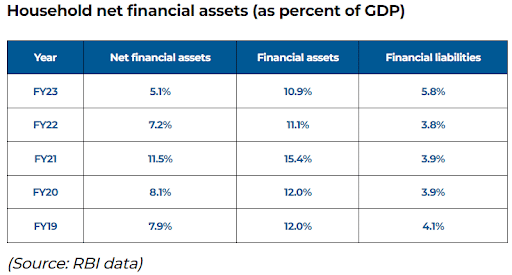
- Recently, the release of the Reserve Bank of India’s (RBI) Monthly Bulletin revealed that households’ net financial savings had declined to 5.1% in 2022-23 from 11.5% in 2020-21.
- RBI showed this household savings data as net financial assets, which is essentially gross financial assets (which include bank deposits, capital mkt investments, life insurance, PFs etc) minus gross financial liabilities (bank or NBFC loans etc).
Table of Contents
What are household financial savings?
- Household financial savings, which form a bulk of overall savings in the Indian economy refer to currency, bank deposits, debt securities, mutual funds, pension funds, insurance, and investments in small savings schemes.
- Gross household financial savings is the total of these savings.
- Net household financial savings is when financial liabilities, including loans from banks, non-banking financial companies (NBFCs), and housing finance companies, are subtracted from gross savings.
Why have the financial savings of households declined recently?
- Household financial savings have declined recently due to the rapid increase in financial liabilities (such as loans from banks and financial institutions) compared to financial assets (such as bank deposits and investments in shares).
- In FY23, household financial liabilities surged to 5.8% of GDP, a significant increase from 3.8% in FY22.
- Between 2000 and 2022, the average growth of financial assets was 12.4%, while financial liabilities grew at a faster rate of 21.6%.
- The difference between financial assets and liabilities represents financial savings, and with liabilities growing faster than assets, there has been a slowdown in the growth of financial savings.
What are the factors behind the decline in financial savings rate?
- Low Interest Rates: The RBI set low interest rates in response to the COVID-19 pandemic to stimulate economic activity. Low interest rates can encourage individuals to borrow and invest in physical assets, like homes and vehicles, rather than keeping their money in traditional savings instruments like fixed deposits or savings accounts.
- Housing Sector Boom: The construction sector, including housing, experienced significant growth during the post-pandemic period. This growth can be attributed to factors like increased demand for housing, government incentives, and easier access to housing loans.
- Increased Access to Credit: The availability of loans for various purposes, such as education and vehicle loans, from both commercial banks and housing finance companies, has expanded. Easy access to credit can lead people to take on more debt for these non-financial assets.
- Inflation Concerns: High inflation can erode the purchasing power of traditional savings and make physical assets like real estate appear as a more attractive store of value. Concerns about inflation may have influenced individuals to invest in assets that are perceived as inflation-resistant.
- Increased Expenditure: As lifestyles improve and become more extravagant, households tend to spend more on luxury goods, leisure activities, dining out, travel, and other non-essential items. This increased expenditure leaves less money available for savings.
- Government Policies: Government policies and incentives, such as subsidies or tax breaks for homebuyers or educational loans, can also play a role in shaping households' investment choices and financial behavior.
Optimistic Growth in Physical Assets vs. Pessimistic Concerns about Rising Liabilities
Optimistic Claim: Shift to Physical Assets
- Construction Sector Growth: Post-COVID, the construction sector has shown robust growth, with a 15% increase between 2020-21 and 2021-22.
- Housing Loans: Housing loans from Scheduled Commercial Banks (SCBs) have consistently grown, with significant expansion from housing finance companies.
- Diversified Investments: Households have diversified their investments, with education and vehicle loans also increasing. Education loans grew at 17%, while vehicle loans increased by approximately 25% between 2021-22 and 2022-23.
- Composition of Savings: Physical assets (excluding gold and silver) now constitute nearly 60% of household net savings, while financial savings have reduced.
Pessimistic Claim: Rising Liabilities and Concerns
- Rise in Gross Liabilities: Gross liabilities have increased to 5.8% of GDP in 2022-23, leading to concerns about rising indebtedness.
- Diverse Personal Loans: Various types of personal loans have surged, including credit card loans and loans against gold jewelry.
- Possible Consumption-Financed Debt: Some evidence suggests that loans might be used for consumption rather than asset creation.
- Non-Banking Institutions' Role: The biggest contributor to the large rise in financial liabilities between 2021-22 and 2022-23 has been loans from non-banking institutions, which grew by almost ten times in just the last year, contributing to 32.1% of the total rise in financial liabilities over this period.
Conclusion
- The Indian economy faces a complex situation, and policymakers must be vigilant and prepared to address both the optimistic and pessimistic aspects of the data.
- They should consider the potential consequences of rising interest rates and develop strategies to ensure the stability and well-being of households in the face of economic uncertainty.
(*Click this link to read prelims specific weekly current affairs articles)
FAQs
Question: What are household financial savings?
Answer:
Household financial savings, which form a bulk of overall savings in the Indian economy refer to currency, bank deposits, debt securities, mutual funds, pension funds, insurance, and investments in small savings schemes.
Question: What are household net financial assets?
Answer:
Household net financial assets represent net savings, calculated as gross financial assets minus financial liabilities.
Question: What are financial assets and financial liabilities?
Answer:
Financial assets encompass a wide range of holdings, including bank deposits, capital market investments, life insurance, provident funds, currency, and more. Conversely, financial liabilities include loans from banks, non-banking financial companies (NBFCs), and other financial institutions.
MCQ
Question: With reference to the Indian economy, consider the following statements: (UPSC 2022)
- A share of the household financial savings goes towards government borrowings.
- Dated securities issued at market-related rates in auctions form a large component of internal debt.
Which of the above statements is/are correct?
(a) 1 only
(b) 2 only
(c) Both 1 and 2
(d) Neither 1 nor 2
Answer: (c) See the Explanation
- Household financial savings include various assets such as currency, bank deposits, mutual funds, and more. These savings can affect government borrowing through instruments like G-secs and Treasury Bills, which are key investments for banks, insurance companies, and mutual funds. Hence, statement 1 is correct.
- Central Government Debt includes both internal and external debt, with marketable debt comprising Government dated securities and Treasury Bills issued through auctions. Hence, statement 2 is correct.
Therefore, option (c) is the correct answer.
Download the PREPP App and attempt FREE IAS Exam Mock Tests and get complete study material!

Full Test - 04: UPSC CSE Prelims CSAT (Paper-II)
Full Test - 03: UPSC CSE Prelims CSAT (Paper-II)
UPSC CSE Prelims 2026 GS Paper 1 Question Paper (24-May-2026)
UPSC CSE Prelims 2026 CSAT Paper 2 Question Paper (24-May-2026)

17 February 2025 | The Hindu Must Read Articles | Current Affairs

16 February 2026 | The Hindu Must Read Articles | Current Affairs

13 February 2026 | The Hindu Must Read Articles | Current Affairs









Comments