Karman Line: Where Space Begins
Relevance: GS3 - Space Technology; Awareness in the fields of IT, Space; Scientific Innovations & Discoveries
(Source: The Hindu, 10/03/2023)
Click here for Daily Current Affairs
Why in the news?
- In the realm of science, boundaries hold significance as they serve to delineate and clarify elements that might otherwise merge or remain ambiguous.
- An example of such a demarcation is the Karman Line.
Table of Contents
What is Karman Line?
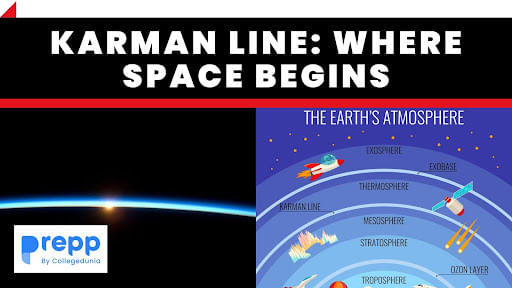
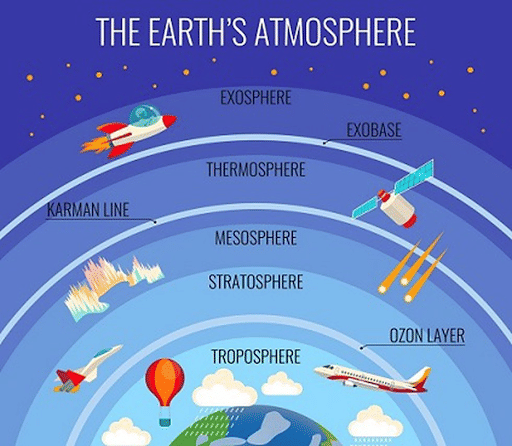
- The Karman Line is an imaginary line that demarcates the earth’s atmosphere from space.
- It is located 100 kilometers (62 miles) above mean sea level.
- It was established in the 1960s by a record-keeping body called Fédération Aéronautique Internationale (FAI).
- Anyone individual who crosses this line qualifies as an astronaut.
- The line is named after Theodore von Kármán (1881–1963), a Hungarian American engineer and physicist, who was active primarily in aeronautics and astronautics.
- He was the first person to calculate the altitude at which the atmosphere becomes too thin to support aeronautical flight and arrived at 83.6 km himself.
What is the significance?
- The Kármán Line is essential for regulating airspace, as it indicates the altitude beyond which traditional aircraft cannot fly without a propulsion system.
- It also serves as a legal reference for distinguishing national airspace from international space, much like international waters.
What are the challenges?
- There are a variety of definitions of where space actually begins and no definitive law that confirms the true boundary.
- For example: For NASA and the U.S. military, space starts at an altitude of 50 miles (around 80 kilometers), according to NOAA. However, to the international community, including the Fédération Aéronautique Internationale (FAI), space starts a little higher, at 62 miles (100 km), at the Kármán line.
- Despite its significance, crossing the Kármán Line physically doesn't yield substantial differences. Air pressure and composition remain relatively consistent within a short distance on either side of the line, and Earth's gravity still exerts its influence. The Earth's atmosphere also doesn't abruptly end at this point, raising questions about its necessity.
Why do we need a Karman Line?
- Legal Framework: It provides a clear and internationally recognized definition of where outer space begins, aligning with principles outlined in the 1967 Outer Space Treaty. This legal framework is crucial for regulating space activities.
- Access to Space: The Kármán line ensures that outer space remains accessible to all countries, promoting equitable opportunities for scientific research and exploration beyond Earth.
- Dispute Avoidance: By defining a boundary for space, it helps prevent disputes and conflicts related to territorial claims or jurisdiction in outer space.
- Monitoring Space Activities: It allows for effective monitoring and tracking of space activities, including satellite launches and human space travel, which is essential for safety and security in space.
- International Cooperation: The Kármán line encourages international cooperation in space exploration, fostering collaboration among nations in the peaceful use of outer space.
(*Click this link to read prelims specific weekly current affairs articles)
FAQs
Question: What is the Atmosphere?
Answer:
The atmosphere is a protective covering of gases that shields all life on Earth by keeping temperatures within a certain range and deflecting harmful solar rays. The atmosphere allows the sun's heat to be retained rather than leaking back into space.
Question: What is the significance of Karman line?
Answer:
The Kármán Line is essential for regulating airspace, as it indicates the altitude beyond which traditional aircraft cannot fly without a propulsion system. It also serves as a legal reference for distinguishing national airspace from international space, much like international waters.
Question: What is Fédération Aéronautique Internationale (FAI)?
Answer:
The Fédération aéronautique internationale is the world governing body for air sports, and also stewards definitions regarding human spaceflight. It was founded on 14 October 1905, and is headquartered in Lausanne, Switzerland.
MCQ
Question: With reference to Karman Line, consider the following statements:
- It is the internationally recognized boundary of space.
- The line is named after Theodore von Kármán, a Hungarian American engineer and physicist.
Which of the statements given above is/are correct?
(a) 1 only
(b) 2 only
(c) Both 1 and 2
(d) Neither 1 nor 2
Answer: (c) See the Explanation
- Kármán Line is a boundary 62 miles (100 kilometers) above mean sea level that borders Earth's atmosphere and the beginning of space. Hence, statement 1 is correct.
- The line is named after Theodore von Kármán (1881–1963), a Hungarian American engineer and physicist, who was active primarily in aeronautics and astronautics. Hence, statement 2 is correct.
Therefore, option (c) is the correct answer.
Download the PREPP App and attempt FREE IAS Exam Mock Tests and get complete study material!

Full Test - 04: UPSC CSE Prelims CSAT (Paper-II)
Full Test - 03: UPSC CSE Prelims CSAT (Paper-II)
UPSC CSE Prelims 2026 GS Paper 1 Question Paper (24-May-2026)
UPSC CSE Prelims 2026 CSAT Paper 2 Question Paper (24-May-2026)

17 February 2025 | The Hindu Must Read Articles | Current Affairs

16 February 2026 | The Hindu Must Read Articles | Current Affairs

13 February 2026 | The Hindu Must Read Articles | Current Affairs









Comments