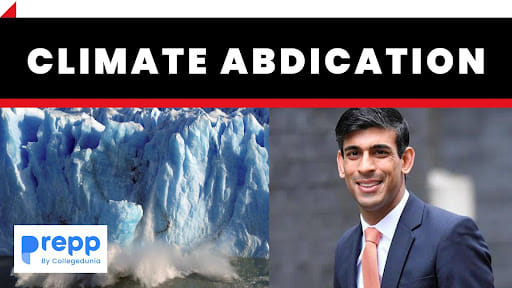
Climate Abdication
Relevance: GS2 - Regional and global groupings and agreements involving India and/or affecting India’s interests; GS3 - Conservation, Environmental Pollution and Degradation; Climate Change
(Source: Indian Express; 09/25/2023)
Click here for Daily Current Affairs
Why in the news?
- Recently, British Prime Minister Rishi Sunak has announced a modification to the UK's approach to meeting its Net Zero climate goals.
- This strategy involves a notable extension of five years in the timeline for the proposed prohibition of petrol and diesel vehicles, now aiming for implementation by 2035.
- In 2019, the UK pledged to achieve carbon neutrality by 2050, but it was viewed as a delay tactic due to insufficient progress.
- Boris Johnson advanced the ban on petrol/diesel cars to 2030, but Rishi Sunak pushed it to 2035, drawing criticism.
Table of Contents
What are the challenges?
- A synthesis report on the progress of the Paris Agreement's Global Stocktake process, sheds light on the formidable obstacles ahead.
- The report underscores that at current ambition levels, the world will emit nearly 20 billion tonnes more carbon dioxide than what is required to keep global temperature rise to less than 1.5 degrees Celsius, the primary goal of the Paris Pact.
- Furthermore, in the wake of the UK's recent policy adjustments, the already challenging task of steering the course towards correction at the upcoming UNFCCC CoP in Dubai, just two months away, has grown even more daunting.
- The contradiction between the UK Prime Minister's UN stance and domestic policies reveals a concerning trend: Developed countries often pledge support for global goals but struggle to align their actions at home.
- For instance, despite positive changes since the Trump era, independent assessments indicate uncertainty in the US's emissions trajectory, even after Joe Biden's commitment to carbon neutrality by 2050.
- Shortly after endorsing a G20 commitment to renewables, the UK has weakened its own climate plans.
About United Nations Global Stocktake Report
- Recently, the United Nations’ Global Stocktake report was released just ahead of the G-20 meet.
- The report is intended to serve as a template for guiding discussions leading up to the 28th Conference of Parties (COP28) scheduled in Dubai in November.
- Its primary purpose is to provide an official assessment of the progress made by countries since 2015 in reducing greenhouse gas (GHG) emissions.
- In 2015, signatories to the UN convention on climate change agreed in Paris to keep global emissions from rising beyond 2°C and, as far as possible, limit it to 1.5°C.
Developments During the Recent G-20 Summit On Climate Change
- G-20 countries are major contributors, as they account for 93% of global operating coal power plants and 88% of prospective ones.
- G20 countries have committed to work towards tripling global renewable energy capacity by 2030.
- Financial commitments: The G-20 Leaders Declaration formally recognizes the financial requirements to address the climate crisis, including the need for approximately $5.8-5.9 trillion in the pre-2030 period for developing countries and $4 trillion per year for clean energy technologies by 2030 to achieve net-zero emissions by 2050.
Tussle Between Developed and Developing Nations regarding Climate Finance
- Climate finance refers to the funds required for various initiatives, such as renewable energy projects, aimed at reducing the impact of climate change.
- Recently, at the Bonn Climate Change Conference held in June, there was repeated fallout between the developed and developing countries mainly over provisions related to finance and the ‘historical responsibility’ of the rich countries.
- Historical Responsibility: A bulk of the accumulated greenhouse gas emissions, the reason for global warming, have come from a group of about 40 rich and industrialized countries, usually referred to as Annex I countries because they were mentioned in Annexure I of the 1992 UN Framework Convention on Climate Change or UNFCCC. This historical responsibility has been the basis for the differentiated burden-sharing on developed and developing countries in the climate change framework.
Concerns raised by the Developed Nations:
- It was stated that the historical emissions happened at a time when there was no alternative to fossil fuel-based energy sources, and when there was little understanding or consensus on the harm caused by greenhouse gases.
- Since 1992, about 57% of the carbon dioxide emissions had come from non-Annex I countries (All Countries excluding a group of about 40 rich and industrialised countries).
- It said that 70% of the incremental warming since 1992 due to emissions from carbon dioxide, methane and sulphur dioxide had come from non-Annex I countries.
- While maintaining that developed countries would take the lead in climate action, bridging the adequacy gap was not the sole responsibility of the developed nations and that it would not agree to references to pre-2020 commitments in the GST.
Initiatives regarding Climate Finance
Global
- In 2010, the 194 member countries agreed to create the Green Climate Fund (GCF) at UNFCCC COP 16.
- At the COP27 summit, delegates from the UN agreed to create a 'Loss and Damages' fund to compensate the most vulnerable countries for their losses due to climate-related disasters.
- At the recent G20 Summit held in India, the G-20 Leaders Declaration formally recognizes the financial requirements to address the climate crisis.
India
- National Adaptation Fund for Climate Change (NAFCC)
- National Clean Energy Fund
- National Adaptation Fund
(*Click this link to read prelims specific weekly current affairs articles)
FAQs
Question: What is Global Stocktake?
Answer:
The Global Stocktake or GST, which was established under the 2015 Paris Agreement, serves as a comprehensive evaluation of the efforts made to combat climate change. It aims to identify areas for improvement and determine strategies to enhance global action, thereby bridging the gap in effectiveness.
Question: What is Climate Finance?
Answer:
Climate finance refers to the funds required for various initiatives, such as renewable energy projects, aimed at reducing the impact of climate change. It involves financial support from different sources, including governments, private companies, and alternative funding channels.
Question: When and where will the COP28 be held?
Answer:
2023 United Nations Climate Change Conference or Conference of the Parties of the UNFCCC, more commonly referred to as COP28 will take place in Dubai, United Arab Emirates, from the 30th November to the 12th December 2023.
MCQ
Question: With reference to ‘Global Climate Change Alliance’, which of the following statements is/are correct? (UPSC 2017)
- It is an initiative of the European Union.
- It provides technical and financial support to targeted developing countries to integrate climate change into their development policies and budgets.
- It is coordinated by World Resources Institute (WRI) and World Business Council for Sustainable Development (WBCSD).
Select the correct answer using the code given below:
(a) 1 and 2 only
(b) 3 only
(c) 2 and 3 only
(d) 1, 2 and 3
Answer: (a) See the Explanation
- The European Union (EU) established the Global Climate Change Alliance (GCCA) in 2007 to strengthen dialogue and cooperation with developing countries, particularly least developed countries (LDCs) and small island developing states (SIDS). Hence, statement 1 is correct.
- The GCCA also provides partner countries with technical and financial assistance in integrating climate change into their development policies and budgets, as well as in implementing projects that address climate change on the ground, promoting climate resilient, low-emission development. Hence, statement 2 is correct.
- By fostering effective climate change dialogue and cooperation, the Alliance contributes to ensuring that poor developing countries most vulnerable to climate change increase their capacity to adapt to the effects of climate change, thereby supporting the achievement of the Millennium Development Goals (MDGs).
- There is no mention of WRI or WBCSD on the GCCA's official partner's page, despite the fact that many other institutions, such as FAO and UNDP, are mentioned. Hence, statement 3 is incorrect.
Therefore, option (a) is the correct answer.
Download the PREPP App and attempt FREE IAS Exam Mock Tests and get complete study material!

Full Test - 04: UPSC CSE Prelims CSAT (Paper-II)
Full Test - 03: UPSC CSE Prelims CSAT (Paper-II)
UPSC CSE Prelims 2026 GS Paper 1 Question Paper (24-May-2026)
UPSC CSE Prelims 2026 CSAT Paper 2 Question Paper (24-May-2026)

17 February 2025 | The Hindu Must Read Articles | Current Affairs

16 February 2026 | The Hindu Must Read Articles | Current Affairs

13 February 2026 | The Hindu Must Read Articles | Current Affairs









Comments