What Is The Five Eyes Alliance, Which Helped ‘Lead’ Canada PM Trudeau To Claims On Nijjar’s Death?
(Source: Indian Express, 09/25/2023)
Click here for Daily Current Affairs
Why in the news?
- Recently, the US Ambassador to Canada claimed that intelligence shared among the members of the Five Eyes Alliance helped “lead” Canada to the allegations made by Canadian PM Justin Trudeau against India.
- The Five Eyes Alliance (FVEY) is an intelligence-sharing partnership that was established after World War II through the UK-USA Agreement, a multilateral agreement for cooperation in signals intelligence.
Table of Contents
What is the Five Eyes alliance?
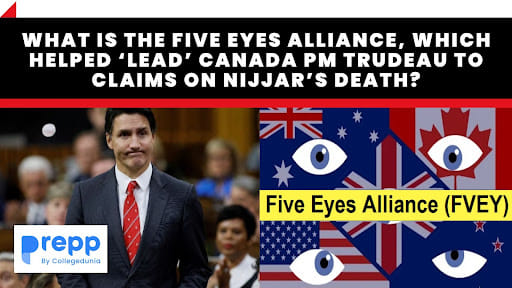
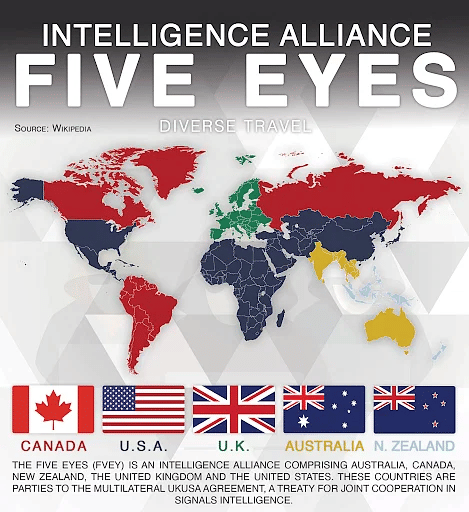
- The Five Eyes alliance is a comprehensive security and intelligence partnership between the UK, the U.S.A., Canada, Australia, and New Zealand.
- The phrase 'Five Eyes' was derived from the lengthy 'AUS/CAN/NZ/UK/Eyes Only' classification level, which listed the 'eyes' who may have access to high-profile files and information.
Why was it formed?
- The origins of the Alliance can be traced back to the Second World War when the U.S.A. and the U.K. shared intelligence.
- The Britain-USA (BRUSA) agreement in 1943 laid the foundations for the UK-USA (UKUSA) agreement.
- BRUSA was signed between the US War Department and the UK’s Government Code and Cypher School to share intelligence information to support US forces in Europe, exchange personnel and develop joint regulations for the handling and distribution of highly sensitive material.
- In 1949, Canada joined the alliance followed by New Zealand and Australia in 1956.
- The alliance was strengthened after the 9/11 attacks with increasing monitoring of internet communications.
- The alliance was not officially acknowledged by member countries until the UKUSA files were released in 2010.
How does the Five Eyes Alliance work?
- The alliance facilitates intelligence sharing, security cooperation, and mutual support among its member countries.
- There has been a closer alignment among the members of the Five Eyes on account of the shared interests such as countering the rise of China.
- Other factors that have enabled cooperation among the nations are mutual trust, shared language, and long historical partnership.
Functions
- Maritime domain: It monitors shipping traffic in strategic maritime areas
- Aerospace domain: It covers activities like ballistic missile tests, foreign satellite deployments, and military activities of relevant air forces.
- Problematic regimes: Terrorist organizations and weapons deals made by 'problematic regimes' are also covered by the FVEY.
- Roles: Each alliance member is in charge of collecting and analyzing information in certain parts of the world.
- UK: Europe, Western Russia, the Middle East, and Hong Kong.
- USA: The Middle East, China, Russia, Africa, and the Caribbean.
- Australia: South and East Asia
- New Zealand: South Pacific and Southeast Asia.
- Canada: Russia, China, and Latin America.
- Five Eyes Intelligence Oversight and Review Council: It was established in 2016 to enhance coordination and collaboration among member countries' intelligence oversight and review entities.
- It includes the non-political intelligence oversight, review, and security entities of the Five Eyes countries.
- They exchange views of mutual interest, share best practices, and conduct virtual and in-person summits throughout the year.
Significant work done
- During the Cold War, a surveillance system code-named ECHELON was developed to intercept and monitor communications of the Soviet Union and the Warsaw Pact members.
- During the Vietnam War, Australia and New Zealand supported the U.S.A. in monitoring North Vietnamese air defense networks.
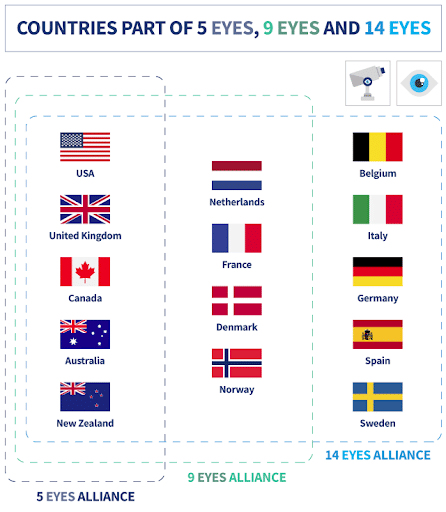
Expansion of Five Eyes
Challenges faced by the Five Eyes alliance
- There has been a lack of uniformity in the foreign policy of the member nations despite their close ties.
- For example, New Zealand has not issued an outright condemnation of Chinese actions in Hong Kong and Xinjiang, unlike the other four countries.
- This has been attributed to the strong trade ties between China and New Zealand.
- The US has also attempted to exert its influence on issues like security with similar-minded countries through other groupings.
- E.g.: The Quadrilateral Security Dialogue (QUAD) of Japan, Australia, India, and the U.S.A. and the AUKUS grouping of Australia, the UK, and the U.S.
India and the FVEY
India-Canada
- The US, UK, Canada, and Australia are home to significant Indian and Indian-origin populations, which necessitates close ties.
- However, the spread of pro-Khalistan activities, especially in Canada is a source of tension in their relationship with India.
- The recent allegations made by the Canadian PM about India’s role in the murder of Khalistani leader Harmeet Singh Nijjar in Canada are an example.
- The other members of the Five Eyes Alliance have claimed that they were monitoring the issue.
- Opportunity: The strong historical ties shared by the other members of the alliance with India and Canada could help them mediate the India-Canada crisis more effectively.
- However, they are unlikely to do so due to their close ties and India’s increasingly assertive approach to geopolitics.
- Quick resolution: They can help facilitate communication and share intelligence to help resolve the matter.
Cooperation with India in other areas
- India has had a poor track record of recognizing threats early enough which could be significantly improved through cooperation with the Five Eyes.
- This will help India deal with challenges like cross-border infiltration in Kashmir and incursions along the Indo-China border.
- Cooperation with the Five Eyes Alliance will help provide more flexible travel options, stronger national passports, and higher levels of national security overseas.
(*Click this link to read prelims specific weekly current affairs articles)
FAQs
Question: What is signals intelligence?
Answer:
Signals intelligence or SIGINT is the process of acquiring information by intercepting signals. This can be done either through direct human communication or by electronic signals.
Question: What is the AUKUS?
Answer:
The AUKUS is a comprehensive partnership between the U.S.A., the UK, and Australia as a trilateral security alliance for the Indo-Pacific region. It facilitates the transfer of U.S. nuclear submarine technology to Australia and is expected to act as a counter to the rising Chinese aggression in the region.
UPSC Mains Practice Question:
|
MCQs
Question: Match List-I with List-II and select the correct answer using
the code given below the Lists: (UPSC CSE 2008)
List-I (Service/Agency) List-II (Country)
- Foreign Intelligence Service 1. Israel
- Ministry of State Security 2. Britain
- Secret Intelligence Service 3. China
- The Mossad 4. Russia
Codes:
(a) A-4; B-1; C-2; D-3
(b) A-2; B-3; C-4; D-1
(c) A-4; B-3; C-2; D-1
(d) A-2; B-1; C-4; D-3
Answer: (c) See the Explanation
- The Foreign Intelligence Service is Russia's external intelligence agency, that mainly handles civilian affairs.
- The Ministry of State Security (MSS) is the intelligence agency and security agency of the People's Republic of China.
- The Secret Intelligence Service or MI6 is the British intelligence agency that supplies the British Government with foreign intelligence.
- Mossad is the national intelligence agency of Israel.
Therefore, option (c) is the correct answer.
Question: Which of the following countries is not a member of the Five Eyes Alliance?
(a) United States of America
(b) United Kingdom
(c) Canada
(d) France
Answer: (d) See the Explanation
- The Five Eyes Alliance is an intelligence-sharing partnership between the U.S.A., the UK, Australia, New Zealand, and Canada.
- It aims to facilitate intelligence sharing, security cooperation, and mutual support among member countries.
- France is not one of the Five Eyes alliance.
Therefore, option (d) is the correct answer.
Download the PREPP App and attempt FREE IAS Exam Mock Tests and get complete study material!

Full Test - 04: UPSC CSE Prelims CSAT (Paper-II)
Full Test - 03: UPSC CSE Prelims CSAT (Paper-II)
UPSC CSE Prelims 2026 GS Paper 1 Question Paper (24-May-2026)
UPSC CSE Prelims 2026 CSAT Paper 2 Question Paper (24-May-2026)

17 February 2025 | The Hindu Must Read Articles | Current Affairs

16 February 2026 | The Hindu Must Read Articles | Current Affairs

13 February 2026 | The Hindu Must Read Articles | Current Affairs









Comments