Lok Sabha Adjourns Sine Die, Clock 160% Productivity
Relevance: GS2 - Parliament and State Legislature
(Source: The Hindu, 09/25/2023)
Click here for Daily Current Affairs
Why in the news?
- Recently, the Rajya Sabha and Lok Sabha adjourned sine die, a day ahead of schedule, after both the Houses passed the landmark Women’s Reservation Bill with absolute majority.
- The Lok Sabha boasted an exceptional productivity rate of 160%, while the Rajya Sabha was highly productive for 128% of its allocated time.
Table of Contents
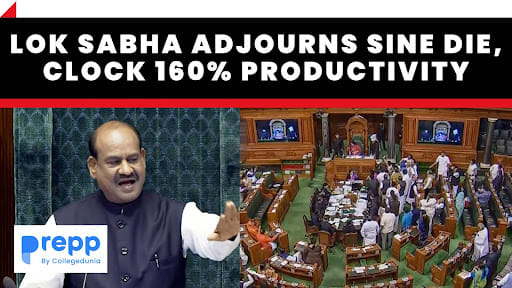
Productivity of 13th Session of the 17th Lok Sabha
- The 13th Session of the 17th Lok Sabha began on September 18 and concluded on September 21. It will be recorded as a “historic session” in history as Parliament started a new journey from the new Parliament building.
- Bill passed: The highlight of the session was the passage of the Constitution (128th Amendment) Bill that will provide for 33% reservation to women in the Lok Sabha and Assemblies. The Women’s Reservation Bill debate lasted for 9 hours and 57 minutes and saw 60 members including 32 women. The Bill was passed with 2/3rd majority, as per the constitutional provisions.
- The session had four sittings lasting for about 31 hours, and the House recorded a productivity of 160%.
- Other discussion: In addition to the Women's Reservation Bill, the Lok Sabha also engaged in discussions on other important topics.
- 75 years of India's parliamentary journey: This discussion, initiated by Prime Minister Narendra Modi, lasted for nearly 7 hours and involved 36 members.
- Chandrayaan-3 Mission: A lengthy discussion on the Chandrayaan-3 Mission took place, lasting over 12 hours and featuring contributions from 87 members.
What is Adjournment Sine Die?
- The term "adjournment sine die" refers to the temporary suspension of a parliamentary session for an undefined amount of time.
- Adjournment sine die, in other terms, is when the House is adjourned without setting a date for resumption.
- The presiding officer of the House has the ability to adjourn sine die.
- A House's presiding officer can call a meeting of the House before the day or time set for suspension, or at any time after the House has been adjourned sine die.
When is an Adjournment Sine Die applied?
- A court may also adjourn a case as Sine Die, which indicates that the case has been indefinitely postponed.
- The following list includes the various causes of sine die.
- Application of incorrect procedure.
- If the proceedings cannot be completed in the near future.
What is the Constitution (128th Amendment) Bill?
- As per the 128th constitutional amendment bill 2023 or the Nari Shakti Vandan Adhiniyam, a third of the seats in the Lok Sabha and state assembly is proposed to be reserved for women.
- Under the legislation, the reservation of seats for women would continue for 15 years and could be extended by Parliament.
- There will be a quota for SC/STs within the reserved seats for women.
- Reserved seats may be allotted by rotation to different constituencies in the state or union territory.
- The bill establishes a connection between women's reservation and the disputed delimitation process.
Implementation of the Bill
- The reservation for women will be implemented after the delimitation exercise based on the first Census conducted following the passage of the Bill, which means this will likely occur around 2029.
- The Bill specifies that women's reservation will be in effect for 15 years from the commencement of the Act, and Parliament has the authority to extend this period if needed.
- The rotation of seats reserved for women will occur following subsequent delimitation exercises, which will be determined by Parliament through legislation.
(*Click this link to read prelims specific weekly current affairs articles)
FAQs
Question: What is Adjournment Sine Die?
Answer:
The term "adjournment sine die" refers to the temporary suspension of a parliamentary session for an undefined amount of time. Adjournment sine die, in other terms, is when the House is adjourned without setting a date for resumption.
Question: What is the difference between prorogation and adjournment?
Answer:
Adjournment terminates a sitting and not a session of the House. Prorogation terminates a sitting but also a session of the House. Adjournment does not affect the bills or any other business pending before the House and the same can be resumed when the House meets again. Prorogation also does not affect the bills or any other business pending before the House. However, all pending notices (other than those for introducing bills) lapse on prorogation and fresh notices have to be given for the next session.
Question: What do you mean by a session in parliament?
Answer:
A session of Parliament is the period spanning between the first sitting of a House and its prorogation (or dissolution in the case of the Lok Sabha). During a session, the House meets every day to transact business. The period spanning between the prorogation of a House and its reassembly in a new session is called ‘recess’.
UPSC Mains Practice Question:
|
MCQ
Question: With reference to the term “Adjournment Sine Die” consider the following statements:
- It means terminating a sitting of the Parliament for an indefinite period.
- Adjournment Sine Die cannot be passed for the Rajya Sabha.
Which of the statements given above is/are correct?
(a) 1 only
(b) 2 only
(c) Both 1 and 2
(d) Neither 1 nor 2
Answer: (a) See the Explanation
- Adjournment Sine Die means terminating a sitting of the Parliament for an indefinite period. Hence, statement 1 is correct.
- Adjournment Sine Die is done by the presiding officer of the House. Rajya Sabha is not subjected to dissolution but Adjournment Sine Die can be passed for Rajya Sabha also as it only terminates the sitting of the House. Hence, statement 2 is incorrect.
Therefore, option (a) is the correct answer.
Download the PREPP App and attempt FREE IAS Exam Mock Tests and get complete study material!

Full Test - 04: UPSC CSE Prelims CSAT (Paper-II)
Full Test - 03: UPSC CSE Prelims CSAT (Paper-II)
UPSC CSE Prelims 2026 GS Paper 1 Question Paper (24-May-2026)
UPSC CSE Prelims 2026 CSAT Paper 2 Question Paper (24-May-2026)

17 February 2025 | The Hindu Must Read Articles | Current Affairs

16 February 2026 | The Hindu Must Read Articles | Current Affairs

13 February 2026 | The Hindu Must Read Articles | Current Affairs









Comments