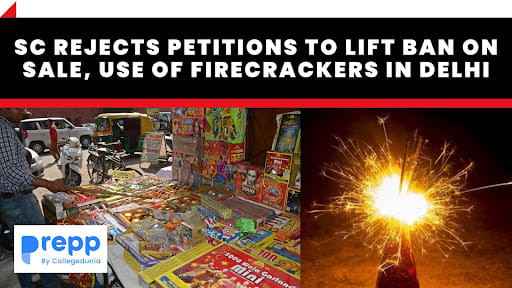
SC Rejects Petitions To Lift Ban On Sale, Use Of Firecrackers In Delhi
Relevance: GS2 - Government policies and interventions for development in various sectors and issues arising out of their design and implementation, Issues relating to development and management of Social Sector/Services relating to Health, GS3 - Conservation, environmental pollution and degradation, environmental impact assessment.
(Source: The Hindu, 09/25/2023)
Click here for Daily Current Affairs
Why in the news?
- Recently, the Supreme Court of India rejected pleas to include barium as an ingredient in fireworks while retaining the prohibition on the sale and bursting of joint crackers.
- According to a report submitted by the Additional Solicitor General, 3,120 cases were registered between 2016 and August 2023 for bursting and 926 cases for the sale and storage of crackers.
Table of Contents
What has the SC said about the ban on the sale and use of firecrackers in Delhi?
- A Supreme Court bench comprising Justices A.S. Bopanna and M.M. Sundaresh directed the Delhi Police and authorities to regulate violations of the ban on firecrackers in Delhi.
- The Bench also stated that filing cases against violators of the ban was not an ideal solution to the health and environmental concerns posed by bursting firecrackers.
- Between 2016 and 2023, the police arrested around 2,626 people for bursting firecrackers and 740 people for the sale and storage of crackers.
- In 2021, The SC ruled that no one will be permitted to infringe the Constitutionally granted Right to Health (Art 21) in the name of celebration.
What has the Delhi Government said?
- According to the Environment Minister of the government of Delhi, all types of firecrackers will be banned in the 2023 winter season.
- Licenses will not be issued by the Delhi police for the manufacture, sale, and storage of firecrackers.
- Pollution: The Delhi government has claimed that PM 10 levels have fallen by 42% between 2014 and 2023 and PM 2.5 levels have fallen by 46% over the same period.
Previous orders banning firecrackers in Delhi
- In 2018, the Supreme Court ruled that only green crackers should be used in the National Capital Region.
- In 2020, the NGT issued an order imposing a total ban on the sale and use of all kinds of firecrackers during the COVID-19 pandemic in the NCR and all cities or towns where the air quality falls in the ‘poor’ or worse categories.
- In 2020, ‘green’ crackers were allowed in Delhi for some time, but in November a complete ban was imposed on firecrackers.
- In 2021 and 2022, all firecrackers were banned in Delhi but the SC later clarified that the ban only extended to fireworks containing barium.
- The Petroleum and Explosives Safety Organisation (PESO) is responsible for certifying that the crackers do not contain arsenic, mercury, and barium and that their loudness is within the prescribed threshold.
Use of barium in fireworks
Why is it used?
- Barium is used in crackers to produce the color green in fireworks.
- It also works as a stabilizing agent that helps improve the shelf life of firecrackers.
Effects
- Health issues: Barium ingestion can cause severe gastrointestinal distress as well as vomiting, abdominal pain, and diarrhea.
- It can also lead to hypokalaemia, a fatal condition in which potassium levels in the body are low.
- Pollution: Barium nitrate contributes to increased air and noise pollution.
- It is a toxic compound and is known to cause respiratory irritation.
- It is a public health hazard, for consumers and laborers involved in manufacturing and transporting the crackers.
Implementation
- The firecracker bans in Delhi are violated every year contributing to air quality dropping to the ‘severe’ category in the AQI.
- Analyses of crackers have found arsenic, lead, sulfur, and chlorine, which have been banned under the Centre’s Hazardous Chemical Rules (2000).
- Instead of complying with the government regulations, producers have simply avoided including barium on the list of ingredients mentioned on the packaging.
Other chemicals used in fireworks and their concerns
- Copper: Respiratory tract irritation, kidney and liver damage, and affects fetal growth
- Cadmium: Reduces the oxygen-carrying capacity of blood, causing anemia.
- Zinc: Metal fume fever and vomiting.
- Lead: Impacts the nervous system.
- Magnesium: It can cause metal fume fever
- Sodium: It can cause burns when it reacts with moisture
- Aluminum: It causes diseases such as dermatitis, Alzheimer's, etc.
- Sulfur dioxide: It causes smog, acid rain, and respiratory concerns like asthma.
- Potassium dioxide: It is carcinogenic and causes skin and eye irritation
- Per-chlorate ammonium: Gastrointestinal problems, lung cancer, and affects the thyroid gland by impacting iodine intake
- Antimony sulfide: It is carcinogenic and can cause pneumoconiosis, stomach pain, ulcers, vomiting, diarrhea, etc.
- Nitrogen dioxide: Toxic and fatal for infants
- Lithium: Affects the skin, eyes, respiratory tract, etc.
- Mercury: It is toxic for the nervous system and affects fetal growth.
- Lead dioxide: Poisonous to plants and animals and impairs growth.
Green crackers
- Green crackers are ‘eco-friendly’ crackers that are believed to cause less air and noise pollution in comparison to traditional firecrackers.
- They were designed in 2018 by the National Environmental and Engineering Research Institute (NEERI), under the CSIR.
Types
- SWAS – Safe Water Releaser: These crackers discharge water vapor into the atmosphere to dampen the discharged dust.
- It leads to a 30% reduction in the amount of particle dust emitted.
- STAR – Safe Thermite Cracker: These crackers do not contain sulfur and potassium nitrate and discharge less particulate matter with low noise.
- SAFAL – Safe Minimal Aluminum: These discharge less particulate matte with lowered noise level as compared to traditional ones
Advantages
- Less polluting: Green crackers are estimated to be 30% less polluting than regular crackers.
- In order to reduce the noise intensity and emissions of crackers, hazardous agents used in traditional crackers are replaced with less polluting substances.
- Most green crackers contain potassium nitrate and aluminum instead of barium nitrate and other harmful substances.
- Less noise: Green crackers only produce about 100-130 decibels while regular crackers produce around 160-200 decibels of sound.
Challenges
- Unemployment: Green crackers can only be legally manufactured by firms that have signed agreements with the CSIR.
- As a result, small-scale businesses and laborers traditionally employed in the sector suffer economically.
- Unfair practices: Sellers might be selling traditional crackers advertised as green crackers.
- Manufacturers have been avoiding mentioning barium as an ingredient on the packaging while including it in the product.
- Cost: Green crackers are generally more expensive than regular crackers, which makes them less attractive to the customer.
(*Click this link to read prelims specific weekly current affairs articles)
FAQs
Question: What is the NGT?
Answer:
The National Green Tribunal (NGT) is a specialized body set up under the National Green Tribunal Act (2010). It has jurisdiction over all civil cases involving substantial questions relating to the environment and conservation of natural resources. It consists of a Chairperson, Judicial Members, and Expert Members who hold office for a term of three years or the age of sixty-five.
Question: What is PESO?
Answer:
The Petroleum and Explosives Safety Office (PESO), previously known as the Department of Explosive is the nodal agency to regulate the safety of hazardous substances such as explosives, compressed gases, and petroleum. It functions under the Department of Industrial Policy and Promotion (DIPP). It aims to ensure the safety and security of the public and property from fire and explosion and is responsible for the administration of the Explosives Act, 1884, Petroleum Act, 1934; and the Inflammable Substances Act, 1952.
UPSC Mains Practice Question:
|
MCQs
Question: In the context of the WHO Guidelines on Air Quality, consider the following statements.
- The 24-hour mean of PM2.5 should not exceed 15 ug/m³ and the annual mean of PM 2.5 should not exceed 5 µg/m³.
- In a year, the highest levels of ozone pollution occur during periods of inclement weather.
- PM10 can penetrate the lung barrier and enter the bloodstream.
- Excessive ozone in the air can trigger asthma.
Which of the statements given above are correct? (UPSC CSE 2022)
(a) 1, 3 and 4
(b) 1 and 4 only
(c) 2, 3 and 4
(d) 1 and 2 only
Answer: (b) See the Explanation
- According to the guidelines, the annual average for PM2.5 should not exceed 5 micrograms per cubic meter of air, while the 24-hour average should not exceed 15 micrograms per cubic meter. Hence statement 1 is correct.=
- Ozone at ground level is one of the major constituents of photochemical smog which is formed by the reaction of pollutants like nitrogen oxides and VOCs with sunlight.
- This means that ozone pollution is highest during periods of sunny weather, not inclement weather. Hence statement 2 is incorrect.
- Generally, particles are with a diameter of 2.5 microns or less, (≤ PM2.5). PM2.5 can penetrate the lung barrier and enter the blood system. Hence statement 3 is incorrect.
- Excessive ozone in the air can cause breathing problems, asthma, reduced lung function, and other lung diseases. Hence statement 4 is correct.
Therefore, option (b) is the correct answer.
Question: Magnetite particles, suspected to cause neurodegenerative problems are generated as environmental pollutants from which of the following?
- Brakes of motor vehicles
- Engines of motor vehicles
- Microwave stoves within homes
- Power plants
- Telephone lines
Select the correct answer using the code given below (UPSC CSE 2022)
(a) 1, 2, 3 and 5 only
(b) 1, 2, and 4 only
(c) 3, 4 and 5 only
(d) 1, 2, 3, 4 and 5
Answer: (d) See the Explanation
- Magnetite particles are pollutants that can lead to neurodegenerative problems like Alzheimer's by penetrating and damaging the blood-brain barrier.
- They are generated by the magnetic flux produced by operating magnetic components in electronic appliances.
- Magnetite particles are generated by the Anti-lock Braking System (ABS) used in vehicles and motor vehicle engines, microwave stoves, coal-power plants, telephone lines, etc.
Therefore, option (d) is the correct answer.
Download the PREPP App and attempt FREE IAS Exam Mock Tests and get complete study material!

Full Test - 04: UPSC CSE Prelims CSAT (Paper-II)
Full Test - 03: UPSC CSE Prelims CSAT (Paper-II)
UPSC CSE Prelims 2026 GS Paper 1 Question Paper (24-May-2026)
UPSC CSE Prelims 2026 CSAT Paper 2 Question Paper (24-May-2026)

17 February 2025 | The Hindu Must Read Articles | Current Affairs

16 February 2026 | The Hindu Must Read Articles | Current Affairs

13 February 2026 | The Hindu Must Read Articles | Current Affairs









Comments