India And The Great Power Contest In West Asia
(Source: The Hindu, 09/25/2023)
Click here for Daily Current Affairs
Why in the news?
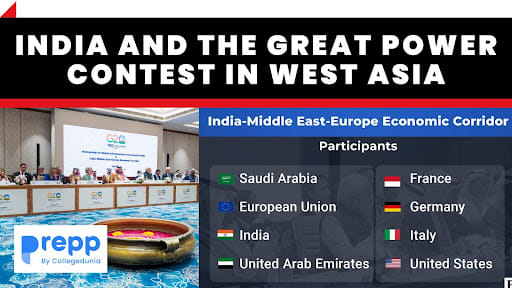
- Recently, the U.S.A, India, Saudi Arabia, UAE, France, Germany, Italy, and the EU announced the establishment of the India-Middle East Economic Corridor to improve its position in the West Asian region where it was a dominating presence.
- This article discusses the U.S. strategy towards West Asia and India’s potential role in the region amid the various challenges to the U.S.A’s dominance.
Table of Contents
What is the U.S.A.’s “two-part policy” towards West Asia?
- The G-20 summit in New Delhi highlighted the U.S.A.’s approach towards West Asia which can be illustrated by the geopolitical developments in the geostrategically important region.
- The Biden administration's strategy consists of two parts:
- Strengthening ties between Gulf Arab nations and Israel to meet common geopolitical challenges
- Reassuring U.S. allies in the region of the U.S.A’s continued presence in the region.
Part I: Strengthening Gulf Arab-Israel ties
- In a continuation of Trump-era policy to counter Iran, the USA has aimed to strengthen ties between its biggest allies in the region - the Gulf Arab states and Israel.
- The U.S.-led Abraham Accords improved Israel-UAE relations and signaled a shift from the “two-state solution”.
- However, the true potential of an Israel-Gulf accord depends on a deal between Israel and Saudi Arabia.
- The U.S. believes that a Saudi-Israel partnership will transform West Asian geopolitics and cement the U.S.’s dominant role in the region without additional military commitments.
Part II: Reassuring allies and economic integration
- The U.S.A. has attempted to assure its allies that it will retain its presence in West Asia.
- The I2U2 including India, Israel, the U.S.A., and UAE was established in 2021
- Goals: Enhance economic integration and technological cooperation between West Asia and South Asia
- Addressing the challenges faced by the Global South.
U.S. Deprioritization of West Asia
- The U.S.A. has shifted focus to East Europe and East Asia due to the challenges posed by Russia and China respectively.
- Although the U.S.A. has deprioritized West Asia in terms of its security commitments, the region is still strategically significant.
China’s role
- China has sought to fill the gap left by the U.S.A. in West Asia.
- Economic: It is a major investor and the largest trading partner for most of the U.S.A.’s allies in the region.
- Diplomatic: It has emerged as a diplomatic influence as evidenced by its role in the successful Saudi-Iran reconciliation.
New West Asia and the challenges faced
- The U.S.A.’s strategy to retain and strengthen its influence in West Asia depends on the potential Saudi-Israeli agreement and faces strong competition from China.
- The U.S.A.'s deprioritization of West Asia has resulted in a security vacuum in the region.
- Regional powers have been pursuing independent foreign policies and diversifying partnerships including UAE and Saudi Arabia joining BRICS.
- Other examples include the Saudi-UAE détente with Iran, the end of the Saudi-led blockade of Qatar, and the Arab reconciliation with Syria.
- However, Gulf states are unlikely to remain client states like during the Cold War.
- Another major challenge for the U.S.A. is its rivalry with Iran, a “hostile power”.
- The Israel-Iran rivalry could destabilize the region and impact the U.S.A.’s ambitions.
- The detente between the Gulf Arab and Israel indicates their unwillingness to get involved in the rivalry.
India's Opportunities
- India’s invitation to participate in the I2U2 is a recognition of its regional influence.
- India is a participant in the economic corridors of the region such as the
- International North-South Transport Corridor between India and Russia via Iran and Central Asia
- The India-Middle East-Europe Corridor aims to build an economic corridor from India through the UAE, Saudi Arabia, Jordan, and Israel, to the Mediterranean
- India’s size, economy, historical engagement, and cultural connections make it an important partner in reshaping West Asia’s geopolitics.
- The success of the IMEC could help the U.S.A. retain its influence in West Asia, through control of trade routes.
- India can leverage the U.S.-China competition in West Asia for enhanced engagement in the region.
- India must adopt multi-engagement in the region without aligning exclusively with any great power.
Conclusion
- The U.S.A.’s West Asia approach will impact India's role in the region.
- Therefore, India should capitalize on its historical ties and regional presence to play a significant role in shaping West Asia’s geopolitics while maintaining its traditional balance in its extended neighborhood.
(*Click this link to read prelims specific weekly current affairs articles)
FAQs
Question: what is the Saudi-UAE detente with Iran?
Answer:
It is a China-brokered agreement between Saudi Arabia, UAE, and Iran to restore diplomatic relations. Iran has agreed to prevent further attacks against Saudi Arabia from the Houthi-controlled parts of Yemen while Saudi Arabia has agreed to regulate Iran International, a Farsi news channel critical of the Iranian regime. It also assisted in Syria’s readmission to the Arab League and is likely to improve Iran’s ties with Egypt, Jordan, etc.
Question: What are the Abraham Accords?
Answer:
The Abraham Accords refer to a series of agreements signed in 2020 between Israel, UAE, Bahrain, Sudan, and Morocco to normalize ties between them and improve economic, political, and security integration in the Middle East. The Accords are named in honor of Abraham, the supposed common ancestor of the Jews and the Arabs. It resulted in the establishment of full diplomatic ties between Israel, the United Arab Emirates, and Bahrain.
UPSC Mains Practice Question:
|
MCQs
Question: The term "two-state solution" is sometimes mentioned in the news in the context of the affairs of (UPSC CSE 2018)
(a) China
(b) Israel
(c) Iraq
(d) Yemen
Answer: (b) See the Explanation
- The two-state solution has been suggested by Palestine to end the conflict with Israel.
- It involves the creation of an Arab Palestine state in the Gaza Strip and West Bank in addition to the state of Israel.
Therefore, option (b) is the correct answer.
Question: Which of the following is not a member of ‘Gulf Cooperation Council’? (UPSC CSE 2016)
(a) Iran
(b) Saudi Arabia
(c) Oman
(d) Kuwait
Answer: (a) See the Explanation
- The Gulf Cooperation Council (GCC) is a political and economic alliance of six Middle East countries.
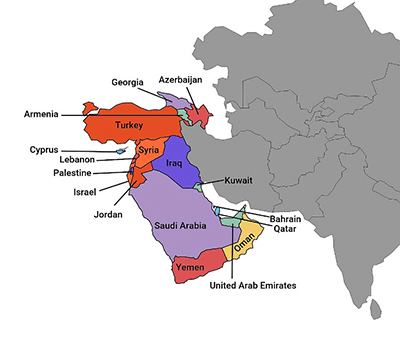
- GCC members are Bahrain, Kuwait, Saudi Arabia, Qatar, Oman, and the UAE.
- Iran is not a member of the GCC.
Therefore, option (a) is the correct answer.
Download the PREPP App and attempt FREE IAS Exam Mock Tests and get complete study material!

Full Test - 04: UPSC CSE Prelims CSAT (Paper-II)
Full Test - 03: UPSC CSE Prelims CSAT (Paper-II)
UPSC CSE Prelims 2026 GS Paper 1 Question Paper (24-May-2026)
UPSC CSE Prelims 2026 CSAT Paper 2 Question Paper (24-May-2026)

17 February 2025 | The Hindu Must Read Articles | Current Affairs

16 February 2026 | The Hindu Must Read Articles | Current Affairs

13 February 2026 | The Hindu Must Read Articles | Current Affairs









Comments