Right Against Exploitation (Article 23 and 24) - Fundamental Rights - Indian Polity Notes
Right Against Exploitation means the right to be free from the forms of exploitation. Right Against Exploitation is a fundamental right guaranteed by the Indian Constitution. According to the Indian Constitution, slavery, beggarism, child labour, bonded labour, and other forms of forced labour are examples of exploitation and they are prohibited. Article 23 and 24 deal with the Right against Exploitation and ensures human dignity. The topic “Right Against Exploitation (Article 23 and 24)” is an important part of the UPSC/IAS Exam Polity and Governance syllabus which is discussed in this article in detail.
| To Read update on this topic: |
|
Table of Contents |

Right Against Exploitation - Concept
- The Indian Constitution protects the individual's dignity by enshrining the Right Against Exploitation. It also forbids the following types of exploitation or misuse of service through coercion or inducement
- It outlaws human trafficking, which is defined as the purchase and sale of human people as a commodity. It also forbids the use of girls or women for immoral purposes.
- Slavery, beggarism, bonded labor, and other types of forced labor are prohibited. Begar is a name describing procedure in which a worker is required to provide free or low-cost service to his master.
- State has been given the responsibility to protect the citizens against such forms of exploitation.
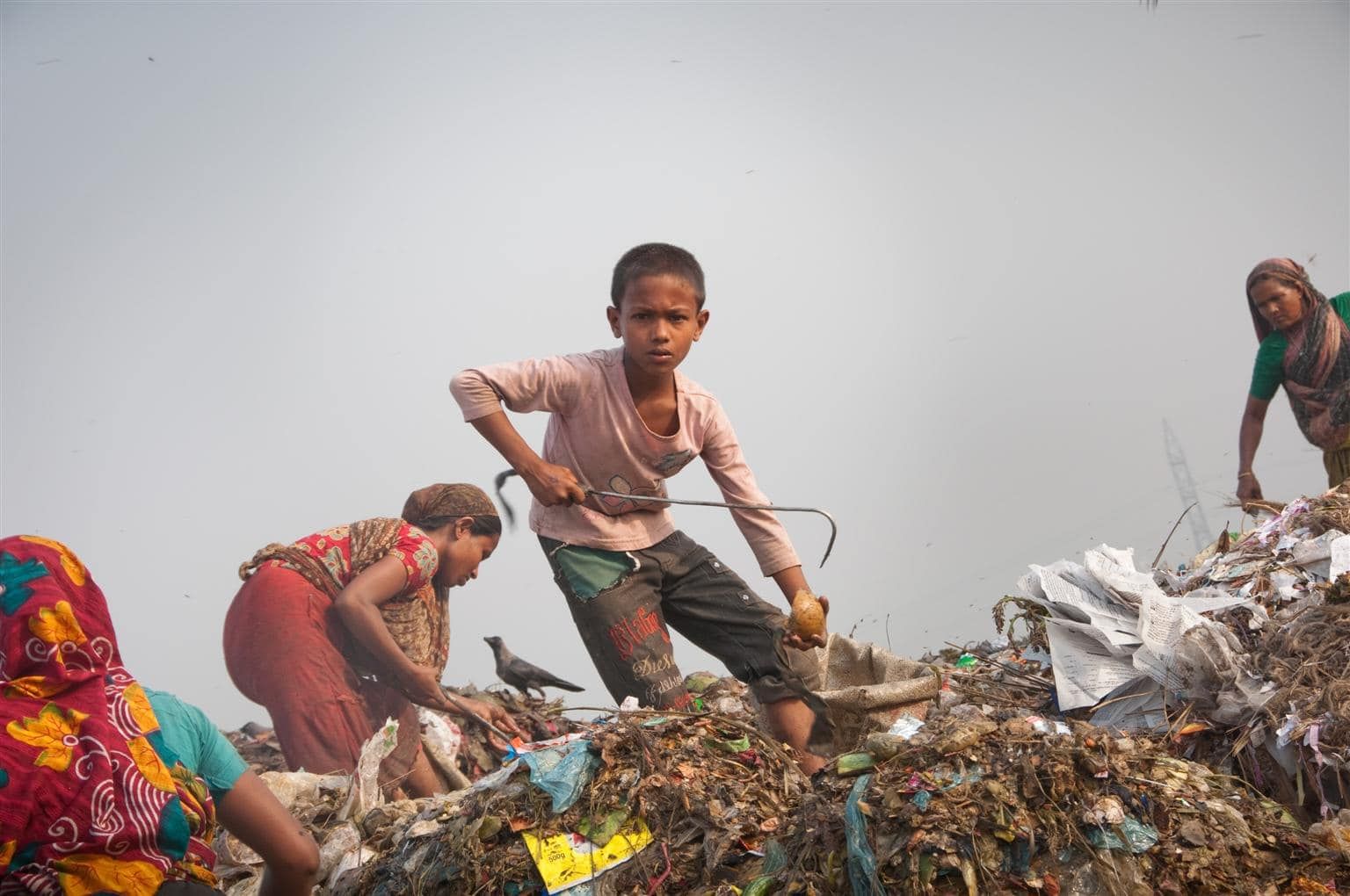
- It makes it illegal to employ children under the age of 14 in factories, mines, and other dangerous jobs.
- In our country, many people are underprivileged and deprived. They may also face exploitation from other people. The exploitation usually occurs in the following forms:
- Forced labour without payment i.e. begar
- Human trafficking and enslavement - for prostitution and devdasi-like practices
- Historically the practice of forced labour has been used by landlords, moneylenders, and wealthy people. In fact, in many places, forms of bonded labour still exist; for example, in Brick kiln work.
- The constitution of India prohibited both forms of practices in part III, and bonded labor is now a punishable crime under the law.
- The Constitution also prohibited the practice of child labor. It is now unlawful to employ children below 14 years, in dangerous jobs like factories and mines.
- By giving these children a right to education, the right against exploitation has become more meaningful.
|
Right against Exploitation is one of the fundamental rights that prohibits human trafficking, bonded labour and child labour in different forms.
|
Right against exploitation - Constitutional Provisions
In order to nurture personal liberty and give protection against discrimination, our constitution led down certain provisions to check on the exploitation of vulnerable sections of society. The provision is made under Article 23 and 24.
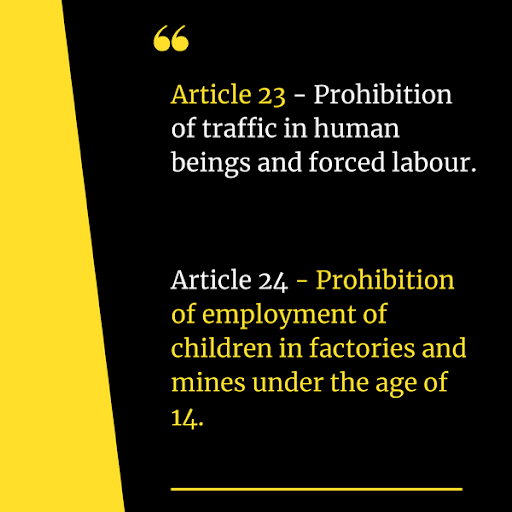
- Article 23 - Prohibits traffic in human beings and begar and other similar forms of forced labour. Any violation of this provision shall be made punishable under the law.
- Article 24 - No child below the age of fourteen years, shall be employed to work in any factory or mine or engaged in any other hazardous employment.
Exceptions made under these articles
There are certain situations that may arise where compulsion of work may require. Therefore, the Constitution itself has made certain exceptions to these provisions.
- Exceptions under Article 23: This article itself made an exception by saying that the State can impose compulsory public service in legitimate cases. Of course, in such a case, state can not discriminate on the grounds of religion, race, caste, or class.
- Thus, it would not prevent the State from imposing compulsory recruitment for public purposes such as military or social services.
- The article also does not prohibit forced labour as punishment for convicted criminals.
- No exception under Article 24: The prohibition under Article 24 is absolute and there would be no exception. It is clear that under no circumstances the children below 14 years can be employed in factories or mines or any hazardous job. Keeping this in mind the Supreme Court has directed to take positive steps for the welfare of such children and improve their quality of life.
Recent issues of Article 23 (Workers' rights):
- During COVID-19 Pandemic, there were waves of reverse migrations of workers. There are several instances where workers' rights were violated by employers and also states failed to protect them.
- Article 23 of our Constitution prohibits “forced labor”. In PUDR v. Union of India (1982), the Supreme Court held that the word ‘force’ must be included the kind of compulsion arising from the pressing economic situation (like Covid-19), which leaves no alternatives to a person in which a person forced to work on very less wage, even lesser than minimum wage”
- It is also a violation of the ILOs ‘Employment and Decent Work for Peace and Resilience Recommendation, 2017’ which demands that the states must ensure the marginalized group's right of “free choice of employment” while recovering after a disaster.
- Thus, the many Home Ministry directives and State ordinances would be in violation of our Constitution as well as international conventions.
The direction of the Supreme Court of India regarding child labour
In MC Mehta vs state of Tamil Nadu the SC, gave the following directions for the elimination of child labor
- There must be a Survey for the identification of child labor
- There must be a mechanism for the withdrawal of children working in dangerous industries and ensuring their enrollment in education institutions.
- The offending employer must be paid Rs. 20000 in the children's welfare fund.
- Employment must be provided for one adult member of the family of the rescued child. If not possible the state must contribute Rs. 5000 in the children's welfare fund.
- The aggrieved family must get financial assistance from the interest that comes from that 20,000/25,000 deposit until the child is attending school.
- The children who engage in non-hazardous work must not work for more than 6 hours. Also, employers must ensure at least 2 hours of education per day.
- The employer in this case must bear the full financial responsibility for such education.
Laws passed by the Parliament in pursuance of Article 23:
- Suppression of Immoral Traffic in Women and Girls Act, 1956
- Bonded Labour System (Abolition) Act, 1976
Laws passed in accordance with Article 24 in India -
Factories Act of 1948
- This was the first law passed after independence that established a minimum age limit for factory workers. The Act established a 14-year-old minimum age.
- This Act was revised in 1954 to prohibit children under the age of 17 from working at night.
The Mines Act of 1952
- The Mines Act of 1952 was enacted to regulate the mining industry.
- This law prevents minors under the age of 18 from working in mines.
The Child Labor (Prohibition and Regulation) Act 1986
- The 1986 Child Labor (Prohibition and Regulation) Act is a law that prohibits and regulates child labour.
- This was a groundbreaking law created to combat the pervasive problem of child labour in India.
- It specified where and how minors might be employed, as well as where and how they could not. A child is defined as a person who has not yet reached the age of fourteen.
- Children are prohibited from working in 13 occupations and 57 procedures under the 1986 Act.
The Child Labor (Prohibition and Regulation) Amendment Act of 2016
- The Child Labor (Prohibition and Regulation) Amendment Act of 2016 is a law that prohibits and regulates child labour.
- The employment of children under the age of 14 is expressly prohibited under this Act. It also prohibits people between the ages of 14 and 18 from working in hazardous activities or processes.
- The penalties for breaking this law have been tightened as a result of this amending act.
- This Act empowers youngsters to work in a variety of household jobs as well as artists.
Amendment Rules to the Child Labor (Prohibition and Regulation) Act 2017
- The government issued the following Rules in 2017 to establish a comprehensive and specific framework for child and adolescent worker prevention, prohibition, rescue, and rehabilitation.
- The Rules simplified concerns relating to the employment of family businesses, as well as providing protection for artists by defining working hours and conditions.
Conclusion
Though the provisions for prohibition of exploitation are noble.The actual elimination process is full of challenges. In dynamic situations like COVID-19 and the changing nature of work, safeguards for the protection of workers' rights must be updated accordingly.
FAQs
Q1: What is the Right Against Exploitation in the Indian Constitution?
Answer: The Right Against Exploitation, provided under Articles 23 and 24 of the Indian Constitution, safeguards individuals from human trafficking, forced labor, and child labor. This right ensures the protection of human dignity and prevents economic exploitation.
Q2: What is Article 23 of the Indian Constitution?
Answer: Article 23 prohibits trafficking in human beings, forced labor, and other forms of exploitation. It ensures that no individual is subjected to work against their will and aims to protect citizens from exploitation and involuntary servitude.
Q3: What protections does Article 24 provide for children?
Answer: Article 24 prohibits the employment of children below the age of 14 in any hazardous industries or occupations. This article seeks to protect children from the physical and psychological harm associated with child labor, especially in dangerous conditions.
Q4: Are there any exceptions to Article 23?
Answer: Yes, the state may impose compulsory service for public purposes, such as in times of national emergency or disaster, as long as it does not discriminate based on religion, race, caste, or class.
Q5: How does the Right Against Exploitation relate to human rights?
Answer: The Right Against Exploitation upholds essential human rights by protecting individuals from forced labor, trafficking, and child labor. These provisions align with global human rights standards and aim to ensure individual dignity, freedom, and well-being.
MCQs
- Which article in the Indian Constitution prohibits trafficking in human beings and forced labor?
A) Article 19
B) Article 20
C) Article 23
D) Article 25
Answer: (C) See the Explanation
- What age does Article 24 specify as the minimum for employment in hazardous industries?
A) 12 years
B) 15 years
C) 14 years
D) 18 years
Answer: (C) See the Explanation
- Article 23 of the Indian Constitution allows for which of the following exceptions?
A) Employment of children in family businesses
B) Discriminatory forced labor for the public
C) Compulsory service for public purposes without discrimination
D) Forced labor for certain castes
Answer: (C) See the Explanation
- Which fundamental right ensures protection from economic exploitation?
A) Right to Equality
B) Right to Freedom
C) Right Against Exploitation
D) Right to Property
Answer: (C) See the Explanation
- Article 24 of the Indian Constitution primarily focuses on which issue?
A) Child marriage
B) Child labor
C) Child trafficking
D) Child education
Answer: (B) See the Explanation
GS Mains Questions and Model Answers
Q1: Explain the significance of Article 23 of the Indian Constitution in protecting individuals from exploitation.
Answer: Article 23 of the Indian Constitution is significant as it prohibits trafficking, forced labor, and other exploitative practices. This provision plays a crucial role in safeguarding human dignity, ensuring that no individual is compelled to work against their will. The prohibition against exploitation aligns with India’s commitment to upholding human rights and offers protection especially to marginalized groups susceptible to forced labor. Additionally, Article 23 provides an exception for compulsory service for public purposes, as long as it is non-discriminatory. By preventing forced labor and exploitation, this article strengthens the rights to freedom and equality in society.
Q2: How does Article 24 of the Indian Constitution address child labor? Discuss its implications for children’s rights in India.
Answer: Article 24 of the Indian Constitution addresses child labor by prohibiting the employment of children under 14 years in hazardous industries. This protection recognizes children’s vulnerability to exploitation and aims to protect their health, safety, and mental well-being. The provision aligns with various international child rights conventions to which India is a signatory, reinforcing India’s commitment to eliminating child labor. It ensures children’s rights to a safe and healthy childhood, free from exploitation, and highlights the importance of education as a tool for empowerment. Through this article, India seeks to provide children with a future rooted in dignity and opportunity.
Q3: Evaluate the challenges in implementing the Right Against Exploitation in India.
Answer: Implementing the Right Against Exploitation in India faces numerous challenges, including socio-economic factors, lack of awareness, and enforcement issues. Poverty and illiteracy often force vulnerable individuals, especially children, into labor to support their families. Additionally, trafficking and forced labor may persist due to inadequate law enforcement, corruption, and lack of coordination between agencies. Social attitudes and practices in certain regions also hinder the elimination of exploitation. Strengthening law enforcement, improving socio-economic conditions, and promoting awareness about rights are critical to overcoming these challenges. Despite legal provisions, effective implementation remains essential for realizing this fundamental right.
Previous Year Questions on Right against Exploitation Article 23 and 24
1. UPSC CSE Mains 2019
Question: Discuss the significance of the Right Against Exploitation as enshrined in the Indian Constitution.
Answer: The Right Against Exploitation is a fundamental right enshrined in Articles 23 and 24 of the Indian Constitution. This right is significant as it safeguards individuals from human trafficking, forced labor, and child labor, thus protecting their dignity and liberty. Article 23 explicitly prohibits trafficking and forced labor, aiming to protect individuals from exploitation, particularly those in vulnerable economic conditions. Article 24 prohibits the employment of children in hazardous occupations, reflecting India’s commitment to ensuring a safe environment for children. By protecting against exploitation, this right promotes human welfare, social justice, and equality, making it vital for the nation’s progress.
2. UPSC CSE Mains 2017
Question: How does the Right Against Exploitation contribute to social equality in India?
Answer: The Right Against Exploitation contributes significantly to social equality by prohibiting practices that perpetuate discrimination and human suffering. Articles 23 and 24 protect marginalized sections of society who are at risk of forced labor and trafficking, particularly due to economic hardship. By banning child labor in hazardous industries, Article 24 helps provide equal opportunities for education and development. These protections align with India's commitment to human rights and seek to reduce socio-economic disparities. Consequently, this right upholds the principles of social justice and equality, which are foundational to India’s democratic and constitutional framework.
*email: contactus@prepp.in
Download the PREPP App and attempt FREE IAS Exam Mock Tests and get complete study material!
UPSC IAS : CSAT - Mini Live Test

Live Test : UPSC CSE Prelims CSAT (Paper-II) (Oct 20 - 23)
Full Test - 04: UPSC CSE Prelims CSAT (Paper-II)
Full Test - 03: UPSC CSE Prelims CSAT (Paper-II)
UPSC CSE Prelims 2026 GS Paper 1 Question Paper (24-May-2026)
UPSC CSE Prelims 2026 CSAT Paper 2 Question Paper (24-May-2026)

17 February 2025 | The Hindu Must Read Articles | Current Affairs

16 February 2026 | The Hindu Must Read Articles | Current Affairs

13 February 2026 | The Hindu Must Read Articles | Current Affairs









Comments