Type of Writs - Indian Polity Notes
‘Writ’ is legal order issued by court to pursue constitutional remedy in case of violation Fundamental Rights of the citizens of a country. Supreme Court (Under Article 32) of India and the High Court (under Article 226) can issue writs to protect the fundamental rights of Indian citizens. Five types of writs in the Indian Constitution are Habeas Corpus, Mandamus, Certiorari, Quo Warranto, and Prohibition. Type of Writs is an important topic for the IAS Exam and its three stages—Preliminary, Main, and Interview, which is discussed in this article.
| To Read update on this topic: |
|
Table of Contents |
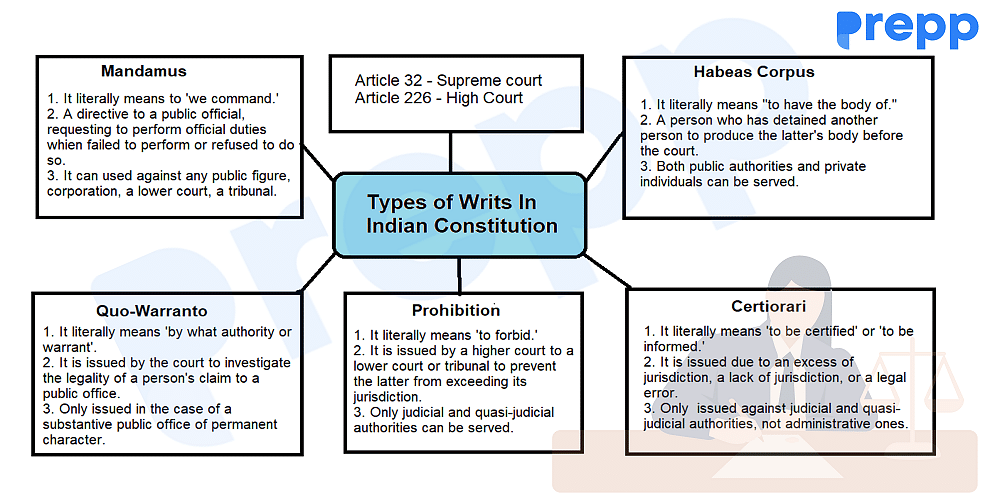 Types of writs
Type of Writs
There are five type of writs in the Indian Constitution that can be issued by the Supreme Court.
Let us look at the details of the respective five types of writs:
| 1. | Habeas Corpus |
| 2. | Mandamus |
| 3. | Prohibition |
| 4. | Certiorari |
| 5 | Quo-Warranto |
|
"Article 32 stands as the guardian of fundamental rights, empowering individuals to seek judicial redress for their constitutional grievances and uphold justice." |

Habeas Corpus
- The Habeas Corpus is also known as "Great Writ" which protects fundamental right guaranteed by Indian constitution against wrongful and indefinite detention.
- It means "show me the body" when translated from Latin.
- To protect individual freedom from arbitrary executive power, habeas corpus has historically been a crucial tool.
- As per Habeas Corpus, thecourt considers the reason for thedetention as well as it legality of detention.
- If the detention is found to be illegal, the detainee will be released. As a result, this writ protects individual liberty from arbitrary detention.
- Both public authorities and private individuals can be served with a writ of habeas corpus.
- The writ, on the other hand, is not issued where:
- the detention is lawful,
- the proceeding is for contempt of a legislature or a court,
- the detention is by a competent court, and
- The detention is outside the court's jurisdiction.
Mandamus
- Mandamus is a court-issued directive to a public official, requesting that he perform his official duties which he failed to perform or refused to do so.
- It can also be used against any public figure, corporation, a lower court, a tribunal, or a government for the purpose of the same goal.
- It literally translates to 'we command.'
- A writ of mandamus cannot be issued when:
- Against a private individual or group;
- To enforce departmental policy that does not have statutory force;
- When the duty is discretionary and not mandatory;
- To compel the execution of a contractual obligation;
- It cannot be issued against the President of India, State Governors and against Chief Justice of High Court acting in judicial capacity.
- Example: When the respondent did not obey the orders of the tribunal, the petitioner approached the supreme court for the enforcement of the orders of the tribunal. The Supreme Court issued a Mandamus ordering the respondent to abide by the orders of the tribunal.
Prohibition
- Writ of Prohibition literally means 'to forbid'.
- Writ of Prohibitionis issued by a higher court to a lower court or tribunal to prevent the latter from exceeding its jurisdiction or usurping jurisdiction that it lacks.
- In contrast to mandamus, which directs activity, the prohibition directs inactivity.
- Only judicial and quasi-judicial authorities can be served with a prohibition writ.
- It cannot be used against administrative authorities, legislative bodies, or private individuals or organisations.
- Example: The Supreme Court directed the lower courts and tribunals to stay the proceedings on the grounds of excess and lack of jurisdiction.
Certiorari
- Write of certiorari literally means 'to be certified' or 'to be informed.'
- Certiorari is issued by a higher court to a lower court or tribunal to either transfer a case pending with the latter or to overturn the latter's order in a case.
- It is issued due to an excess of jurisdiction, a lack of jurisdiction, or a legal error.
- As a result, unlike prohibition, which is only preventative, certiorari is both preventive and curative.
- Previously, the writ of certiorari could only be issued against judicial and quasi-judicial authorities, not administrative ones.
- However, the Supreme Court ruled in 1991 that certiorari can be issued even against administrative authorities affecting individual rights.
- Certiorari, like prohibition, is not available against legislative bodies or private individuals or bodies.
- Example: There is a case before District Court, and the court lacks jurisdiction to hear such matters. Nonetheless, the District Court Judge hears the matter and renders his judgement, and the aggrieved party (by such decision) petitions the High Court. As a result the High Court issued a Writ of Certiorari on the District Court's order, and the District Court's order will be invalidated.
Quo-Warranto
- Quo-Warranto means 'by what authority or warrant'.
- Quo-Warranto is issued by the court to investigate the legality of a person's claim to a public office. As a result, it prevents a person from illegally usurping public office.
- The writ can only be issued in the case of a substantive public office of permanent character established by statute or by the Constitution.
- It cannot be issued in the case of a ministerial or private office.
- Unlike the other four writs, this can be sought by anyone who is interested, not just the aggrieved party.
- Example: A 62-year-old has been appointed to a public office, despite the fact that the retirement age is 60. The competent High Court now has the authority to issue a writ of Quo Warranto against the individual and declare the office vacant.
Significance of Writs
- Writs are essential in the defence of fundamental rights; without them, Part III is worthless since they give the right teeth.
- They are effective checks on the state's excesses, as defined in Article 12.
- The judiciary has used them to construe numerous additional rights as inseparable adjuncts to other basic rights. For example, consider the Maneka Gandhi case from 1978.
- To safeguard fundamental rights Articles 32 and 226 of the Indian Constitution grant the right to petition the Supreme Court or the High Court to anybody whose Fundamental Right has been infringed.
- At the same time, the two articles grant the highest courts in the country the authority to issue writs in order to enforce Fundamental Rights.
- The Indian Constitution's hallmark music is "Social and Economic Justice." It protects basic rights that cannot be waived under normal circumstances.
- To defend these rights, the Constitution provides for writ remedies that are enforced by the High Court and the Supreme Court.
- The award of compensation as part of the relief that can be awarded to the aggrieved individual is an essential aspect of these remedies.
Origin of Writ in India
Constitutional Provisions
|
Difference between Prohibition and Certiorari
Both the Writs Certiorari and the Prohibition look to be the same, yet there are significant differences.
| Prohibition | Certiorari |
|---|---|
|
|
|
|
|
|
|
|
Difference of writ jurisdiction of Supreme Court and High Court
The Supreme Court's writ jurisdiction differs from that of a high court in three ways:
| Writs Jurisdiction of Supreme Court | Writs Jurisdiction of High Court | Remarks |
|---|---|---|
|
|
|
|
|
|
|
|
|
Important Judgements about Writs in India
Sunil Batra v. Delhi Administration
- In this case, the Supreme Court approved an appeal submitted by a co-convict (a stranger) by letter owing to inhumane treatment of inmates.
- The letter was recognized as an application in this case, and a warrant of Habeas Corpus was issued.
Vijaya Mehta v. State of Rajasthan
- In this case, a petition was filed in the High Court requesting that the State perform its duty of appointing a commission to investigate climate change and flooding in the state.
- The Court determined that the State Government would be required to appoint a commission only if a resolution was enacted by the Legislature; moreover, it was a discretionary obligation rather than a mandatory one, hence the Writ of Mandamus was not issued in this instance.
Jamalpur Arya Samaj Sabha v. Dr. D Rama
- In this case, the petitioner filed an application in the Patna High Court for a Writ of Quo Warranto against the Working Committee of the Bihar Raj Arya Samaj Pratinidhi Sabha, a private entity. Because it was not a public position, the court declined to grant the Writ.
Conclusion
All of these writs are an effective method of enforcing people's rights and compelling authorities to perform the duties that they are obligated to perform under the law. As habeas corpus and Quo warranto are limited to specific situations, the two most commonly sought writs to control the actions of administrative bodies are Certiorari and Mandamus.
FAQs
Question: What is the purpose of the writ of Habeas Corpus?
Answer: The writ of Habeas Corpus ensures that a person who is detained is brought before the court to determine whether the detention is lawful, safeguarding personal liberty.
Question: Which writ is issued to compel a public official to perform their duty?
Answer: The writ of Mandamus is issued to compel a public official or authority to perform a duty they are legally obligated to carry out.
Question: How does the writ of Certiorari function?
Answer: The writ of Certiorari is issued by a higher court to quash an order of a lower court or tribunal that has acted beyond its jurisdiction or violated natural justice.
Question: What does the writ of Quo Warranto challenge?
Answer: The writ of Quo Warranto challenges the legality of a person’s claim to a public office and inquires whether they have the legal right to hold the position.
Question: Which writ prevents lower courts from exceeding their jurisdiction?
Answer: The writ of Prohibition is issued by a higher court to prevent a lower court or tribunal from exceeding its jurisdiction or acting contrary to the law.
MCQs
1. Which of the following writs is known as the "Great Writ of Liberty"?
A) Mandamus
B) Habeas Corpus
C) Certiorari
D) Quo Warranto
Answer: (B) See the Explanation
Explanation: Habeas Corpus is known as the "Great Writ of Liberty" because it protects individual freedom by ensuring that a person is not unlawfully detained.
2. A writ issued to a lower court to prevent it from acting beyond its jurisdiction is called:
A) Habeas Corpus
B) Mandamus
C) Prohibition
D) Certiorari
Answer: (C) See the Explanation
Explanation: The writ of Prohibition is issued by a higher court to prevent a lower court or tribunal from acting beyond its legal authority.
3. The writ of Quo Warranto can be issued against which of the following?
A) A person unlawfully occupying public office
B) A person in police custody
C) A private company violating government norms
D) A public official neglecting their duties
Answer: (A) See the Explanation
Explanation: The writ of Quo Warranto can be issued to challenge a person who is unlawfully occupying a public office without the legal authority to do so.
4. Which writ is used to quash an order passed by a lower court?
A) Prohibition
B) Habeas Corpus
C) Certiorari
D) Mandamus
Answer: (C) See the Explanation
Explanation: The writ of Certiorari is used by a higher court to quash an order passed by a lower court or tribunal that acted without or in excess of its jurisdiction.
5. Which writ directs a public official or government body to perform their duty?
A) Certiorari
B) Mandamus
C) Prohibition
D) Habeas Corpus
Answer: (B) See the Explanation
Explanation: The writ of Mandamus is used to direct a public official, lower court, or government body to perform a duty that they are legally obligated to do.
GS Mains Questions and Model Answers
Q1: Discuss the significance of writs in the protection of Fundamental Rights in India.
Answer: Writs are essential legal instruments for safeguarding Fundamental Rights in India. Enshrined under Articles 32 and 226 of the Constitution, writs provide individuals with a direct mechanism to approach the courts in case of rights violations. Writs like Habeas Corpus, Mandamus, and Certiorari ensure that the state and its functionaries remain accountable for their actions, preventing unlawful detentions, non-performance of duties, and overreach by authorities. By empowering citizens to seek judicial redress, writs promote the rule of law and uphold the integrity of constitutional democracy in India.
Q2: Analyze the role of the writ of Habeas Corpus in safeguarding personal liberty.
Answer: The writ of Habeas Corpus plays a critical role in protecting personal liberty by ensuring that no person is detained unlawfully. It allows the courts to intervene in cases of illegal detentions and secure the release of individuals who have been imprisoned without valid reasons. This writ acts as a powerful check against arbitrary arrests and misuse of power by law enforcement agencies, ensuring that the right to life and personal liberty, as guaranteed by Article 21 of the Constitution, is upheld. Historically, Habeas Corpus has been instrumental in preserving the balance between state authority and individual freedom.
Q3: Evaluate the differences between the writs of Certiorari and Prohibition.
Answer: Both Certiorari and Prohibition are judicial writs aimed at controlling the actions of lower courts and tribunals, but they differ in their purpose and timing. The writ of Certiorari is issued to quash a decision already made by a lower court or tribunal when it has acted without jurisdiction or violated the principles of natural justice. In contrast, the writ of Prohibition is preventive in nature and is issued to stop a lower court or tribunal from proceeding with a case that falls outside its jurisdiction. While Certiorari is corrective, Prohibition is preventive, ensuring that the judiciary remains within its legal boundaries.
Previous Year Questions on Writs in India
1. UPSC CSE Prelims 2019
Question: Which of the following writs can be issued to prevent a lower court from exceeding its jurisdiction?
A) Habeas Corpus
B) Mandamus
C) Prohibition
D) Certiorari
Answer: C
Explanation: The writ of Prohibition is issued by a higher court to prevent a lower court or tribunal from exceeding its jurisdiction.
2. UPSC CSE Mains 2020 (GS Paper 2)
Question: Discuss the constitutional significance of the writ of Habeas Corpus in the context of the protection of personal liberty in India.
Answer: The writ of Habeas Corpus holds immense constitutional significance in protecting personal liberty in India. It empowers individuals to challenge illegal detention by requiring the detaining authority to justify the legality of the detention before a court. This writ ensures that no person is deprived of their liberty without due process of law, thereby enforcing the fundamental right to life and liberty guaranteed under Article 21 of the Constitution. Habeas Corpus acts as a safeguard against state overreach and misuse of power, making it a cornerstone of individual rights protection in India.
*email: contactus@prepp.in
Download the PREPP App and attempt FREE IAS Exam Mock Tests and get complete study material!

Full Test - 04: UPSC CSE Prelims CSAT (Paper-II)
Full Test - 03: UPSC CSE Prelims CSAT (Paper-II)
UPSC CSE Prelims 2026 GS Paper 1 Question Paper (24-May-2026)
UPSC CSE Prelims 2026 CSAT Paper 2 Question Paper (24-May-2026)

17 February 2025 | The Hindu Must Read Articles | Current Affairs

16 February 2026 | The Hindu Must Read Articles | Current Affairs

13 February 2026 | The Hindu Must Read Articles | Current Affairs









Comments