Right to Property - Meaning, Evolution, 44th Amendment, SC Judgements, Significance - Indian Polity Notes
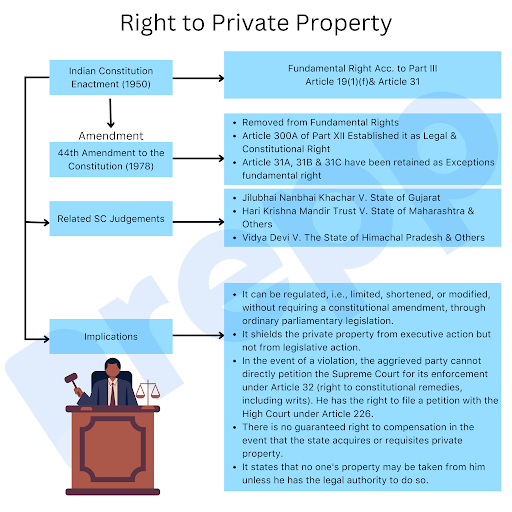
Right to property was a fundamental right in the Indian Constitution until it was amended in 1978. Article 19(1)(f) and Article 31 dealt with it. The 44th Amendment Act of 1978 abolished the right to property as a Fundamental Right by repealing Articles from Part III. Instead, the Act added a new Article 300A under the heading 'Right to Property' to Part XII. The right to property is still a legal or constitutional right, but it is no longer a fundamental right. It is not a part of the Constitution's basic structure.
This article explains Right to property is important for UPSC IAS exam preparation.
|
Table of Contents |

Right To Property – Meaning
- The right to property is a person's natural and intrinsic right. The right to property is recognised in the majority of contemporary constitutions, with the exception of those of communist nations. Citizens thus have the legal right to acquire and possess the property. This individual right clashes with the government's property rights.
- A right to property is recognized in Article 17 of the Universal Declaration of Human Rights, but it is not recognised in the International Covenant on Civil and Political Rights or the International Covenant on Economic, Social and Cultural Rights.
- Though the Fundamental Right to Property under Part III has been repealed, Part III still contains two provisions that guarantee the right to compensation in the event of the state's acquisition or requisition of private property. It states that no one's property may be taken from him unless there is legal authority to do so.
- Following are the two instances where compensation is paid:
- When the State acquires the property of a minority educational institution (Article 30);
- This provision was added by the 44th Amendment Act (1978).
- When the State acquires land under personal cultivation held by a person and the land is within the statutory ceiling limits (Article 31 A). This provision was added by the 17th Amendment Act (1964).
| Right to property in India implies that person's right to property would be violated if he/she forcibly expelled from the property without following the due process of law set forth in Article 300 A of the Constitution. |
How 44th Amendment 1978 changed Right to Property?
- Under Article 31, the right to property remained a fundamental right till the 44th Amendment in 1978 was done.
- According to Article 31(2), the Government would only be granted the right to seize private property and utilise it only for public purposes once the person receiving the property received the appropriate compensation from the Government.
- Private property could only be taken by the government with the power of law, not an executive order, according to Article 31(1) of the Constitution.
- As citizens began petitioning the courts during the Government's land acquisition, the aforementioned regulations were blocking the Government from implementing public infrastructure projects and other agrarian reforms.
- As a result, an amendment to the Indian Constitution was made in 1978.
- The Right to Property was proclaimed to no longer be a Fundamental Right by the 44th amendment to the Indian Constitution.
- With the aid of the 44th Amendment, Article 31 and Article 19(1)(f) were entirely eliminated from Part III - Fundamental Rights of the Constitution.
- The Supreme Court reminded the State Government that before taking someone else's private property, the State had to adhere to legal authority and correct procedure. In accordance with the rules outlined in Article 300A, this must be done.
Constitutional Provisions Related To The Right To Property
- The right to property was removed from the list of Fundamental Rights by the 44th Amendment Act of 1978.
- Article 300-A of Part XII of the Constitution establishes it as a legal right.
- Articles 31A, 31B, and 31C have been retained as exceptions to the fundamental rights.
Criticism of Right to Property
- The Fundamental Right to Property has been the most controversial since the beginning of the Constitution.
- It has resulted in clashes between the Supreme Court and Parliament.
- It has resulted in several constitutional amendments, including the 1st, 4th, 7th, 25th, 39th, 40th, and 42nd Amendments.
- Articles 31A, 31B, and 31C have been added and modified over time to nullify the effect of Supreme Court judgments and to protect certain laws from being challenged on the basis of violation of Fundamental Rights.
- The majority of the litigation is centred on the state's obligation to pay compensation for the acquisition or requisition of private property.
Right To Property Related SC Judgements
Jilubhai Nanbhai Khachar v. State of Gujarat
It was determined that the right to property under Article 300A is not a basic structure of the Constitution. It is only a constitutional right.
Hari Krishna Mandir Trust v. the State of Maharashtra and Others
The Supreme Court ruled that the appellant could not be deprived of his strip of land, which was a private road, without the authority of law, which if allowed would be a violation of Art. 300A of the Constitution of India.
Vidhya Devi v. The State of Himachal Pradesh & Ors.
- The Supreme Court ruled that the right to own private property is a human right that cannot be denied.
- The party denying one's right to property must have legal authority.
- In this case, the plaintiff was compensated for the incorrect acquisition of property by the state.
Implications of the Right to Property as a Legal Right
- It can be regulated, i.e., limited, shortened, or modified, without requiring a constitutional amendment, through ordinary parliamentary legislation.
- It shields private property from executive action but not from legislative action.
- In the event of a violation, the aggrieved party cannot directly petition the Supreme Court for its enforcement under Article 32 (right to constitutional remedies, including writs). He has the right to file a petition with the High Court under Article 226.
- There is no guaranteed right to compensation in the event that the state acquires or requisites private property.
- It states that no one's property may be taken from him unless he has legal authority to do so.
Significance of Right to Property
- Economic Growth: It encourages investment and economic growth. It ensures a person's freedom if the government is unable to seize their property. Additionally, it encourages private investment in the infrastructure sector.
- Security: People can pursue their businesses because their property is secure. A farmer, for example, wouldn't cultivate crops or further develop his land if he knew that the government may seize it.
- Important to eradicate poverty and empower the Vulnerable section: Without effective land tenure arrangements, economies run the risk of losing the building blocks for long-term expansion, endangering the livelihoods of the most vulnerable and underprivileged people. Without achieving significant advancement in land and property rights, it is simply impossible to eradicate poverty and increase shared wealth.
- Can prevent Large informal Settlements: The urban poor may not be able to afford properties due to rising property values as a result of the failure to clarify land rights and correct unfair land policies. Large informal settlements have already grown as a result of these gaps in several places all over the world.
- Can ensure women’s right to property: The legal system does not fully allow equal access to property ownership or the use of land titles as collateral without a male guardian, which continues to deny land rights to many women throughout the world.
- Help in recognising the rights of Indigenous People: In addition to being a matter of human rights, recognising the land rights of indigenous peoples is also sensible from an economic and environmental standpoint. Indigenous peoples will be able to exploit the resources on their land more sustainably if their land rights are acknowledged, which will raise their economic and social status and make them a more positive influence in society.
Conclusion
Due to the excessive possession of land by zamindars and tenants, the legal status of the right to freedom was changed from a fundamental right to a constitutional right in order to avoid the situation of zamindars and other landowners misusing the right to property as a fundamental right against state measures to acquire land and to implement land ceiling laws in India. Nonetheless, as a constitutional right, this right is available to all persons and can be invoked in high court under Article 226 of the Indian Constitution.
FAQs
Question: What was the status of the right to property under the original Constitution of India?
Answer: The right to property was a fundamental right under Article 19(1)(f) and Article 31 of the Constitution.
Question: Which Constitutional Amendment removed the right to property as a fundamental right?
Answer: The 44th Constitutional Amendment Act, 1978 removed the right to property from the list of fundamental rights.
Question: What is the current status of the right to property in India?
Answer: The right to property is now a constitutional right under Article 300A.
Question: Can a violation of property rights be challenged directly in the Supreme Court?
Answer: No, since it is no longer a fundamental right, property disputes must be taken to the High Courts under Article 226.
Question: What is the significance of Article 300A in the Indian Constitution?
Answer: Article 300A protects individuals from being deprived of their property, except by the authority of law, making it a constitutional safeguard.
MCQs
1. Under which Article is the right to property currently recognized?
A. Article 14
B. Article 19
C. Article 300A
D. Article 31
Answer: (C) See the Explanation
Article 300A, introduced by the 44th Constitutional Amendment, grants the right to property as a constitutional right, not a fundamental right.
2. Which Amendment removed the right to property from the list of fundamental rights?
A. 24th Amendment
B. 42nd Amendment
C. 44th Amendment
D. 52nd Amendment
Answer: (C) See the Explanation
The 44th Constitutional Amendment Act, 1978, removed the right to property from the list of fundamental rights, making it a constitutional right.
3. Can the right to property be taken directly to the Supreme Court under Article 32?
A. Yes
B. No
C. Only in cases involving compensation
D. Only in cases of state acquisition
Answer: (B) See the Explanation
Since the right to property is no longer a fundamental right, disputes over property must be addressed by High Courts under Article 226.
4. Which Article originally provided for the right to acquire, hold, and dispose of property?
A. Article 14
B. Article 19(1)(f)
C. Article 21
D. Article 31
Answer: (B) See the Explanation
Article 19(1)(f), which was part of the original Constitution, provided the right to acquire, hold, and dispose of property, but it was repealed by the 44th Amendment.
5. What does Article 300A of the Indian Constitution state?
A. Right to equal protection of the laws
B. No person shall be deprived of his property save by authority of law
C. Right to freedom of speech and expression
D. No person shall be denied personal liberty except by procedure established by law
Answer: (B) See the Explanation
Article 300A protects property rights as a constitutional right, requiring lawful authority for deprivation of property.
GS Mains Questions and Model Answers
Q1: Discuss the significance of the 44th Constitutional Amendment in relation to the right to property. How has it impacted the legal framework of property rights in India?
Answer: The 44th Constitutional Amendment Act, 1978, marked a significant shift by removing the right to property from the list of fundamental rights and placing it under Article 300A as a constitutional right. This amendment allowed the state to pursue land reforms and public welfare projects without facing extensive judicial interference. However, it also reduced the protection previously available to property owners. While compensation is not mandatory, the courts have played a crucial role in ensuring that acquisitions are not arbitrary. Thus, the amendment strikes a balance between the state’s need for economic justice and individual property rights.
Q2: Analyze the judicial interpretation of the right to property post-44th Amendment. How has the Supreme Court dealt with cases of property acquisition?
Answer: Post-44th Amendment, the right to property remains a constitutional right, and courts have emphasized the importance of procedural fairness in property acquisition cases. In cases like Tukaram Kana Joshi v. Maharashtra Industrial Development Corporation (2013), the Supreme Court reiterated that while the right to property is no longer fundamental, it remains protected against arbitrary action. The judiciary has maintained the requirement that state acquisition must follow due process, ensuring that property rights are not infringed without adequate legal authority.
Q3: Compare the right to property under the original Constitution and its current status. How has this transition affected the balance between individual rights and state authority?
Answer: Under the original Constitution, the right to property was a fundamental right under Article 19(1)(f) and Article 31, giving it strong legal protection. The transition to a constitutional right under Article 300A through the 44th Amendment allowed the state greater flexibility in acquiring property for public purposes. This change was essential for land reforms but reduced individual protections. The balance has shifted in favor of the state’s ability to implement social justice and economic reforms, though the judiciary continues to safeguard against arbitrary acquisitions.
Previous Year Questions from Right to Property
1. UPSC CSE Prelims 2018
Question: Which Constitutional Amendment Act removed the right to property as a fundamental right?
A. 24th Amendment
B. 42nd Amendment
C. 44th Amendment
D. 52nd Amendment
Answer: C
Explanation: The 44th Constitutional Amendment Act, 1978, removed the right to property as a fundamental right and established it as a constitutional right under Article 300A.
2. UPSC CSE Mains 2019 (GS Paper 2)
Question: Discuss the current status of the right to property in India and how the judiciary has protected this right post-44th Amendment.
Explanation: Post the 44th Constitutional Amendment, the right to property was moved from fundamental rights to constitutional rights under Article 300A. While individuals cannot directly approach the Supreme Court for property rights violations, the judiciary has ensured procedural fairness in acquisition cases. The Supreme Court has held that although compensation is no longer guaranteed by law, arbitrary deprivation of property is not allowed.
Download the PREPP App and attempt FREE IAS Exam Mock Tests and get complete study material!

Full Test - 04: UPSC CSE Prelims CSAT (Paper-II)
Full Test - 03: UPSC CSE Prelims CSAT (Paper-II)
UPSC CSE Prelims 2026 GS Paper 1 Question Paper (24-May-2026)
UPSC CSE Prelims 2026 CSAT Paper 2 Question Paper (24-May-2026)

17 February 2025 | The Hindu Must Read Articles | Current Affairs

16 February 2026 | The Hindu Must Read Articles | Current Affairs

13 February 2026 | The Hindu Must Read Articles | Current Affairs









Comments