Enforcement of the Constitution - Indian Polity Notes
Constitution of India came into effect on 26th November 1949. A special committee was constituted to draft the Constitution. The Constitution was enforced on 26th January 1950. Enforcement is the process of ensuring that people follow a law or rule, or that a specific event occurs or is accepted. The act of enforcing the Constitution's laws and processes is known as constitutional enforcement.
The enforcement of the Constitution refers to the legal process and mechanisms through which the principles, rights, and duties outlined in the Constitution are applied, upheld, and protected by governmental institutions, ensuring its adherence across the country. The Indian Constitution was enforced on 26th January 1950.
|
Table of Contents |
Enforcement of the Constitution – Historical Background
- The Indian Constitution came into effect on January 26, 1950. The Assembly ceased to exist on that date but it continued as the Provisional Parliament of India until a new Parliament came into reality in 1952.
- The 26th of January was chosen to commemorate the momentous day in 1930 when Purna Swaraj was celebrated and the tri color flag of Indian independence was unfurled following a resolution of the Indian National Congress's Lahore Session (December 1929).
|
" Constitution of India, enforced on January 26, 1950, stands as a beacon of democratic principles”
|
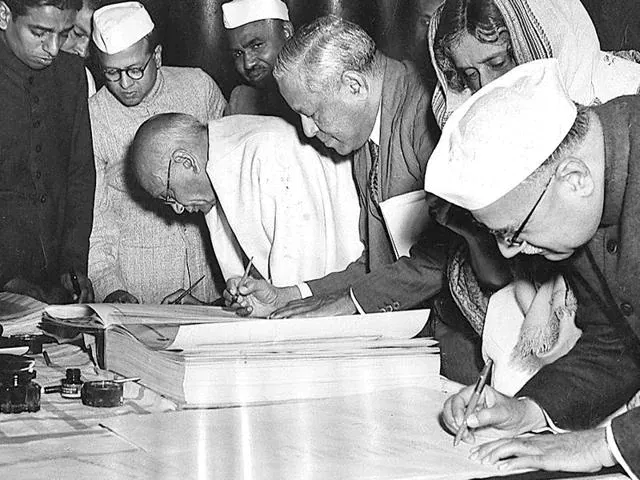
Enforcement of the Constitution
Articles 5, 6, 7, 8, 9, 60, 324, 366, 367, 379, 380, 388, 391, 392 and 393 of the Constitution relating to citizenship, elections, provisional parliament, temporary and transitional measures, and the short title came into effect on November 26, 1949.
The Constitution's remaining clauses (the majority) went into effect on January 26, 1950. The Constitution refers to this day as the "day of its start," and it is celebrated as Republic Day.
Because of its historical significance, January 26 was chosen as the Constitution's 'day of commencement.' Purna Swaraj Day was observed on this day in 1930, following a resolution passed by the INC's Lahore Session (December 1929).
Conclusion
The Indian Independence Act of 1947 and the Government of India Act of 1935, as well as all enactments modifying or supplementing the latter Act, were repealed when the Constitution came into effect. However, the Privy Council Jurisdiction Abolition Act (1949) was not repealed.
FAQs
Question: What is meant by the 'enforcement of the Constitution'?
Answer: The enforcement of the Constitution refers to the implementation and adherence to the provisions, laws, rights, and duties enshrined in the Constitution of India. It ensures that all citizens, governments, and institutions operate within the framework of constitutional principles and that justice is delivered as per its directives.
Question: How does the judiciary play a role in the enforcement of the Constitution?
Answer: The judiciary plays a crucial role in enforcing the Constitution by interpreting its provisions, protecting fundamental rights, and ensuring that all laws and government actions are constitutional. The Supreme Court and High Courts have the power of judicial review to strike down any law or action that violates constitutional principles.
Question: What is meant by the 'Rule of Law' in the context of constitutional enforcement?
Answer: The 'Rule of Law' is a fundamental principle in the Constitution that emphasizes the supremacy of law over any individual, equality before the law, and protection of fundamental rights. It ensures that all actions of the state and citizens are governed by the Constitution and the legal system.
Question: What are Directive Principles of State Policy (DPSP) and their role in constitutional enforcement?
Answer: Directive Principles of State Policy are non-justiciable guidelines for the State to establish social and economic justice, as provided in Part IV of the Constitution. While they are not enforceable by the courts, they aim to create a welfare state and influence laws and policies for the betterment of society.
Question: What mechanisms exist to ensure the enforcement of fundamental rights?
Answer: Fundamental rights are enforced through the writ jurisdiction of the Supreme Court and High Courts under Articles 32 and 226. Citizens can approach these courts directly for the enforcement of their rights, making it a key mechanism to protect individual liberties and maintain constitutional supremacy.
MCQs
- Which part of the Constitution deals with the enforcement of fundamental rights?
A) Part III
B) Part IV
C) Part V
D) Part II
Answer: (A) See the Explanation
Part III of the Indian Constitution deals with fundamental rights and their enforcement, providing citizens with various protections and the ability to seek judicial remedies.
- Which Article allows citizens to directly approach the Supreme Court for enforcement of fundamental rights?
A) Article 14
B) Article 32
C) Article 226
D) Article 21
Answer: (B) See the Explanation
Article 32 of the Constitution allows citizens to directly approach the Supreme Court for the enforcement of fundamental rights through writs such as habeas corpus, mandamus, prohibition, certiorari, and quo warranto.
- The Directive Principles of State Policy (DPSP) are found in which part of the Constitution?
A) Part II
B) Part III
C) Part IV
D) Part V
Answer: (C) See the Explanation
Directive Principles of State Policy are enumerated in Part IV of the Indian Constitution, providing guidelines to the State for social and economic policies but are non-justiciable.
- What is the primary role of the judiciary in enforcing the Constitution?
A) Making laws
B) Interpreting and ensuring adherence to the Constitution
C) Implementing government policies
D) Enacting ordinances
Answer: (B) See the Explanation
The judiciary interprets and enforces the Constitution by reviewing laws and actions to ensure they are constitutional, thereby protecting the rights of citizens.
- Which of the following is an example of a writ issued by the courts to enforce rights?
A) Ordinance
B) Mandamus
C) Directive
D) Notification
Answer: (B) See the Explanation
Mandamus is a writ issued by the courts to command a public authority to perform its legal duties and enforce rights.
GS Mains Questions and Model Answers
Q1: Explain the significance of the judiciary in the enforcement of the Indian Constitution.
Answer: The judiciary is pivotal to the enforcement of the Indian Constitution. It acts as the guardian and interpreter of the Constitution, ensuring that its provisions are upheld and adhered to by all branches of government and citizens. Through the power of judicial review, the Supreme Court and High Courts have the authority to invalidate any law or action that contravenes constitutional principles. The judiciary also protects fundamental rights by enabling citizens to directly seek redressal through writ petitions. Landmark cases such as Kesavananda Bharati and Maneka Gandhi have demonstrated the judiciary's role in expanding constitutional interpretations and safeguarding democracy.
Q2: Discuss the importance of Directive Principles of State Policy (DPSP) in achieving social and economic justice in India.
Answer: The Directive Principles of State Policy (DPSP), enshrined in Part IV of the Constitution, aim to establish social and economic justice in India by guiding the State in formulating policies and laws. Though not enforceable by the courts, DPSPs hold moral and political significance, promoting values such as equitable wealth distribution, protection of labor rights, and health and education for all. They have influenced various laws and welfare schemes like the Mahatma Gandhi National Rural Employment Guarantee Act (MGNREGA) and midday meal schemes. By setting broad socio-economic goals, DPSPs complement fundamental rights and help achieve a more inclusive and just society.
Q3: Analyze the role of fundamental rights in ensuring constitutional enforcement in India.
Answer: Fundamental rights, provided in Part III of the Constitution, are essential for constitutional enforcement as they guarantee basic liberties and protect individuals from state overreach. These rights empower citizens to seek judicial redress in case of violations, ensuring accountability and adherence to constitutional norms. The Supreme Court and High Courts act as custodians of these rights, issuing writs under Articles 32 and 226 to enforce compliance. This legal framework promotes democratic values, protects against discrimination, and upholds individual dignity, thereby strengthening constitutional governance.
Previous Year Questions on Enforcement of the Constitution
1. UPSC CSE - 2021
Question: "What is the role of judicial review in the enforcement of the Indian Constitution?"
Answer: Judicial review is a critical tool for enforcing the Indian Constitution. It empowers the judiciary, particularly the Supreme Court and High Courts, to review and invalidate laws, policies, and executive actions that violate constitutional provisions. By ensuring that all actions adhere to constitutional norms, judicial review upholds the rule of law, protects individual rights, and maintains the balance of power between the State's organs. It plays a central role in safeguarding democracy and preventing the arbitrary exercise of power, as evident in landmark cases like Marbury v. Madison in the US context and Kesavananda Bharati in India.
2. UPSC CSE - 2019
Question: "Examine the challenges associated with the enforcement of fundamental rights in India."
Answer: Enforcing fundamental rights in India faces challenges such as delayed justice due to an overburdened judiciary, socio-economic disparities limiting access to justice, and the need for awareness among citizens about their rights. Political interference, inadequate infrastructure, and the complexity of legal processes further complicate enforcement. Despite these challenges, writ petitions and public interest litigations (PILs) have enhanced accessibility to justice. Addressing systemic issues, improving legal aid, and strengthening judicial capacity are crucial for effective rights enforcement and maintaining constitutional integrity.
*email: contactus@prepp.in
Download the PREPP App and attempt FREE IAS Exam Mock Tests and get complete study material!

Full Test - 04: UPSC CSE Prelims CSAT (Paper-II)
Full Test - 03: UPSC CSE Prelims CSAT (Paper-II)
UPSC CSE Prelims 2026 GS Paper 1 Question Paper (24-May-2026)
UPSC CSE Prelims 2026 CSAT Paper 2 Question Paper (24-May-2026)

17 February 2025 | The Hindu Must Read Articles | Current Affairs

16 February 2026 | The Hindu Must Read Articles | Current Affairs

13 February 2026 | The Hindu Must Read Articles | Current Affairs









Comments