Determinants of Morality – Ethics Notes
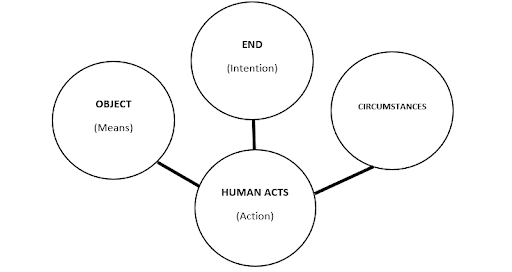
The determinants are essential features of morality that indicate whether an action is right or wrong. It allows us to recognise the uniqueness of morality. Only human beings act for a reason, a purpose, and an intention or goal because only human beings are endowed with intelligence and the ability to choose between good and evil. The three moral determinants are the Object of the Act, the Circumstance surrounding the Act and the End or Intention of the Act. In this article we will discuss Determinants of Morality which will be helpful for UPSC exam Ethics, Integrity & Aptitude (GSIV) preparation.
Table of Contents
What are the Determinants of Morality?
1) Object of the Human Act
- Every action has an object that defines it and distinguishes it from other actions.
- The object can be good, bad, or indifferent, which means it is neither good nor bad.
- Telling the truth is right; telling lies is wrong. Truth is good by definition, and lying is bad by definition.
- The three principles that apply to any action are as follows:
- An action with a bad object by definition will always be bad. Neither circumstance, intention, or purpose can change the inherent or intrinsic badness of an action with a bad object.
- A good action can become bad due to circumstances or intention.
- For example, telling the truth is a good act; however, destroying another person's good name or character is a morally bad act due to the speaker's purpose or intention.
- An indifferent action (neither good nor bad) can become good or bad depending on the circumstances or purpose.
- Running is neither good nor bad in and of itself. However, rushing to an ATM to rob it is not a good idea. It is a good run if it is into a burning house to rescue trapped children.
2) Circumstances surrounding the Human Act
- By circumstances, we mean the characteristics that give abstract actions their distinct, concrete content.
- They refer to the time and place of an action, the agent performing the action, and the manner in which the act is performed.
- The rightness or wrongness of actions is determined by moral rather than physical circumstances.
- Opening a bank safe for the purpose of withdrawing cash for normal transactions is a normal function; however, opening a bank safe for the purpose of theft is immoral (and a crime).
- Some circumstances aggravate or worsen the severity of an action.
- Misappropriating Rs 20,000 from a widow's account is far worse than misappropriating the same amount from the account of a wealthy stockbroker.
- The badness of an action is exacerbated in the first instance.
- Extenuating circumstances can also reduce the evil character of actions.
- Robberies become less immoral if a robber acts like Robin Hood by stealing from the rich to help the poor.
- However, the actions in both examples remain immoral.
- Circumstances specify when they transform indifferent actions into good or bad, or when they impart a new type of goodness or badness to an action.
- As a result, when someone throws stones at random without aiming at anyone in particular, his actions are indifferent. However, if he throws stones with the intent of hitting a dog or a cat, he is acting immorally.
3) End or Intention of the Agent Performing the Act
- The end is the purpose or intention that moral agents have in mind when performing an act. An action can have one or more outcomes.
- A neutral act can be good or bad depending on its purpose.
- One can learn computer skills to play games and pass the time. This action has no moral implications.
- One can learn computer skills to assist an elderly home with its work. This is a wise decision.
- One could learn computer skills in order to hack into bank accounts. This is unethical.
- An action with a good object can become more or less good depending on its goals.
- Giving a subscription to a worthy cause is a good thing to do. However, if it is done solely to get rid of the person seeking subscription, the action is not as effective as before.
- If the subscription is given with the intention of later inciting the person seeking the subscription to engage in undesirable activities, the action is immoral.
- Depending on the moral agent's goal, an inherently wrong action may become a greater or lesser wrong.
- It is wrong to tell a lie. However, telling lies in order to falsely implicate someone in a crime is a far greater sin.
- However, if someone lies in order to help an innocent man in trouble, the action is still wrong, but its gravity is reduced.
- As previously stated, an inherently bad act can never be made good.
- Furthermore, bad means cannot be used to achieve good results. Both ends and means must be beneficial.
| Other Relevant Links | |
|---|---|
| Ethical Ideals in Life | Aspects of Morals |
| Definition of Ethics | Moral subjectivism |
| Cultural relativism | Sceptical doctrines |
| Challenges To Ethics and Moral Accountability | Character in Ethics |
| Pyschological egosim | Plato |
| Socrates | Aristotle |
Conclusion
Moralists believe that a human act is morally good when it is good in its object, circumstances, and intention, and that an action is good when each of these three factors is in order (Bonum ex integra causa). If even one of these determinants is against the rules, the action will be flawed (Malum ex quocumque defectu).
| Other Relevant Links | |
|---|---|
| Post Aristotelian Philosophers | Western Moral Thinkers |
| Epicureanism | Stoicism |
| Utilitarianism | Ethical Ideas in Indian Philosophical Tradition |
| Lessons From The Lives Of Great Indian Leaders, Reformers And Administration | Moral Thinkers of the Twentieth Century |
FAQs
Question: What are the determinants of morality in ethics?
Answer: The determinants of morality in ethics refer to the factors that influence human behavior and decision-making, such as cultural norms, societal values, personal beliefs, and the consequences of actions. These factors help shape what individuals or societies perceive as right or wrong.
Question: How does culture influence moral decisions?
Answer: Culture plays a significant role in shaping moral decisions by establishing societal norms and values that guide individuals' actions. Cultural differences in moral perspectives often lead to varying interpretations of right and wrong across societies.
Question: What is the role of personal conscience in determining morality?
Answer: Personal conscience serves as an internal guide for making moral judgments. It involves an individual's sense of right and wrong, which may be influenced by upbringing, personal experiences, and self-reflection.
Question: How do consequences play a role in moral decision-making?
Answer: Consequences play a crucial role in moral decision-making as individuals often consider the potential outcomes of their actions. A moral decision is typically influenced by whether the consequences are beneficial or harmful to others.
Question: What is the relationship between ethical theories and the determinants of morality?
Answer: Ethical theories, such as utilitarianism, deontology, and virtue ethics, provide frameworks for understanding morality. These theories guide how individuals interpret the determinants of morality, such as cultural norms, personal beliefs, and the consequences of actions, to make ethical decisions.
MCQs
1. Which of the following is considered a determinant of morality in ethics?
A) Cultural norms
B) Personal beliefs
C) Societal values
D) All of the above
Answer: (D) See the Explanation
Explanation: The determinants of morality include cultural norms, personal beliefs, and societal values, all of which influence the way individuals and societies define what is morally right or wrong.
2. How does culture affect moral judgments?
A) It establishes universal moral truths
B) It shapes societal norms and influences what is considered right or wrong
C) It has no impact on morality
D) It only affects personal preferences
Answer: (B) See the Explanation
Explanation: Culture shapes societal norms and values, influencing individuals' moral judgments by providing guidelines on what is considered right or wrong within a particular community.
3. What role does personal conscience play in determining morality?
A) It helps individuals make moral decisions based on internal judgment
B) It has no influence on moral decision-making
C) It only reflects societal expectations
D) It is irrelevant to moral considerations
Answer: (A) See the Explanation
Explanation: Personal conscience helps individuals make moral decisions by guiding them based on their internal sense of right and wrong, which is shaped by experiences, upbringing, and personal reflection.
4. How does the consideration of consequences influence moral decisions?
A) It leads to decisions based only on self-interest
B) It encourages individuals to consider the outcomes of their actions on others
C) It disregards ethical principles
D) It has no impact on moral reasoning
Answer: (B) See the Explanation
Explanation: Considering the consequences of actions helps individuals make moral decisions by weighing the potential impact of their actions on others, leading to ethical outcomes that promote well-being.
5. Which ethical theory focuses on moral duties and rules in determining morality?
A) Utilitarianism
B) Deontology
C) Virtue ethics
D) Relativism
Answer: (B) See the Explanation
Explanation: Deontology is an ethical theory that focuses on moral duties and rules, asserting that actions are morally right if they follow prescribed rules or duties, regardless of the consequences.
GS Mains Questions and Model Answers
Q1: Discuss the factors that determine morality and how they influence ethical decision-making.
Answer: Morality is determined by several factors, including cultural norms, societal values, personal beliefs, and the consequences of actions. Cultural norms and societal values shape individuals' understanding of right and wrong, while personal beliefs offer internal guidelines for moral decisions. Additionally, the consideration of consequences—whether they benefit or harm others—also plays a crucial role. Ethical theories, such as deontology, utilitarianism, and virtue ethics, help individuals navigate these determinants by providing frameworks for making moral judgments. Overall, these factors interact to guide individuals in making ethical choices that align with personal and societal expectations.
Q2: How do cultural norms influence moral behavior and decision-making? Provide examples from different cultures.
Answer: Cultural norms have a significant impact on moral behavior and decision-making by defining what is considered acceptable or unacceptable within a society. In collectivist cultures, such as those in East Asia, moral behavior often emphasizes group harmony, respect for authority, and family loyalty. In contrast, individualistic cultures, like those in Western societies, may prioritize personal freedom and individual rights. For example, in some cultures, honesty may be seen as a fundamental moral value, while in others, maintaining social harmony may take precedence, even if it involves concealing certain truths. These variations highlight how cultural context shapes moral decision-making.
Q3: Explain the role of consequences in moral reasoning and ethical decision-making. How do ethical theories address this aspect?
Answer: Consequences play a crucial role in moral reasoning and ethical decision-making, as individuals often assess the outcomes of their actions before deciding what is morally right. Consequentialist ethical theories, such as utilitarianism, argue that the morality of an action depends on its outcomes—actions that maximize well-being are considered morally right. In contrast, deontological ethics focuses on following moral duties and rules, regardless of the consequences. Virtue ethics emphasizes developing good character traits that naturally lead to morally right decisions. Each theory provides a different perspective on the importance of consequences in shaping ethical behavior.
Previous Year Questions on Determinants of Morality
1. UPSC CSE Mains 2017 (GS Paper 4):
Question: "Discuss the impact of personal beliefs and cultural norms in shaping an individual's moral decisions. How do these factors affect the moral outcomes of actions?"
Answer: Personal beliefs and cultural norms significantly shape an individual's moral decisions. Personal beliefs, such as religious values or philosophical principles, provide an internal compass for distinguishing right from wrong. Cultural norms, on the other hand, offer societal guidelines, influencing individuals to conform to practices considered ethical in their society. These factors interact to affect moral outcomes, as decisions often reflect a balance between personal convictions and societal expectations, guiding individuals towards actions that are deemed morally acceptable within their cultural context.
2. UPSC CSE Mains 2019 (GS Paper 4):
Question: "Evaluate the significance of consequences in moral decision-making. How do different ethical theories address the role of consequences in ethical reasoning?"
Answer: The significance of consequences in moral decision-making is emphasized in consequentialist theories such as utilitarianism, which asserts that actions are morally right if they result in the greatest good for the greatest number. In contrast, deontological ethics maintains that actions should be guided by duties and principles, regardless of their outcomes. Virtue ethics, on the other hand, emphasizes the development of virtuous character traits that lead to morally right decisions. Each ethical theory offers a distinct perspective on how consequences influence moral reasoning, highlighting the complexities of ethical decision-making in real-world scenarios.
Download the PREPP App and attempt FREE IAS Exam Mock Tests and get complete study material!

Full Test - 04: UPSC CSE Prelims CSAT (Paper-II)
Full Test - 03: UPSC CSE Prelims CSAT (Paper-II)
UPSC CSE Prelims 2026 GS Paper 1 Question Paper (24-May-2026)
UPSC CSE Prelims 2026 CSAT Paper 2 Question Paper (24-May-2026)

17 February 2025 | The Hindu Must Read Articles | Current Affairs

16 February 2026 | The Hindu Must Read Articles | Current Affairs

13 February 2026 | The Hindu Must Read Articles | Current Affairs









Comments