Cultural Relativism - Ethics Notes
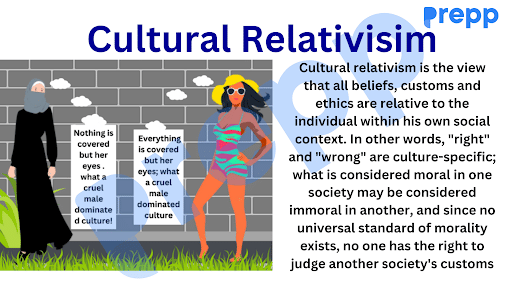
Cultural relativism refers to not judging others' culture ethically to our own standards of what is right or wrong, strange or normal. Instead, we should try to understand the cultural practices of other groups in their own cultural context. Beliefs, habits, artefacts, and other qualities shared by groups of people are referred to as culture. This is one of the most important notions since it acknowledges and confirms the linkages between larger societal structures and trends and individual people's daily lives. This article will explain Cultural relativism which will be helpful in Ethics preparation for the UPSC Civil service Mains exam.
Table of Contents
Cultural relativism
- Cultural relativism refers to the capacity to comprehend different cultures without refraining from forming judgements based on one's own cultural norms.
- Cultural relativism argues that ethical behaviours differ among cultures, and that what is right in one culture may be incorrect in another.
- Cultural relativism implies that no society is superior to another; they are only different.
- This assertion has multiple corollaries: various communities have distinct moral codes, there is no objective standard to determine how excellent or awful these moral codes are, and the task of individuals who study cultures is to describe them rather than compare them to their own.
- Moral relativism claims that what is common in a culture is always correct in that culture. Cultural relativism is weaker, with some claiming that there is no meaningful method to judge good and wrong.
- While cultural relativism has been the topic of debate, particularly among philosophers, anthropological and sociological research have led to universal agreement among social scientists that it is genuine.
- Cultural relativism is opposed to ethnocentrism, which encourages people to view the world through the lens of their own culture.
- The principle is occasionally applied in research to prevent cultural bias and to avoid evaluating another culture by the norms of one's own culture.
- As a result, cultural relativism has been viewed as an attempt to prevent ethnocentrism.
|
Following examples demonstrate how cultural relativism appreciates and understands the diversity of cultural practices and beliefs without imposing one's own values as the universal standard:
|
| Other Relevant Links | |
|---|---|
| Ethical Ideals in Life | Ethics bases on Theory of Evolution |
| Definition of Ethics | Aspects of Morals |
| Moral relativism and moral objectivism | Moral subjectivism |
| Challenges To Ethics and Moral Accountability | Sceptical doctrines |
| Pyschological egosim | Character in Ethics |
Cultural relativism - Types
- There are two types of cultural relativism:
- Absolute cultural relativism
- Critical cultural relativism.
- Outsiders should not question anything that transpires within a culture, according to absolute cultural relativists.
- Meanwhile, critical cultural relativism examines cultural practices in terms of who accepts them and why, as well as power dynamics.
- Cultural relativism undermines views about the objectivity and universality of moral truth.
- In essence, cultural relativism asserts that there is no such thing as universal truth and ethics, just different cultural rules. Furthermore, the code of one culture is not unique, but rather one among many.
|
Conclusion
According to the cultural relativist view point, no culture is superior to another in terms of morality, law, politics, and so on. According to cultural relativism, ethical behaviours change between cultures, and what is appropriate in one culture may be improper in another. According to cultural relativism, no civilization is superior to another; they are only different. Cultural relativism holds that a person's views and behaviours should be interpreted in the context of their own culture. Culture refers to the beliefs, customs, artefacts, and other characteristics shared by groups of people.
| Other Relevant Links | |
|---|---|
| Sources of Ethical Guidance Laws, Rules, Regulations and Conscience | Western Moral Thinkers |
| Socrates | Plato |
| Aristotle | Ethical Ideas in Indian Philosophical Tradition |
| Lessons From The Lives Of Great Indian Leaders, Reformers And Administration | Moral Thinkers of the Twentieth Century |
FAQs
Question: What is cultural relativism?
Answer: Cultural relativism is the concept of understanding and evaluating cultural practices and beliefs within their own context, rather than judging them by the standards of another culture. It emphasizes that no culture is superior to another; they are simply different.
Question: How does cultural relativism differ from moral relativism?
Answer: While both concepts deal with the relativity of moral standards, cultural relativism focuses on understanding cultural practices without judgment, whereas moral relativism suggests that moral judgments are true or false only relative to a particular standpoint, such as an individual or culture.
Question: Why is cultural relativism important in anthropology?
Answer: Cultural relativism is crucial in anthropology as it helps researchers avoid ethnocentrism—the tendency to view one's own culture as superior. By understanding cultures within their own contexts, anthropologists can provide more accurate and unbiased analyses.
Question: Can cultural relativism lead to ethical dilemmas?
Answer: Yes, cultural relativism can lead to ethical dilemmas, especially when cultural practices conflict with universal human rights. Balancing respect for cultural diversity with the protection of fundamental rights can be challenging.
Question: How does cultural relativism relate to ethnocentrism?
Answer: Cultural relativism opposes ethnocentrism. While ethnocentrism involves judging other cultures by one's own cultural standards, cultural relativism promotes understanding and evaluating cultures based on their own norms and values.
MCQs
1. What does cultural relativism advocate?
A) Judging other cultures by one's own cultural standards
B) Understanding cultural practices within their own context
C) Asserting the superiority of one's own culture
D) Promoting cultural homogeneity
Answer: (B) See the Explanation
Explanation: Cultural relativism advocates understanding and evaluating cultural practices within their own context, rather than judging them by the standards of another culture.
2. Which of the following is a potential challenge of cultural relativism?
A) It promotes cultural superiority
B) It may lead to ethical dilemmas
C) It discourages cultural understanding
D) It enforces universal moral standards
Answer: (B) See the Explanation
Explanation: Cultural relativism can lead to ethical dilemmas, especially when cultural practices conflict with universal human rights.
3. How does cultural relativism help in anthropological research?
A) By promoting ethnocentrism
B) By providing a framework to judge other cultures
C) By helping researchers avoid cultural bias
D) By enforcing one's own cultural norms
Answer: (C) See the Explanation
Explanation: Cultural relativism helps researchers avoid cultural bias and ethnocentrism by promoting the understanding of cultural practices within their own contexts.
4. Which concept is the opposite of cultural relativism?
A) Cultural diversity
B) Ethnocentrism
C) Multiculturalism
D) Cultural assimilation
Answer: (B) See the Explanation
Explanation: Ethnocentrism is the opposite of cultural relativism, as it involves judging other cultures by one's own cultural standards.
5. What is a key principle of cultural relativism?
A) All cultures are inferior to one's own
B) Cultural practices should be evaluated based on universal standards
C) No culture is superior to another; they are just different
D) Cultural homogeneity is essential for societal progress
Answer: (C) See the Explanation
Explanation: A key principle of cultural relativism is that no culture is superior to another; they are simply different.
GS Mains Questions and Model Answers
Q1: Discuss the significance of cultural relativism in understanding human societies.
Answer: Cultural relativism is significant in understanding human societies as it promotes the evaluation of cultural practices and beliefs within their own contexts. This approach helps in avoiding ethnocentrism and fosters a deeper appreciation of cultural diversity. By understanding cultures on their own terms, we can gain insights into the values, norms, and social structures that shape human behavior, leading to more effective cross-cultural communication and cooperation.
Q2: Analyze the challenges that cultural relativism poses to the implementation of universal human rights.
Answer: Cultural relativism can pose challenges to the implementation of universal human rights by emphasizing that moral and ethical standards are culture-specific. This perspective may lead to the acceptance of practices that conflict with international human rights norms, such as gender discrimination or harmful traditional rituals. Balancing cultural relativism with the protection of fundamental human rights requires a nuanced approach that respects cultural diversity while promoting universal standards of dignity and equality.
Q3: How does cultural relativism impact cross-cultural communication and international relations?
Answer: Cultural relativism impacts cross-cultural communication and international relations by encouraging empathy, tolerance, and mutual respect among diverse groups. By understanding cultural differences and avoiding judgmental attitudes, nations and individuals can foster diplomatic relations and cooperative efforts. However, challenges arise when deeply rooted cultural practices conflict with international norms, necessitating dialogue and negotiation to bridge differences while respecting each party's values and traditions.
Previous Year Questions on Cultural Relativism
1. UPSC CSE Prelims 2019:
Question: What is the key idea of cultural relativism?
A) Promoting cultural superiority
B) Judging all cultures by a single standard
C) Understanding cultures within their own context
D) Enforcing cultural homogeneity
Answer: (C)
Explanation: The key idea of cultural relativism is to understand and evaluate cultures within their own context, rather than judging them by external standards.
2. UPSC CSE Mains 2018 (GS Paper 4):
Question: "Examine the ethical implications of cultural relativism in a multicultural world."
Answer: Cultural relativism promotes the understanding of different cultural practices and beliefs, fostering tolerance and reducing ethnocentric biases. However, it also presents ethical challenges, particularly when cultural norms clash with universal human rights, such as gender equality or freedom from violence. Balancing respect for cultural diversity with the protection of fundamental human rights requires a nuanced ethical approach that considers context while upholding universal principles of dignity and justice.
Download the PREPP App and attempt FREE IAS Exam Mock Tests and get complete study material!

Full Test - 04: UPSC CSE Prelims CSAT (Paper-II)
Full Test - 03: UPSC CSE Prelims CSAT (Paper-II)
UPSC CSE Prelims 2026 GS Paper 1 Question Paper (24-May-2026)
UPSC CSE Prelims 2026 CSAT Paper 2 Question Paper (24-May-2026)

17 February 2025 | The Hindu Must Read Articles | Current Affairs

16 February 2026 | The Hindu Must Read Articles | Current Affairs

13 February 2026 | The Hindu Must Read Articles | Current Affairs









Comments