Psychological Egoism - Ethics Notes
Psychological egoism is the concept that all of our activities are driven primarily by self-interest. This empirical doctrine holds that the determining purpose of all voluntary actions is a desire for one's own well-being. Psychological egoism offers no assertion about how one should behave. According to this idea, all people pursue their own self-interest, and this notion is regarded as non moral and behaviorally observable by the psychological egoist.
The theory of psychological egoism has a long history, dating back to ancient Greek philosophy. However, it was not until the seventeenth century that it was formally articulated by philosophers such as Thomas Hobbes and Jean-Jacques Rousseau.
It is a viewpoint shared by various thinkers, including Thomas Hobbes. This article will explain to you the Psychological Egoism which will be helpful in Ethics preparation for the UPSC Civil service Mains exam.
Table of Contents
Psychological Egoism
- Psychological egoism is the theory that humans are always motivated by self-interest and selfishness, even while doing seemingly altruistic activities.
- It asserts that when individuals choose to help others, they do it primarily for the personal gains that they hope to gain, either directly or indirectly, by doing so.
- This explanation of human nature, says that all the acts of people exclusively in ways that benefit their own self-interest.
- According to psychological egoism, every human conduct is driven by selfish goals.
- For example: Psychological egoism denotes that caring for the pleasure of others is a means to one's own happiness.
- As a result, it excludes the possibility of noble and kind behaviours.
- Psychological egoism does not explain the morality of these activities, i.e., whether they are good or evil; rather, it merely observes the cause for such actions.
- It simply observes that everyone's activities are influenced by selfishness or self-interest.
Psychological Hedonism
- Psychological hedonism is a subset of psychological egoism in which the ultimate motivation for all intentional human conduct is the desire to feel pleasure or avoid suffering.
- For example: According to psychological hedonism, a person eats the cake because he expects it to bring him pleasure, either from the taste or the positive feelings associated with indulging in a treat.
| Other Relevant Links | |
|---|---|
| Ethical Ideals in Life | Ethics bases on Theory of Evolution |
| Definition of Ethics | Aspects of Morals |
| Cultural relativism | Moral subjectivism |
| Challenges To Ethics and Moral Accountability | Sceptical doctrines |
| Ethical egosim | Character in Ethics |
Psychological Egoism of Thomas Hobbes
- According to Thomas Hobbes, Psychological Egoism means every human activity is motivated by self-interest.
- Selfishness is usually associated with and driven by psychological egoism.
- Psychological egoism is descriptive in the sense that the theory makes no claims about how one should act.
- According to Hobbes, charity is the most universal reason that we attribute to people when we believe they are doing something out of care for others.
- Psychological Egoism is based on the concept that selfless activities provide a sense of self-satisfaction in the person who performs them.
- Hobbes ruled out the possibility of morally obligated altruistic acts. He imposed a moral duty on us to maximise our particular self-interest.
- Specifically, to engage in ethically egoistic behaviours that contribute to our individual existence.
- He claims that we only act altruistically with reasonable effort since it follows that acting totally for self-interest is ethically justifiable.
- Hobbes argues that if humans were outside of any community, without rules or agreed-upon morality, they would be in a "state of nature."
- There are no common methods of living, only violence settles disagreements, and individuals are untrustworthy and unpredictable.
- Hobbes supports a strong government with strong law enforcement and an effective punishment mechanism to deter infractions.
- The danger of being detected and punished should serve as a deterrent to criminal behaviour. People must think that breaking the law is not in their best interests.
Psychological Egoism of Jean-Jacques Rousseau
- Jean-Jacques Rousseau, the famous French philosopher of the 18th century, had his views on this concept.
- Rousseau believed that humans are inherently decent and generous, and that society corrupts them by creating greed and competitiveness in them.
- Rousseau maintained in his classic essay, "Discourse on Inequality," that humans were not originally driven by self-interest.
- He argued that the notion of private property was at the foundation of society's greed and inequity. According to him, private property created rivalry and a drive to amass riches, which eventually eroded humans' altruistic nature.
- Rousseau further argued that humans were social beings, and their actions were motivated by a desire to maintain social harmony and cooperation. He believed that humans have a natural compassion for others, which motivates them to help others without any expectation of reward.
- He also argued that humans have a sense of moral duty, which is not based on self-interest but on the principles of justice and fairness.
- In "The Social Contract," Rousseau presented a political philosophy aimed at establishing a just and equitable society. He felt that the state should be founded on general will principles, which represent the collective interests of society as a whole.
- According to him, the government should protect the well-being of its residents by giving equitable opportunities and meeting their fundamental requirements.
- Finally, Rousseau's ideas on psychological egoism are diametrically opposed to those of the theory's proponents. He felt that humans are inherently decent and selfless, but that the structures and institutions of society corrupt them.
- He contended that people have an inherent sympathy for others and a feeling of moral obligation that drives them to serve others without expecting anything in return.
- Rousseau's political philosophy sought to establish a just and equitable society based on the principles of the universal will, which represented society's common interests.
Difference between Psychological Egoism and Ethical Egoism
| Psychological Egoism | Ethical Egoism |
|---|---|
|
|
|
|
|
|
|
|
|
|
Conclusion
Psychological egoism is the belief that all of our actions are essentially motivated by self-interest. According to this empirical philosophy, the determining goal of all voluntary activities is the desire for one's own well-being. Psychological egoism makes no claims about how one should act. Egoism, both psychological and ethical, discusses how self-interest impacts human behaviour. The major distinction between psychological egoism and ethical egoism is that psychological egoism stresses that individuals behave primarily for their own benefit, but ethical egoism emphasises that people should act for their own benefit.
| Other Relevant Links | |
|---|---|
| Post Aristotelian Philosophers | Western Moral Thinkers |
| Socrates | Plato |
| Aristotle | Ethical Ideas in Indian Philosophical Tradition |
| Lessons From The Lives Of Great Indian Leaders, Reformers And Administration | Moral Thinkers of the Twentieth Century |
FAQs
Question: What is Psychological Egoism?
Answer: Psychological Egoism is the theory that suggests all human actions are motivated by self-interest. It argues that individuals act in ways that ultimately benefit themselves, even when they appear to help others.
Question: How does Psychological Egoism relate to Ethical Egoism?
Answer: While Psychological Egoism is a descriptive theory about human motivation, Ethical Egoism is a normative theory suggesting individuals should act in their self-interest. The former explains behavior, while the latter prescribes it.
Question: What is a common criticism of Psychological Egoism?
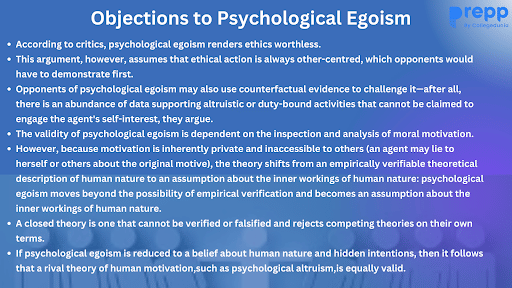
Answer: A common criticism is that Psychological Egoism is too simplistic, failing to account for selfless acts. Critics argue that not all actions are driven by self-interest, such as altruism or sacrifices made for others.
Question: Who are the key philosophers associated with Psychological Egoism?
Answer: Key philosophers associated with Psychological Egoism include Thomas Hobbes, who argued that humans are driven by selfish desires, and Friedrich Nietzsche, who emphasized individual will and self-interest.
Question: Can Psychological Egoism be empirically verified?
Answer: Psychological Egoism is difficult to empirically verify, as it requires a universal claim about human behavior. Many psychologists and ethicists debate its validity due to the complexity of human motivations.
MCQs
1. What does Psychological Egoism claim about human actions?
A) All human actions are motivated by self-interest
B) Humans can act in a completely selfless manner
C) Ethical actions are always motivated by morality
D) Actions are guided by societal norms
Answer: (A) See the Explanation
Explanation: Psychological Egoism argues that all human actions are ultimately driven by self-interest, even when they appear altruistic or selfless.
2. Which of the following philosophers is associated with Psychological Egoism?
A) John Locke
B) Thomas Hobbes
C) Immanuel Kant
D) David Hume
Answer: (B) See the Explanation
Explanation: Thomas Hobbes is one of the key proponents of Psychological Egoism, arguing that human beings are motivated by selfish desires and a desire for self-preservation.
3. Ethical Egoism differs from Psychological Egoism in that it:
A) Describes human behavior
B) Prescribes how people should act
C) Is less controversial
D) Focuses on the moral responsibility of individuals
Answer: (B) See the Explanation
Explanation: Ethical Egoism is a normative theory suggesting that individuals should act in their own self-interest, whereas Psychological Egoism merely describes how people behave.
4. Which of the following is a criticism of Psychological Egoism?
A) It overlooks the complexity of human emotions
B) It does not address self-interest
C) It overstates human altruism
D) It fails to consider social norms
Answer: (A) See the Explanation
Explanation: Critics argue that Psychological Egoism oversimplifies human behavior by ignoring the complexity of emotions and the possibility of truly selfless acts.
5. What is the central claim of Psychological Egoism?
A) All actions are morally right
B) Human beings are motivated by self-interest
C) Altruism is the highest moral principle
D) People act based on societal expectations
Answer: (B) See the Explanation
Explanation: Psychological Egoism asserts that every human action is motivated by self-interest, even those that seem altruistic.
GS Mains Questions and Model Answers
Q1: Critically analyze the concept of Psychological Egoism in the context of ethics. Do you think it can justify all human actions?
Answer: Psychological Egoism, which claims that all human actions are motivated by self-interest, is often criticized for its reductionist view of human nature. It fails to account for altruistic behaviors or acts of self-sacrifice. Critics argue that by labeling every action as self-interested, the theory undermines the complexity of human motivations. Although it provides insight into some aspects of behavior, it cannot justify all human actions, particularly those driven by empathy or moral duties that transcend self-interest.
Q2: Discuss the ethical implications of accepting Psychological Egoism as a valid theory. What would be its impact on moral philosophy?
Answer: If Psychological Egoism were accepted as a valid theory, it would challenge conventional moral philosophies that emphasize altruism and selflessness. It would shift the focus to individual self-interest as the primary motivator for all human actions, making ethical principles based on duty or virtue harder to justify. Such a view could justify morally questionable actions if they are deemed to serve one’s self-interest. Additionally, it would complicate the understanding of social and moral responsibility, as it would be difficult to distinguish between genuinely selfless acts and those masked as altruism.
Q3: Is Psychological Egoism an adequate explanation for the complexity of human motivations? Discuss with examples.
Answer: Psychological Egoism, while providing an explanation for certain self-interested behaviors, is insufficient in accounting for the full complexity of human motivations. For instance, acts of charity, such as donating to a cause or helping a stranger, often involve personal sacrifice without immediate personal gain. Psychological Egoism struggles to explain such behavior adequately. Moreover, human motivations are influenced by empathy, moral values, and social norms, which cannot be reduced solely to self-interest. Therefore, the theory fails to provide a comprehensive understanding of human behavior.
Previous Year Questions on Psychological Egoism
1. UPSC CSE Prelims 2021:
Question: Psychological Egoism asserts that:
A) All actions are driven by self-interest
B) Altruistic acts are morally superior
C) People only act out of moral duty
D) Self-interest is a secondary motivator
Answer: (A)
Explanation: Psychological Egoism argues that every human action is motivated by self-interest, even if those actions seem altruistic on the surface.
2. UPSC CSE Mains 2020 (GS Paper 4):
Question: Analyze the role of Psychological Egoism in ethical theories. How does it compare with other theories like Ethical Egoism?
Answer: Psychological Egoism is a descriptive theory explaining human motivation, asserting that self-interest drives all actions. In contrast, Ethical Egoism is a normative theory that advocates for individuals to act in their self-interest. The two theories are related but differ in their approach—one explains behavior, and the other prescribes it. Critics argue that Psychological Egoism oversimplifies human motivations, whereas Ethical Egoism is controversial due to its potential to justify harmful actions if they align with self-interest.
Download the PREPP App and attempt FREE IAS Exam Mock Tests and get complete study material!

Full Test - 04: UPSC CSE Prelims CSAT (Paper-II)
Full Test - 03: UPSC CSE Prelims CSAT (Paper-II)
UPSC CSE Prelims 2026 GS Paper 1 Question Paper (24-May-2026)
UPSC CSE Prelims 2026 CSAT Paper 2 Question Paper (24-May-2026)

17 February 2025 | The Hindu Must Read Articles | Current Affairs

16 February 2026 | The Hindu Must Read Articles | Current Affairs

13 February 2026 | The Hindu Must Read Articles | Current Affairs









Comments