Plato - Western Moral Thinkers - Ethics Notes
Plato (428/427 - 348/347 BCE) was an ancient Greek philosopher who was born in Athens during the Classical period. Plato established the Academy in Athens, a philosophical institution where he taught the philosophical theories that became known as Platonism. He was a Socratic student who founded the first known "university," the Academy. He has made significant contributions to political theory. The Republic is his finest work, and the Theory of Forms is his most well-known concept.
This article will explain Plato which will be helpful in Ethics preparation for the UPSC Civil service Mains exam.
Table of Contents
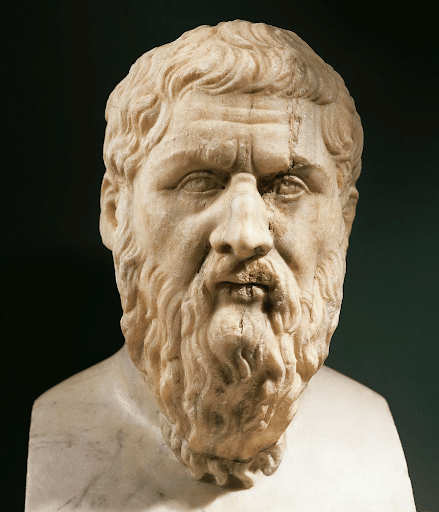
Plato
Plato (428/427 - 348/347 BCE)
- Plato (428/427 - 348/347 BCE) is the preeminent Greek philosopher, best known for his Dialogues and for establishing his Academy in Athens, which is often regarded as the first university in the Western world.
- Plato was a student of Socrates, and he included his old master in practically all of his dialogues, which serve as the foundation of Western philosophy.
- His family was aristocratic and politically connected, and it appears Plato was groomed for a political career.
- His inclinations, on the other hand, were toward the arts, and in his youth, he penned plays and maybe poems.
- Plato abandoned his literary endeavours and dedicated himself to Socrates, even during his trial and execution, and created the basic philosophical writings of the ancient world that influenced world civilization.
- The world's three great monotheistic religions owe much to Platonic thought, whether directly or through the works of his student and friend Aristotle (384-322 BCE), whose teachings remained consistent with Plato's vision of the importance of caring for one's soul and leading a virtuous lifestyle, even though Aristotle would depart from some of Plato's specifics.
| Other Relevant Links | |
|---|---|
| Ethical Ideals in Life | Aspects of Morals |
| Definition of Ethics | Moral subjectivism |
| Cultural relativism | Sceptical doctrines |
| Challenges To Ethics and Moral Accountability | Character in Ethics |
| Pyschological egosim | Western Moral Thinkers |
| Socrates | Aristotle |
Plato and His thoughts
- Socrates is credited with originating Greek political thinking. Plato was one of Socrates' most gifted students.
- Plato is regarded as the father of Western political thinking. It's because his mentor, Socrates, didn't write anything, and we only know about his ideas through Plato's works.
- Plato, whose actual name is Aristocles, was interested in pursuing philosophy and looking for the "truth".
- Following Socrates' sad death, Plato wrote a number of works on state, law, justice, politics, and philosophy. One of his most well-known works is The Republic.
- It covers a wide range of topics, many of which are still relevant and being researched today.
Plato - Theory of Justice
- In the form of a dialogue, the Republic discusses Justice.
- This is known as the Dialectical Method, which Plato learned from his mentor, Socrates. Socrates, Glaucon, Adeimantus, Cephalus, and Thrasymachus engage in a discussion.
- The dialogue decided that allowing one to oppress another would result in utter chaos, making any condition of things impossible.
- Men engage into a contract to avert injustice on themselves or others to preserve themselves from such pain and to prevent injustice.
- That is also how laws came to be in order to codify typical human behaviour and provide a feeling of justice.
- Plato's concept of justice holds that just individuals and just societies are inextricably linked.
- To fully grasp Plato's idea of justice and its core, it is necessary to first resolve the question of choosing the appropriate ruler for the state.
- Statesmanship, he claims, is a unique job that can only be fulfilled by competent individuals of moral character.
- Plato believed in the phrase "Like Man, Like State," which implies that the character of a state is determined by the character of its residents.
- It also meant that if the nature of humans is understood, it is simpler to grasp the functions of human society and determine who is most suited to rule in this society.
Plato - Characterises human behaviour
- Plato characterises human behaviour in three ways:
- Desire (or Appetite)
- Emotion (or Spirit)
- Knowledge (or Intellect)
- Each human being has all three emotions, however the extent to which these feelings are present varies.
- Those who are restless and voracious, according to Plato, are suitable for commerce.
- Others who are motivated by passion or spirit are more likely to join warriors.
- Finally, there are others who are content with mediation rather than worldly pursuits or triumph. Such individuals strive to learn and are continually on the lookout for the truth, and Plato believes that only wise men are competent to lead.
- Plato believes that, just as the ideal individual possesses the optimum mix of desire, emotion, and knowledge, a just state has individuals as its citizens for trade, military service, and rule.
- Individuals motivated by desire will lead to growth and production but will not govern; armed armies will preserve security but will not rule.
- Only those with no desire for material things or power and who are forces of knowledge would become kings.
Plato - Cardinal Virtues
- Plato's concept of justice defines qualities that are appropriate for each social class.
- Temperance, Courage, and Wisdom would be developed by the Trader, Soldier, and Philosopher classes, respectively, while Justice, the fourth virtue, would function as the architect in constructing a perfect society.
- Temperance is the appropriate virtue for the social class of merchants, whose dominating attribute is want.
- Soldiers are a social class whose dominating attribute is spirit or feeling, and the appropriate virtue for soldiers is Courage.
- Wisdom is the appropriate virtue for the social class of Philosophers, whose major quality is knowledge or intelligence.
- Justice, which generates harmony in all three social strata and is an essential prerequisite for human pleasure, is the virtue that befits the state.
- The first three virtues are associated with the three social classes, while the fourth virtue is an expression of harmony among the three groups. These four qualities are also known as Plato's idea of Justice's four Cardinal Virtues.
Conclusion
Plato was an outstanding Greek philosopher. He is regarded as a real Socratic follower. Plato's cardinal virtues philosophy is founded on his idea of virtue. According to Plato, justice is an essential prerequisite of living a decent life. It contributes to human happiness. His most renowned book, The Republic, is the most essential work that defines his concept of justice. His theory of justice, which is based on moral principles and includes an explanation of virtues and a categorization of social classes, is regarded as timeless.
| Other Relevant Links | |
|---|---|
| Post Aristotelian Philosophers | Gandhian Ethics |
| Epicureanism | Stoicism |
| Utilitarianism | Ethical Ideas in Indian Philosophical Tradition |
| Lessons From The Lives Of Great Indian Leaders, Reformers And Administration | Moral Thinkers of the Twentieth Century |
FAQs
Question: Who was Plato and what is his contribution to Western philosophy?
Answer: Plato (427-347 BCE) was an ancient Greek philosopher and student of Socrates, known for his works on ethics, politics, metaphysics, and epistemology. He founded the Academy in Athens, one of the earliest institutions of higher learning in the Western world. Plato's most significant contribution was his theory of Forms, the idea that the physical world is only a shadow of a higher, more perfect reality. His works, including "The Republic," laid the foundation for much of Western philosophy, particularly in the areas of ethics and political theory.
Question: What is Plato's theory of Forms?
Answer: Plato's theory of Forms posits that the material world is only a reflection of an abstract, ideal world of unchanging, perfect Forms. According to Plato, the objects we perceive through our senses are imperfect copies of these ideal Forms. For instance, a physical chair is merely a reflection of the perfect concept of a "chair" that exists in the realm of Forms. This theory underpins Plato's views on knowledge and reality, suggesting that true knowledge is about understanding the eternal and unchanging Forms, not the mutable objects of the physical world.
Question: How does Plato view justice in society?
Answer: In his work "The Republic," Plato outlines his vision of justice, which he believes is achieved when each individual performs their appropriate role in society. Justice, for Plato, is a state where the three parts of the soul (reason, spirit, and appetite) are in harmony, just as the three classes of society (rulers, auxiliaries, and producers) must work together. The rulers, guided by wisdom, must govern; the auxiliaries, driven by courage, must defend the state; and the producers, motivated by desire, must provide for material needs. When all parts of society do their proper tasks, justice is achieved.
Question: What is Plato's view on the ideal government?
Answer: Plato’s ideal government, as depicted in "The Republic," is a philosopher-king system. He argues that the rulers of a state should be philosopher-kings, individuals who have knowledge of the Forms and can make decisions based on wisdom and reason rather than personal desires or political ambition. Plato believed that only philosopher-kings could create a just and rational state. This form of government contrasts with democracy, which Plato viewed as a flawed system, as it allows people who are not knowledgeable in philosophy to make decisions.
Question: How did Plato’s ideas influence Western ethics?
Answer: Plato's contributions to Western ethics are significant, particularly through his ideas on the nature of virtue, the soul, and the relationship between knowledge and morality. He believed that moral virtue is a form of knowledge and that individuals can achieve ethical behavior through rational understanding. Plato's ethics emphasize the importance of wisdom, courage, and moderation in the individual's soul, which leads to a just life. His influence can be seen in later ethical theories, including those of Aristotle, as well as in Christian and modern moral thought.
MCQs
1. Who was Plato's teacher and what was their influence on him?
A) Aristotle, who emphasized empirical observation
B) Socrates, who focused on the Socratic method of questioning
C) Pythagoras, who focused on mathematical principles
D) Epicurus, who focused on hedonism
Answer: (B) See the Explanation
Explanation: Plato’s teacher was Socrates, whose method of questioning, known as the Socratic method, influenced Plato's thinking. Socrates emphasized the importance of dialogue and critical questioning to reach truth and knowledge, which became central to Plato’s philosophy.
2. What is the central concept of Plato’s theory of Forms?
A) The belief that only physical objects are real
B) The belief that the material world is a shadow of a higher reality
C) The concept of the soul being immortal
D) The idea that moral virtues are subjective
Answer: (B) See the Explanation
Explanation: Plato’s theory of Forms suggests that the physical world is an imperfect reflection of a higher, ideal realm of Forms. These Forms represent the true essence of things, while the material objects we see are just imperfect copies.
3. According to Plato, what role does the philosopher-king play in an ideal government?
A) They create laws based on popular demand
B) They govern with wisdom and reason, based on knowledge of the Forms
C) They enforce laws through military power
D) They act as advisors to the ruling classes
Answer: (B) See the Explanation
Explanation: Plato’s ideal government consists of philosopher-kings, who possess knowledge of the eternal Forms and rule based on wisdom, rationality, and justice, unlike rulers driven by personal gain or power.
4. In Plato's ethics, what is the relationship between virtue and knowledge?
A) Virtue is independent of knowledge
B) Virtue is acquired through training alone
C) Virtue is a form of knowledge, achievable through reason
D) Virtue is determined by divine intervention
Answer: (C) See the Explanation
Explanation: Plato believed that virtue is essentially knowledge. He argued that people behave morally when they have knowledge of the true nature of things, and that rational understanding leads to virtuous actions.
5. What was Plato's view on democracy?
A) Democracy is the ideal form of government
B) Democracy is the most rational form of government
C) Democracy is a flawed system that leads to mob rule
D) Democracy is necessary for human progress
Answer: (C) See the Explanation
Explanation: Plato viewed democracy as a flawed system that allowed people who lacked knowledge or wisdom to make decisions. He believed it could lead to disorder and the rise of demagogues who manipulated the masses for personal gain.
GS Mains Questions and Model Answers
Q1: Discuss Plato’s theory of Forms and its relevance to his views on knowledge and reality.
Answer: Plato’s theory of Forms suggests that the physical world is only a shadow of a higher, ideal world of Forms, which represent the true essence of things. For Plato, knowledge is not about the material objects we see, but about understanding the eternal and unchanging Forms. This theory challenges the empirical observation of the material world and instead emphasizes the role of reason and intellect in accessing true knowledge. Plato’s view that true knowledge is about the Forms influenced later philosophical thought, including the development of metaphysics and epistemology in Western philosophy.
Q2: Analyze the impact of Plato's concept of the philosopher-king on political theory. How does his ideal government differ from modern democracies?
Answer: Plato’s concept of the philosopher-king is central to his political philosophy. He argued that only those who possess knowledge of the eternal Forms should rule, as they are best equipped to govern justly. In contrast to modern democracies, where leaders are chosen based on popularity or election, Plato's ideal government emphasizes knowledge, wisdom, and reason over political skill or charisma. This idea has influenced political theory, particularly in debates about the relationship between expertise and political power. While modern democracies emphasize participation and representation, Plato’s model prioritizes governance by the wisest individuals.
Q3: Evaluate Plato’s views on justice and its application in the ideal state. How do these views relate to his broader ethical theories?
Answer: Plato's concept of justice is fundamental to his philosophy. In "The Republic," he argues that justice in the state occurs when each class of society performs its appropriate role: rulers govern, auxiliaries defend, and producers provide for material needs. Justice, for Plato, is a form of harmony, where each part of society and the soul acts in accordance with its true nature. This view of justice extends to Plato's broader ethical theories, where the virtue of an individual is achieved through knowledge and reason. Plato’s ideal state, therefore, is one where justice is achieved through rational governance, and individuals attain moral virtue by understanding the true nature of things.
Previous Year Questions on Plato and Western Philosophy
1. UPSC CSE Prelims 2021:
Question: Who among the following is known for his theory of Forms in philosophy?
A) Socrates
B) Aristotle
C) Plato
D) Pythagoras
Answer: (C)
Explanation: Plato is known for his theory of Forms, which posits that the physical world is an imperfect reflection of a higher, ideal realm of Forms.
Download the PREPP App and attempt FREE IAS Exam Mock Tests and get complete study material!
UPSC IAS : CSAT - Mini Live Test

Live Test : UPSC CSE Prelims CSAT (Paper-II) (Sep 20 - 23)
Full Test - 03: UPSC CSE Prelims CSAT (Paper-II)
Full Test - 02: UPSC CSE Prelims CSAT (Paper-II)
UPSC CSE Prelims 2026 GS Paper 1 Question Paper (24-May-2026)
UPSC CSE Prelims 2026 CSAT Paper 2 Question Paper (24-May-2026)

17 February 2025 | The Hindu Must Read Articles | Current Affairs

16 February 2026 | The Hindu Must Read Articles | Current Affairs

13 February 2026 | The Hindu Must Read Articles | Current Affairs









Comments