Definition of Ethics - Ethics Notes
The word Ethics is derived from the Greek word ‘ethos’ which means character or conduct. The term is also used to refer to the moral values of a certain social or religious organisation or an individual. In other words, Ethics is the systematic study of human behaviours from the perspective of their rightfulness or wrongfulness as a way of achieving ultimate satisfaction. It is a branch of philosophy that deals with moral values in society. Ethics is essential in public administration. This article will explain to you the Definition of Ethics which will be helpful in Ethics preparation for the UPSC Civil service Mains exam.
Table of Contents
Definition of Ethics
- The word Ethics is derived from the Greek word ‘ethos’ which means character or conduct.
- The term is also used to refer to the moral values of a certain social or religious organisation or an individual.
- Ethics is the branch of philosophy that deals with moral principles and values that govern individual and collective behavior.
- It involves critical thinking about what is right and wrong, and the principles and values that should guide human conduct.
- Ethics is concerned with questions such as how we should live, what is the right thing to do in specific situations, and what kind of person we should aspire to be.
- It investigates human character and behaviour in terms of good and bad, right and wrong.
- For example, the term ethics refers to the norms that impose reasonable responsibilities to refrain from rape, theft, murder, assault, defamation, and fraud. Ethical norms also prescribe the values of honesty, compassion, and loyalty.
- Ethics is sometimes known as moral philosophy or philosophical moral reasoning.
- This morality has been further developed as action and behaviour concerned with the 'good' or 'evil' of certain traditions, organisations, or individuals.
- In contrast to 'immoral' and 'unethical,' the terms moral' and 'ethical' are frequently employed as synonyms for right or good.
- It does not signify morally right or morally excellent, but it does refer to morality.
- Ethics refers to the principles that should guide what humans should do, generally in terms of justice, duties, fairness, and special virtue.
- The nature of ethics reveals that it is concerned with human existence and assesses human behaviour from a normative standpoint.
- As a result, various thinkers have developed distinct definitions of ethics.
- According to Mackenzie, ethics is a broad study of the ideals involved in human existence.
- According to Dewey, the subject of ethics is to bring out what is right and good in behaviour.
- G.E. Moore was a firm believer in non-naturalism. He argued that we cannot equate moral and natural notions, and that doing so is a Naturalistic Fallacy.
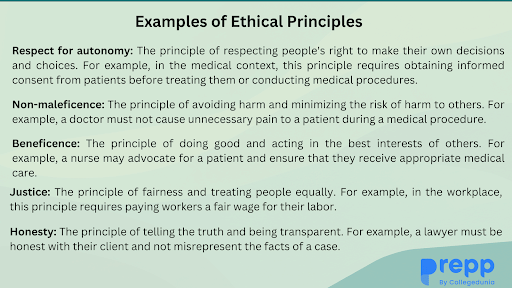
These ethical principles provide guidance for moral decision-making in various fields, including healthcare, law, business, and politics.
- Environmental Ethics: Should humans be held responsible for the negative impact of their actions on the environment?
- Business Ethics: Should companies prioritize profits over ethical considerations such as social responsibility, transparency, and fair treatment of workers?
- Medical Ethics: Should medical professionals be allowed to assist terminally ill patients in ending their lives?
- Animal Ethics: Is it ethical to use animals for human purposes such as medical research, food production, or entertainment?
- Political Ethics: Should politicians be held accountable for their actions and statements, and if so, how?
- Cyber Ethics: Is it ethical to collect and use personal data for commercial purposes without consent?
- Sexual Ethics: What are the moral limits of sexual behavior, and how should they be determined?
- Religious Ethics: How should religious beliefs and practices be reconciled with modern ethical values and principles?
| Other Relevant Links | |
|---|---|
| Moral Judgements Based on Content | Moral Judgements Based on Form or Attitude: The right and Good |
| Aspects of Morals | Models of Moral Decision Making |
| Cultural relativism | Moral subjectivism |
| Psychological egosim | Sceptical doctrines |
| Ethical egosim | Character in Ethics |
Branches of Ethics

Descriptive Ethics
- Descriptive ethics is the study of people's beliefs about morality. It involves empirical investigation.
- It gives us a general pattern or a way of life of people in different types of communities.
- Descriptive ethics studies the history and evolution of ethics. It gives a record of certain taboos, customs or conventions.
- For example, it states the history of various institutions like family or marriage.
- Descriptive ethics focuses on people's ethical beliefs or what acts are prohibited in a community.
- It seeks to discover people's values, beliefs, which behaviours are right and immoral, and which moral agent qualities are virtuous.
- Descriptive ethics aims to explain actual decisions made in practice by moral agents.
- It attempts to investigate the ethical rules followed by distinct societies. Descriptive Ethics is an ethical viewpoint that is value-free. It is an empirical study of people's moral ideas.
|
Normative Ethics
- Normative ethics is the process of developing moral rules that govern what is proper and incorrect behaviour.
- It is, in some ways, a search for a perfect litmus test of appropriate behaviour. Prescriptive ethics is another name for normative ethics.
- It is the study of ethical beliefs that dictate how individuals should behave. It investigates the rightness and wrongness of activities.
- It justifies punishing someone who disrupts the social and moral order.
- It attempts to build specific theories based on the rules of particular conventions. Normative ethics provides moral standards for making challenging moral judgements.
- The theories in Normative Ethics are Aristotle's virtue ethics, Kant's deontological ethics, Mill's Consequentialism (Utilitarianism), and the Bhagavad Gita's Nishkam Karma Yoga.
|
Meta-Ethics
- Study of the origin and meaning of ethical concepts is known as meta ethics. It is also known as ethics of ethics.
- The prefix "meta" means "beyond" or "beyond," and hence the concept of Meta ethics entails a detached, or bird's eye view of the overall undertaking of ethics.
- Two questions are prevalent in meta ethics: first is metaphysical issues about whether morality exists independently of humans, and second is psychological issues addressing the underlying mental basis of our moral judgements and behaviour.
- Meta ethics, in other words, is the study of what ethical concepts and ideas truly relate to. It determines the validity of Normative Ethics ideas.
- Meta ethics is the study of ethical notions. It investigates the meanings of moral language as well as the metaphysics of moral truths.
- Meta ethics tries to comprehend the nature of ethical qualities and assessments.
|
Applied Ethics
- Applied ethics is the area of ethics concerned with the examination of specific, contentious moral issues such as abortion, animal rights, and euthanasia.
- It helps to present difficulties with understanding of moral standards. Certain challenges develop as a result of a newly established lifestyle.
- Applied ethics addresses issues for example "Is having an abortion immoral?" "Is euthanasia morally permissible?" etc.
- For a problem to be deemed a 'applied ethical concern,' it must have two characteristics.
- First, the subject must be contentious in the sense that there are considerable groups of individuals who support and oppose the issue at hand.
- The second criteria for an issue to be classified as an applied ethical issue is that it be a clearly moral concern rather than merely a social disagreement.
|
Ethics in Public Administration
- Maximisation of Legality and Rationality: An administrator will abide by the law and the norms that have been established to control and guide various types of policies and choices.
- Responsibility and accountability are maximised when an administrator accepts full responsibility for his decisions and actions.
- He would hold himself ethically accountable for his acts and the use of his judgement in decision-making.
- Maxim of Excellence: An administrator would guarantee the greatest quality standards in administrative choices and activities, refusing to compromise standards for the sake of ease or complacency.
- Maxim of Fusion: An administrator would logically bring about a fusion of individual, organisational, and social aims to aid in the evolution of ideals and would imbue such a fusion in his behaviour.
- Maxim of Justice: Those in charge of policy design and implementation would guarantee that the principles of equality, equity, fairness, impartiality, and objectivity be respected, and that no special favours are bestowed based on rank, position, power, gender, class, caste, or money.
- Transparency: An administrator will make and implement choices in a transparent way so that individuals affected by the decisions and those who seek to analyse their logic may comprehend the reasons for such judgments and the sources of information on which these decisions were formed.
- Maxim of Integrity: An administrator would take an administrative decision based on honesty rather than using his authority, position, and judgement to suit his own interests as well as the illicit interests of other persons or organisations.
Ethics and Morality
- Morality, unlike ethics, does not require the approval of others. Ethics brings other people into the self-realisation process.
- It is possible to be moral without being ethical, but not to be moral without being ethical.
- Ethics is a communal judgement of what is right and wrong, whereas morality is a personal assessment of what is right and wrong.
- For example, while a moralist may agree that capital punishment is unfair, it might exist in the community in which he lives.
- Individual ideas have no influence on social ethics, hence societal ethics ultimately determines whether capital punishment is right or wrong.
| Ethics | Morality |
|---|---|
|
|
|
|
|
|
|
|
|
|
|
|
- Aristotle called man a 'social animal'. It implies a human intervention to stay in the condition of sociability.
- And their opposing survival and dominance inclinations continuously force him to confront the dichotomy of selfishness and altruism.
- Thus, ethics has been a tool for moral perfection of the individual in order to develop amicable relationships with others in the present and future.
Ethics and Law
- The law takes effect when an offence is committed. Right from the commencement of the offence's genesis, ethics enters the scene. The law demands hard proof to show an offender's guilt.
- In ethics, a person's ill intentions are sufficient to indict them; on the other hand, ethics cannot be avoided by finding loopholes in language or method; it creates an indelible imprint that lasts a lifetime.
- "A man is criminal in law when he violates the rights of others; he is guilty in ethics if he simply considers doing so," by Immanuel Kant.
Ethics and Religion
- A religious individual must adhere to a structured set of beliefs, doctrines, points of view, and duties.
- The three primary pillars of any religion are truth, compassion, and justice.
- Through religion, a person obtains inner purity and acquires a moral sense of what is good, evil, right, and wrong. Religion frequently aids morality.
- Despite the fact that most faiths encourage and urge high ethical standards, ethics is not a religion.
- Many individuals are not religious, yet ethical principles apply to everyone, regardless of faith, and even to those who are not religious (atheists). Furthermore, one can be ethical without practising any religion.
Ethics as a Science
- Ethics is a normative science, as opposed to natural and factual science. Every science is concerned with a certain area of knowledge.
- As a result, ethics as a science has its own domain. It is concerned with specific judgments we make about human behaviour.
- In the words of Muirhead "Ethics is not just concerned with temporal behaviour but it provides the basis of legal choice".
- Ethics is not a practical science; it just directs us toward a certain aim. Its path is not like that of practical science, which is a means to an aim or ideal.
- Medical science, for example, is a way of removing the causes of sickness. So ethics seeks to determine what the ultimate objective of life is and how to achieve it.
Conclusion
The study of what is good and wrong in human behaviour is known as ethics. This is a philosophical discipline that explores moral values. As a result, Ethics is sometimes referred to as Moral Philosophy. Ethics is a collection of rules, norms, principles, or directives imposed by a community against which individuals' acts are judged in terms of rightness and wrongness, goodness and badness. Ethical standards can also be used to determine if human intentions and aims are good or evil. As a result, ethics is the philosophical branch concerned with what is good and wrong. It analyses the essence of morality and how individuals should spend their lives in relation to others.
| Other Relevant Links | |
|---|---|
| Challenges To Ethics and Moral Accountability | Western Moral Thinkers |
| Socrates | Plato |
| Aristotle | Ethical Ideas in Indian Philosophical Tradition |
| Lessons From The Lives Of Great Indian Leaders, Reformers And Administration | Moral Thinkers of the Twentieth Century |
FAQs
Q1: What is the definition of ethics?
Answer: Ethics is the branch of philosophy that deals with moral principles and values that govern individual and collective behavior. It involves critical thinking about what is right and wrong, and the principles that should guide human conduct. Ethics examines questions such as how one should live, what is the right thing to do in specific situations, and what kind of person one should aspire to be.
Q2: What is the origin of the term "ethics"?
Answer: The term "ethics" is derived from the Greek word "ethos," which means character or conduct. It refers to the moral values of a certain individual, society, or religious organization.
Q3: What is the difference between ethics and morality?
Answer: While ethics refers to the systematic study of moral principles, morality refers to the actual beliefs, values, and customs that individuals or societies hold regarding what is right and wrong. Ethics involves theoretical reflection on moral issues, whereas morality is the practical application of those principles in daily life.
Q4: What are some examples of ethical principles?
Answer: Ethical principles include honesty, integrity, fairness, compassion, loyalty, and justice. These principles guide behavior in different areas, such as business ethics, medical ethics, environmental ethics, and political ethics.
Q5: How does ethics impact decision-making?
Answer: Ethics plays a critical role in decision-making by providing a framework for evaluating options based on what is morally right or wrong. Ethical decision-making involves considering the consequences of actions, the rights and well-being of others, and aligning decisions with societal norms and personal values.
MCQs
- What does the term "ethics" primarily refer to?
A) The science of happiness
B) The study of moral values and principles
C) The exploration of political philosophy
D) The scientific study of human behavior
Answer: (B) See the Explanation
- Who is known for the concept of "Nishkam Karma" in ethics?
A) Socrates
B) Aristotle
C) Immanuel Kant
D) Bhagavad Gita
Answer: (D) See the Explanation
- Which of the following is NOT a branch of ethics?
A) Normative ethics
B) Descriptive ethics
C) Meta-ethics
D) Legal ethics
Answer: (D) See the Explanation
- What does normative ethics focus on?
A) The study of people's moral beliefs
B) The development of moral rules and standards
C) The examination of moral language
D) The description of people's ethical behaviors
Answer: (B) See the Explanation
- Which ethical theory is associated with "the greatest happiness for the greatest number"?
A) Virtue ethics
B) Deontological ethics
C) Utilitarianism
D) Care ethics
Answer: (C) See the Explanation
GS Mains Questions and Model Answers
Q1: Discuss the significance of ethics in public administration.
Answer: Ethics plays a fundamental role in public administration by ensuring that public officials and institutions uphold values like transparency, accountability, and integrity. Ethical conduct in public administration ensures that decisions and actions are made in the public’s interest, free from corruption or personal gain. It fosters trust between the government and citizens, upholds the rule of law, and strengthens democratic governance. Public servants are expected to adhere to ethical norms, demonstrating fairness, honesty, and justice, which ultimately contribute to effective and responsible governance.
Q2: How does the concept of ethics differ from that of morality?
Answer: While both ethics and morality concern right and wrong conduct, ethics is the philosophical study of moral values, whereas morality is a set of personal or societal beliefs about what is right or wrong. Ethics involves critical thinking and reasoning to understand moral principles, whereas morality is more about the norms and rules followed in a society or by an individual. Ethics seeks to provide a theoretical foundation for moral judgments, whereas morality is practical and cultural, dictating specific behaviors or actions considered acceptable.
Q3: Explain how ethics impacts decision-making in healthcare.
Answer: In healthcare, ethics influences decision-making by ensuring that medical professionals consider patient well-being, autonomy, confidentiality, and justice when making choices. Ethical principles such as beneficence (doing good), non-maleficence (avoiding harm), and respect for patient autonomy guide healthcare providers in making decisions that are in the best interest of the patient. Ethical dilemmas in healthcare, such as end-of-life decisions, resource allocation, and patient consent, require careful consideration of moral principles to ensure that decisions are not only clinically sound but also just and humane.
Previous Year Questions on Ethics
1. UPSC CSE 2019
Question: "Explain the difference between ethics and law. How do ethics influence legal decision-making?"
Answer: Ethics and law are closely related but distinct concepts. While ethics deals with moral principles guiding individual behavior, law is a formal system of rules enforced by social institutions. Laws are often based on ethical principles, but not all ethical issues are addressed by law. For example, while laws prohibit theft, ethics also concerns honesty, which may guide individual behavior beyond legal obligations. In legal decision-making, ethics influences how laws are interpreted and applied, ensuring that justice is served not just according to the letter of the law, but also in a fair and morally responsible manner.
2. UPSC CSE 2018
Question: "Discuss the importance of ethics in public life and governance."
Answer: Ethics plays a critical role in public life and governance by ensuring that public servants and leaders uphold principles of transparency, fairness, and accountability. Ethical governance strengthens public trust and prevents corruption, promoting a fair distribution of resources and services. Ethical decision-making is essential for maintaining the rule of law and ensuring that policies and actions align with the public interest. Moreover, ethical behavior in leadership sets a positive example for citizens and fosters a culture of integrity and responsibility within public institutions.
Download the PREPP App and attempt FREE IAS Exam Mock Tests and get complete study material!

Full Test - 04: UPSC CSE Prelims CSAT (Paper-II)
Full Test - 03: UPSC CSE Prelims CSAT (Paper-II)
UPSC CSE Prelims 2026 GS Paper 1 Question Paper (24-May-2026)
UPSC CSE Prelims 2026 CSAT Paper 2 Question Paper (24-May-2026)

17 February 2025 | The Hindu Must Read Articles | Current Affairs

16 February 2026 | The Hindu Must Read Articles | Current Affairs

13 February 2026 | The Hindu Must Read Articles | Current Affairs









Comments