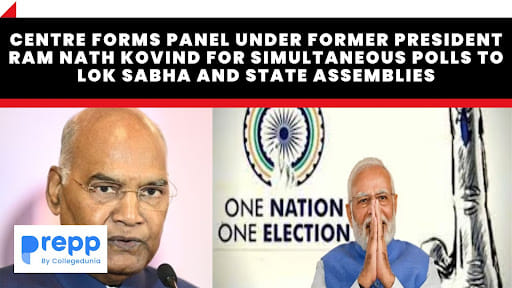
Centre Forms Panel Under Former President Ram Nath Kovind For Simultaneous Polls To Lok Sabha And State Assemblies
Relevance: GS 2- Indian Constitution, Parliament and State legislatures—structure, functioning, conduct of business, powers & privileges and issues arising out of these, Functions and responsibilities of the Union and the States, issues and challenges pertaining to the federal structure, devolution of powers, Salient features of the Representation of People’s Act. Government policies and interventions for development in various sectors and issues arising out of their design and implementation.
(Source: The Hindu, 09/01/2023)
Click here for Daily Current Affairs
Why in the news?
Recently, the Union government announced the formation of a panel headed by former President Ram Nath Kovind to look into the matter of simultaneous elections to the state legislatures and Parliament.
Table of Contents
- Committee for simultaneous elections
- Response to the decision
- What are simultaneous elections?
- Previous experiences
- Advantages of One Nation, One Election?
- Disadvantages associated with One Nation, One Election?
- Which article of the Constitution will need to be amended to implement simultaneous elections in India?
- Previous Commissions
- Conclusion
- FAQs
- MCQs
Committee for simultaneous elections
- The Union Minister for Parliamentary Affairs, Pralhad Joshi, declared that a committee has been constituted under the chairmanship of former President Ram Nath Kovind.
- The government has not officially mentioned who the other members of the committee will be or the terms of reference that it would operate under.
- Once the committee releases its findings, it will be opened for public discussion.
Response to the decision
Chief Ministers of several states such as Yogi Adityanath (Uttar Pradesh), Himanta Biswa Sarma (Assam), and Pramod Sawant of Goa supported the move.
What are simultaneous elections?
- The concept of simultaneous elections suggests that elections be held in all states and the Lok Sabha at the same time every five years.
- It requires the restructuring of the Indian election cycle so that elections at the Center and the states can be synchronized.
- The current electoral system of India involves separate elections for the Lok Sabha and state Assemblies when their tenures conclude or they are dissolved prematurely.
- The terms of the state assemblies are not necessarily in sync with each other or the Lok Sabha. This means that elections may have to be held multiple times a year.
- Implementing simultaneous elections would mean that voters elect members of the Lok Sabha and the state assemblies at the same time or in phases on the same day.
Previous experiences
- Previously, simultaneous elections were conducted in India in 1952, 1957, 1962, and 1967.
- However, it was discontinued following the dissolution of some of the Legislative Assemblies between 1968 -69.
What are the advantages of One Nation, One Election?
Reducing expenses
- Simultaneous elections are a good way to check the expenses borne by the parties and the government in connection with elections.
- The first elections to the Lok Sabha (1951-52) were contested by 53 parties and 1874 candidates with expenses amounting to ₹11 crore.
- In 2019, the elections were contested by 610 political parties and around 9,000 candidates with poll expenses of nearly ₹ 60,000 crores.
- Consequently, smaller parties with less capital and money for election expenditure may not be able to compete with larger parties, thereby affecting the equity and equality of the democratic process.
Effective governance
- The introduction of simultaneous elections will reduce the administrative burden on the bureaucracy and security forces.
- It will also ensure the timely implementation of government policies and put an end to the tendency of politicians to delay making sensitive decisions on account of short-term electoral gains which may affect national interests..
- In the present system, the administrative machinery is regularly engaged in electioneering which adversely affects governance.
- In contrast, simultaneous elections would ensure the focus of the administrative machinery is developmental activities.
- It will also improve the delivery of services as government staff are deployed for election duties multiple times at present.
Better decision-making
- Simultaneous elections will allow voters to judge the policies and programmes of the state and central governments.
- This would make it easier for the public to assess which political parties have delivered on their promises.
More efficient conduct of elections
- Simultaneous elections held once in five years for all parts of the country will ensure that all stakeholders i.e. political parties, the Election Commission of India, paramilitary forces, and civilians are prepared for the conduct of the elections.
Impact on the social fabric
- Elections are polarising events that have accentuated casteism, communalism, and corruption.
- Therefore, regular conduct of elections could damage the ideals of equality, and fraternity expressed in the constitution.
What are the disadvantages associated with One Nation, One Election?
Synchronizing elections
- In order to implement the idea of simultaneous elections, the terms of the Lok Sabha and the State Legislative Assemblies will need to be synchronized.
- While the term of the present Lok Sabha is up to 2024, some elections took place in 2023.
- In order to conduct simultaneous elections the terms of the state Legislative Assemblies will have to be curtailed which could meet public opposition.
- Even if simultaneous elections are implemented by prolonging and shortening the tenures of the Houses, it would be difficult to maintain this as the entire system may fall into disarray if one government falls.
Need for constitutional amendments
- Multiple articles in the Constitution of India related to the terms of the Parliament and state legislatures will need to be amended to implement simultaneous elections.
Accountability of governments
- In India’s Parliamentary Form of Government, the government is accountable to the Lower House i.e. the Lok Sabha at the center and the Legislative Assembly at the state.
- This means that the government could fall before the completion of its term necessitating elections.
- If the government is assured of a fixed tenure without the fear of recall, it could lead to autocratic tendencies and political welfarism to influence the voters.
Anti-federal
- Political parties have opposed simultaneous elections by claiming it to be anti-federal.
- The judgment of the people at the state level could be influenced by central considerations and vice versa, which could affect the federal nature of the Indian political system.
- While national elections are dominated by issues about national interests, state elections primarily deal with local issues. In a simultaneous election, national issues may dominate state issues.
Anti-democratic
- The present system of separate elections was chosen with the aim of upholding the will of the population through regular elections and the right to vote.
- As a result, any modification of the election system could result in the tampering of the people’s expression of their democratic will.
Logistical Challenges
- Presently, one voting machine is used at each polling station while holding elections.
- However, in order to implement simultaneous elections, a greater number of EVMs and VVPATs would be required.
- It would also require the posting of additional staff, equipment, and vehicles to transport materials to the polling stations.
- Security arrangements will have to be improved and the number of servicemen and paramilitary forces deployed will have to be increased for simultaneous elections.
- The Election Commission will also face additional challenges such as the safe storage of EVM machines until the counting process, difficulties in implementing simultaneous counting of votes, etc.
Which article of the Constitution will need to be amended to implement simultaneous elections in India?
- At least five constitutional amendments would be required to implement the idea of “One Nation, One Poll” in the country.
- Article 83 (duration of Houses of Parliament): It stipulates that the term of the Lok Sabha will be five years from the date of its first sitting.
- Article 85 (dissolution of the Lok Sabha): It empowers the President to dissolve the Lok Sabha.
- Article 172 (duration of the State legislatures): It states that the term of the legislative assembly will be five years from the date of its first sitting.
- Article 174 (dissolution of the State legislatures): It empowers the Governor of the state to dissolve the Legislative Assembly.
- Article 356 (President’s Rule): It authorizes the Central Government to impose the President’s Rule when there is a failure of constitutional machinery in the state.
- Additionally, the Representation of the People Act (1951) and related parliamentary procedure will also need to be amended.
Previous Commissions
- In 1983, the Election Commission of India had recommended reverting to simultaneous polls.
- In 2015, the Parliamentary Standing Committee on Personnel, Public Grievances, Law and Justice, headed by E M Sudarsana Natchiappan, compiled a report on ‘Feasibility of Holding Simultaneous Elections to House of People (Lok Sabha) and State Legislative Assemblies’.
- The idea of simultaneous elections has been referred to the Law Commission for further examination and to produce a practical framework for implementation.
- In 2018, the Law Commission observed that simultaneous elections could not be held within the existing framework of the Constitution.
- It recommended the replacement of the “no-confidence motion” with a “constructive vote of no-confidence”i.e. a government may only be removed if there is confidence in an alternative government.
(*Click this link to read prelims specific weekly current affairs articles)
FAQs
Question: What is the Election Commission of India?
Answer:
The Election Commission of India (ECI) is an autonomous constitutional body that administers elections to the Lok Sabha, Rajya Sabha, and State Legislative Assemblies, and the offices of the President and Vice President.
Question: What is a non-confidence motion?
Answer:
A No Confidence Motion is a formal request made by the opposition against the government in the Lok Sabha. Once it is passed, the ruling party is required to quit if it cannot demonstrate its majority in the Lok Sabha. It is mentioned in Rule 198 of the Rules of Procedure and Conduct of Business in the Lok Sabha.
UPSC Mains Practice Question:
|
MCQs
Question: Consider the following statements:
- In India, there is no law restricting the candidates from contesting in one Lok Sabha election from three constituencies.
- In the 1991 Lok Sabha Election, Shri Devi Lal contested from three Lok Sabha constituencies.
- As per the existing rules, if a candidate contests in one Lok Sabha election from many constituencies, his/her party should bear the cost of bye-elections to the constituencies vacated by him/her in the event of him/her winning in all the constituencies.
Which of the statements given above is/are correct?
(a) 1 Only
(b) 2 Only
(c) 1 and 3
(d) 2 and 3
Answer: (b) See the Explanation
- According to the Representation of the People Act, 1951(amended in 1996) a candidate can contest in a maximum of two seats. However, they can only retain one. Hence statement 1 is incorrect
- In 1991 Lok Sabha Election, Shri Devi Lal contested from three Lok Sabha constituencies. Hence statement 2 is correct.
- There is no such provision that stipulates that the party should bear the cost of bye-elections to the constituencies vacated by a candidate who contests in one Lok Sabha election from many constituencies they win in all the constituencies.
- The cost of elections/bye-elections in all the constituencies in Lok Sabha and assembly elections is borne by the Election Commission of India (ECI). Hence statement 3 is incorrect.
Therefore, option (b) is the correct answer.
Question: The main advantage of the parliamentary form of government is that (UPSC CSE 2017)
(a) The executive and legislature work independently.
(b) It provides continuity of policy and is more efficient.
(c) The executive remains responsible to the legislature.
(d) The head of the government cannot be changed without an election.
Answer: (c) See the Explanation
- Articles 74 and 75 (Union) and Articles 163 and 164 (States) of the Constitution deal with the Parliamentary form of government in India.
- In a Parliamentary system, the executive is responsible to the legislature. Hence statement 3 is correct.
- The features of the Presidential system are the independent functioning of the executive and the legislature work and continuity of policy.
Therefore, option (c) is the correct answer.
Download the PREPP App and attempt FREE IAS Exam Mock Tests and get complete study material!

Full Test - 04: UPSC CSE Prelims CSAT (Paper-II)
Full Test - 03: UPSC CSE Prelims CSAT (Paper-II)
UPSC CSE Prelims 2026 GS Paper 1 Question Paper (24-May-2026)
UPSC CSE Prelims 2026 CSAT Paper 2 Question Paper (24-May-2026)

17 February 2025 | The Hindu Must Read Articles | Current Affairs

16 February 2026 | The Hindu Must Read Articles | Current Affairs

13 February 2026 | The Hindu Must Read Articles | Current Affairs









Comments