India’s First Solar Observatory Mission Launched Today
Relevance: GS3 - Awareness in the fields of IT & Space
(Source: The Hindu, The Hindu; 09/02/2023)
Click here for Daily Current Affairs
Why in the news?
- ISRO has successfully launched Aditya-L1, India's first space-based observatory to study the Sun.
- Aditya-L1 began its journey towards the Sun after being launched atop a Polar Satellite Launch Vehicle (PSLV) rocket from the Satish Dhawan Space Centre in Sriharikota.
- The solar mission is being carried out to study the Sun from a vantage point at the Sun-Earth Lagrange point (L1).
Table of Contents
What is the Aditya-L1 mission?
- Aditya in Sanskrit means the Sun. Aditya L1 is the first space-based Indian mission to study the Sun.
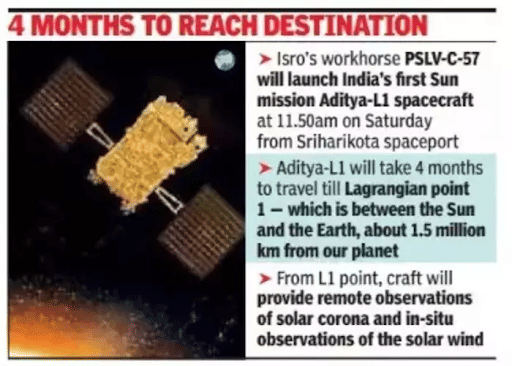
- The satellite will be placed in a halo orbit around the Lagrange point 1 (L1) of the Sun-Earth system, which is about 1.5 million km (about 1% of the Earth-Sun distance) from the Earth.
- As it is known, the Sun is a giant sphere of gas and Aditya-L1 will study the outer atmosphere of the Sun.
- Aditya-L1 will neither land on the Sun nor approach the Sun any closer. The spacecraft will be directed towards the Sun.
- The Aditya-L1 mission would carry seven payloads to observe the photosphere, chromosphere and the outermost layers of the Sun, the corona, in different wavebands.
- The seven payloads onboard the satellite are:
- Visible Emission Line Coronagraph (VELC), Solar Ultraviolet Imaging Telescope (SUIT), Solar Low Energy X-ray Spectrometer (SoLEXS), High Energy L1 Orbiting x-ray Spectrometer (HEL1OS), Aditya Solar wind Particle Experiment (ASPEX), Plasma Analyser Package for Aditya (PAPA), and Advanced Tri-axial High Resolution Digital Magnetometers.
About its Journey
- Aditya-L1 will stay in earth-bound orbits for 16 days, during which it will undergo five manoeuvres to gain the necessary velocity for its journey.
- Subsequently, Aditya-L1 will undergo Trans-Lagrangian1 insertion manoeuvre, marking the beginning of its 110-day trajectory to the destination around the L1 Lagrange point.
- Upon arrival at the L1 point, another manoeuvre binds Aditya-L1 to an orbit around L1, a balanced gravitational location between the Earth and the Sun.
- Aditya-L1 will stay approximately 1.5 million km away from the earth, directed towards the sun; this is about 1% of the distance between the earth and the sun.
Objective of the Mission
- The Aditya L-1 satellite carries seven payloads aimed at understanding solar phenomena like coronal heating, coronal mass ejections, flares, space weather dynamics, and particle propagation.
- The primary payload, VELC, observes the solar corona and mass ejections. The satellite's halo orbit around the L1 point allows continuous, uninterrupted solar observation.
- Solar quakes can eject energetic material from the sun, potentially affecting Earth's satellites and electronics.
- Continuous solar monitoring is crucial to mitigate the impact on our technology-dependent lives.
*To read more about Aditya L-1 Mission, click here
Support from European Space Agency
- ESA is providing support from all three of its 35-metre deep space antennas over Australia, Spain and Argentina, as well as support from the Kourou station in French Guiana and coordinated support from the Goonhilly Earth Station in the UK, for the Aditya-L1 mission.
- ESA said that it was the main provider of ground station services for Aditya-L1.
- The European Space Agency (ESA) is an intergovernmental organization of 22 member states dedicated to the exploration of space.
- It was established in 1975 and headquartered in Paris.
- The European Space Agency (ESA) had provided crucial support to ISRO to monitor the Chandrayaan-3’s health.
- It is also supporting Aditya-L1, providing deep space communication services to the mission.
(*Click this link to read prelims specific weekly current affairs articles)
FAQs
Question: What is the Aditya L1 Mission?
Answer:
Aditya L1 is the first space-based Indian mission to study the Sun. The spacecraft will be placed in a halo orbit around the Lagrange point 1 (L1) of the Sun-Earth system, which is about 1.5 million km from the Earth.
Question: What are Lagrangian Points?
Answer:
Lagrangian points, also known as Lagrange points or libration points, are specific locations in space where the gravitational forces of two large bodies, such as a planet and its moon or a planet and the Sun, produce enhanced regions of gravitational equilibrium.
Question: What is the Solar Photosphere?
Answer:
The photosphere is the lowest layer of the solar atmosphere and visible “surface” of the Sun. The photosphere is the bright outer layer of the Sun that emits most of the radiation. The photosphere is an extremely uneven surface. The effective temperature on the outer side of the photosphere is 6000°C.
UPSC Mains Practice Question:
|
Download the PREPP App and attempt FREE IAS Exam Mock Tests and get complete study material!

Full Test - 04: UPSC CSE Prelims CSAT (Paper-II)
Full Test - 03: UPSC CSE Prelims CSAT (Paper-II)
UPSC CSE Prelims 2026 GS Paper 1 Question Paper (24-May-2026)
UPSC CSE Prelims 2026 CSAT Paper 2 Question Paper (24-May-2026)

17 February 2025 | The Hindu Must Read Articles | Current Affairs

16 February 2026 | The Hindu Must Read Articles | Current Affairs

13 February 2026 | The Hindu Must Read Articles | Current Affairs









Comments