Four Soldiers Killed, Three Injured, In Fresh Clash Between Armenia And Azerbaijan
Relevance: GS2 - Effect of Policies & Politics of Countries on India's Interests
(Source: The Hindu, 09/02/2023)
Click here for Daily Current Affairs
Why in the news?
- Recently, four Armenian soldiers were killed after Azerbaijani shelling near the border town of Sotk, northwest of the breakaway region of Nagorno-Karabakh.
- Nagorno-Karabakh, internationally recognised as part of Azerbaijan, has been a source of conflict between the two Caucasus neighbors.
- Azerbaijan accused Armenia of building up troops along the two countries’ volatile borders in August, while Armenia accused Azerbaijan’s military of opening fire on European Union observers.
Table of Contents
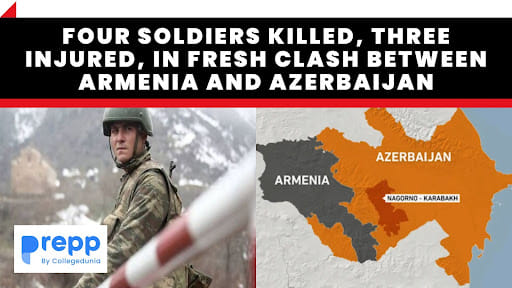
Background of Nagorno-Karabakh Conflict
- The Nagorno-Karabakh region, internationally recognized as part of Azerbaijan, has been a focal point of conflict between Armenia and Azerbaijan since the dissolution of the Soviet Union in 1991.
- Despite mediation efforts by the European Union, United States, and Russia, the two sides have not been able to reach a lasting peace settlement.
- In August, Azerbaijan accused Armenia of amassing troops along their volatile borders, while Armenia alleged that Azerbaijan's military had fired upon European Union observers.
- The unresolved disputes and sporadic clashes in the region continue to fuel tensions, posing a persistent threat to stability in the South Caucasus.
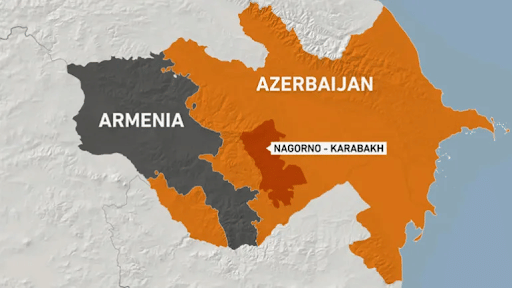
Armenia and Azerbaijan
- Armenia
- It is a landlocked country in the Armenian Highlands of West Asia, with geopolitical ties to Europe.
- It is a part of the Caucasus region and is bordered by Turkey to the west, Georgia to the north and Azerbaijan to the east, and Iran and the Azerbaijani exclave of Nakhchivan to the south.
- Yerevan is the capital and largest city.
- Azerbaijan
- It is a transcontinental country located at the boundary of Eastern Europe and West Asia.
- It is a part of the South Caucasus region and is bounded by the Caspian Sea to the east, Russia (Republic of Dagestan) to the north, Georgia to the northwest, Armenia and Turkey to the west, and Iran to the south.
- Baku is the capital and largest city.
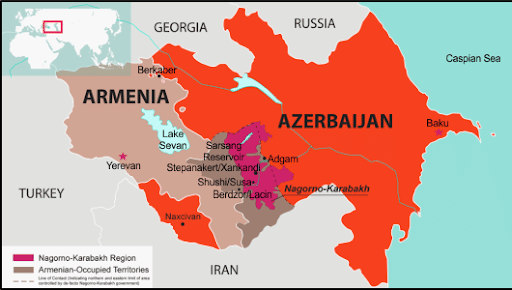
Strategic Significance
- The region between the Black Sea and the Caspian Sea, known as the Caucasus, plays a crucial role in energy transportation due to its pipelines connecting resource-rich Azerbaijan to Turkey and Europe.
- These pipelines, such as the Western Route Export oil pipeline, the Trans-Anatolian gas pipeline, the South Caucasus gas pipeline, and the Baku-Tbilisi-Ceyhan oil pipeline, have the capacity to transport a significant amount of oil and gas daily.
- Some of these pipelines are located in close proximity to the conflict-prone area, within approximately 16 kilometers of the border.
Role of India
- Initial Support for Territorial Integrity: At the outset of the Nagorno-Karabakh conflict in 1993, India supported the principle of respecting territorial integrity.
- Shift Due to Azerbaijan-Pakistan Relations: India's position shifted as Azerbaijan actively supported Pakistan's stance on the Kashmir issue. This alignment prompted India to reconsider its support for Azerbaijan's territorial integrity.
- Azerbaijan's disregard for India's territorial integrity in Jammu and Kashmir has led India to oppose Azerbaijan's territorial integrity in response.
- Support for Peaceful Solutions: India has consistently backed efforts to find a peaceful resolution to the Armenia-Azerbaijani conflict, aligning itself with international diplomatic initiatives.
- Supporting International Partners: India has supported Russia, the United States, and France in voting against Azerbaijani resolutions related to the conflict, emphasizing the importance of international cooperation.
- Trade Interests and the INSTC: Azerbaijan is also a part of the International North-South Transport Corridor (INSTC), which runs through Central Asia and links Russia with India. Thus, peace in the region is of utmost importance for India and its trade relations with other Central Asian nations.
(*Click this link to read prelims specific weekly current affairs articles)
FAQs
Question: What is Nagorno-Karabakh Region?
Answer:
Nagorno-Karabakh is a mountainous and heavily forested region that under international law is recognised as part of Azerbaijan.
Question: Where is the Caspian Sea?
Answer:
It is Earth's largest inland body of water, when measured by surface area.
It is bordered by Russia (northwest), Azerbaijan (west), Iran (south), Turkmenistan (southeast) and Kazakhstan (northeast).
Question: Where is Armenia?
Answer:
It is a landlocked country in the Armenian Highlands of West Asia, with geopolitical ties to Europe. It is a part of the Caucasus region and is bordered by Turkey to the west, Georgia to the north and Azerbaijan to the east, and Iran and the Azerbaijani exclave of Nakhchivan to the south.
MCQ
Question: With reference to Azerbaijan, consider the following statements:
- It is a transcontinental country located at the boundary of Eastern Europe and West Asia.
- It is a part of the South Caucasus region and is bounded by the Caspian Sea and Georgia.
Which of the statements given above is/are correct?
(a) 1 only
(b) 2 only
(c) Both 1 and 2
(d) Neither 1 nor 2
Answer: (c) See the Explanation
- Azerbaijan is a transcontinental country located at the boundary of Eastern Europe and West Asia.
- It is a part of the South Caucasus region and is bounded by the Caspian Sea to the east, Russia (Republic of Dagestan) to the north, Georgia to the northwest, Armenia and Turkey to the west, and Iran to the south.
Therefore, option (c) is the correct answer.
Download the PREPP App and attempt FREE IAS Exam Mock Tests and get complete study material!

Full Test - 04: UPSC CSE Prelims CSAT (Paper-II)
Full Test - 03: UPSC CSE Prelims CSAT (Paper-II)
UPSC CSE Prelims 2026 GS Paper 1 Question Paper (24-May-2026)
UPSC CSE Prelims 2026 CSAT Paper 2 Question Paper (24-May-2026)

17 February 2025 | The Hindu Must Read Articles | Current Affairs

16 February 2026 | The Hindu Must Read Articles | Current Affairs

13 February 2026 | The Hindu Must Read Articles | Current Affairs









Comments