China’s Economic Slowdown, Its Ripple Effect
Relevance: GS3 - Indian Economy and issues relating to planning, mobilization, of resources, growth, Effects of liberalization on the economy, changes in industrial policy and their effects on industrial growth GS2 - Effect of policies and politics of developed and developing countries on India’s interests,
(Source: The Hindu, 02/09/2023)
Click here for Daily Current Affairs
Why in the news?
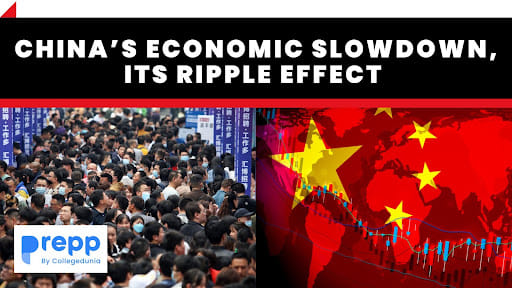
- Recently, a report by the Wall Street Journal revealed that the Chinese economy, the world’s second-largest, is in deep distress and that its growth model is now broken.
- This has raised concerns about deflation which is concerning for China and the rest of the world.
Table of Contents
Unbalanced growth and short-term solutions
- In 2007, Chinese Prime Minister Wen Jiabao warned about China's unstable, unbalanced, uncoordinated, and unsustainable economic growth.
- Although he recommended the imposition of corrective measures, the 2008 global financial crisis prompted China to implement short-term solutions such as investments in infrastructure, railways, highways, and energy.
- The core concerns such as a lack of consumption, regional inequality, and lack of social security were ignored in favor of sustaining a double-digit growth rate.
- This was done to ensure the domestic legitimacy of China’s leadership in China which depended on the creation and spreading of prosperity among the citizens.
- However, Chinese financial markets suffered from a lack of regulatory oversight as loans to businesses were based on “Guanxi”, which is a Chinese term that refers to the nodal networks based on factions, friendships, and relationships.
In a ‘new normal’, the ground realities
China is the world’s second-largest economy and the world’s largest developing economy.
Changing Priorities in 2017
- In 2017, President Xi Jinping announced a shift in China's focus towards improving the quality of life of its citizens.
- China transitioned from an era of exports, infrastructure expenditure, and large-scale investments to a "new normal" which is characterized by slower growth rates.
- This would mean a change from the more than 10% growth enjoyed by China in the previous decades which also meant more jobs and disposable income.
- As a consequence of the lower growth, there was a shortage of new jobs despite a continuous increase in China’s working-age population.
- As a result, unemployment has risen leading to the Chinese government advising students to defer their graduation.
Labor Costs and Overproduction
- In Xi's first term (2012-17), export growth rates slowed meaning that labor costs were rising.
- Increased investments in social security have led to wage hikes.
- The overproduction problem in sectors like housing, energy, and construction emerged as a result of excessive credit availability. Despite early supply-side reforms, these sectors faced inventory surpluses.
A political choice
Political Choice as a Solution
- One of the demands of China's unique political economy is that overcoming economic challenges is viewed as a political choice.
- In 2020, President Xi referred to the "Disorderly expansion of capital" in the context of the withdrawal of the Ant Group’s IPO.
- This highlighted the government's role in controlling capitalist activities with experts casting doubts on the Chinese economy’s ability to innovate.
Rollback of Promises
- There has been a significant rollback of China's promise in 2013 of allowing markets to play a greater role in resource allocation.
- This has been attributed to the persistence of political interventions in loans and investments.
- This has further resulted in the tightening of the convertibility of the RMB.
Challenge of Saving Habits
- Historically, Chinese citizens have saved more than 50% of their income and have resisted measures to discourage this saving habit.
- Although the government has implemented some social security measures to counteract excessive saving, progress has been slow.
- These include initiatives like "Common Prosperity" and "Dual Circulation" which are aimed at improving wealth distribution and boosting domestic consumption which have not yielded the expected results.
Slowing Growth Since 2015
- China's economic slowdown is considered to have begun in 2015 but was temporarily mitigated by government spending on urbanization projects.
- The US-China trade war and policies such as de-risking and "China plus one" have accelerated the economic challenges faced by China.
- These economic crises were worsened by China's zero-COVID policy which might have led to increased cash hoarding by individuals and businesses.
On state enterprises
- The political connections possessed by State-owned enterprises (SOEs) allow them to evade change and continue with outdated practices.
- They are a significant part of the Chinese economy as they provide social security to a significant workforce.
- The Evergrande crisis exposed China's housing bubble, revealing the issues that affect the Chinese economy such as misregulation and path-dependency.
- Other long-term concerns include the middle-income trap and China's ambition to move up the value chain, i.e. designing and making things.
Impact on the Global Economy
- Even with an estimated growth rate of 5%, China continues to add substantial value, especially when compared to India's projected 6.1% growth for 2023. This has global implications, affecting markets for commodities like crude oil, cement, and steel.
- Economic instability in China may influence its perception of regional power dynamics and risk appetite, which could impact border disputes and international relations.
Conclusion
China's economic challenges are complex and multifaceted with historical, political, and external influences. China’s economic slowdown could have far-reaching consequences making it necessary for observers and policymakers to understand its dynamics.
(*Click this link to read prelims specific weekly current affairs articles)
FAQs
Question: What is the labor force?
Answer:
According to Current Weekly Status (CWS), the labor force is the number of persons either employed or unemployed on average in a week preceding the date of the survey.
Question: What is a political economy?
Answer:
Political economy is a branch of political science and economics that studies economic systems like markets and national economies and their governance by political systems i.e. law, institutions, and government.
UPSC Mains Practice Question:
|
MCQs
Question: What is/are the most likely advantages of implementing ‘Goods and Services Tax (GST)’?
- It will replace multiple taxes collected by multiple authorities and will thus create a single market in India.
- It will drastically reduce the ‘Current Account Deficit’ of India and will enable it to increase its foreign exchange reserves.
- It will enormously increase the growth and size of the economy of India and will enable it to overtake China in the near future.
Which of the above statements is/are correct?
(a) 1 only
(b) 2 and 3 only
(c) 1 and 3 only
(d) 1, 2 and 3
Answer: (a) See the Explanation
- Implementation of the GST in India will create a single market in India by merging multiple central and state taxes. Hence statement 1 is correct.
- This will have positive effects on India's exports, current account deficit, and its size. Hence statements 2 and 3 are incorrect.
Therefore, option (a) is the correct answer.
Download the PREPP App and attempt FREE IAS Exam Mock Tests and get complete study material!

Full Test - 04: UPSC CSE Prelims CSAT (Paper-II)
Full Test - 03: UPSC CSE Prelims CSAT (Paper-II)
UPSC CSE Prelims 2026 GS Paper 1 Question Paper (24-May-2026)
UPSC CSE Prelims 2026 CSAT Paper 2 Question Paper (24-May-2026)

17 February 2025 | The Hindu Must Read Articles | Current Affairs

16 February 2026 | The Hindu Must Read Articles | Current Affairs

13 February 2026 | The Hindu Must Read Articles | Current Affairs









Comments