Children From Void Marriages Entitled To Parents’ Share In Property, Says SC
Relevance: GS2 - Constitutional Amendments; Judgements & Case; Prelims
(Source: The Hindu, 09/02/2023)
Click here for Daily Current Affairs
Why in the news?
Recently, the Supreme Court ruled that children born out of invalid marriages can claim a right in their parents’ ancestral property under the Hindu family property governed by the Mitakshara law.
Table of Contents

Background
- Earlier, the Supreme Court of India has reserved its judgment regarding the inheritance rights of children born from invalid, void, and voidable Hindu marriages.
- The apex court's verdict came on a 2011 plea pertaining to the legal issue of whether children born out of wedlock were entitled to a share in the ancestral property of their parents under Hindu laws.
- The issue in the case related to the interpretation of Section 16 of the Hindu Marriage Act 1955, which confers legitimacy to children who are born out of invalid marriages.
- Section 16(3) states such children are entitled to inherit only their parents' property and will have no right over the other coparcenary shares.
About SC’s Verdict
- The key points of the verdict are as follows:
- Children born out of a marriage that is null and void are considered legitimate under statutory law.
- In cases where a voidable marriage is annulled, any child conceived before the annulment is deemed legitimate.
- Equal inheritance rights have been granted to daughters.
- The court also questioned whether the share of such children is limited only to the self-acquired property of their parents under Section 16(3) of the Hindu Marriage Act.
- It was also stated that the children from such “void or voidable” marriages will not be able to inherit the ancestral properties of the coparceners other than their parents.
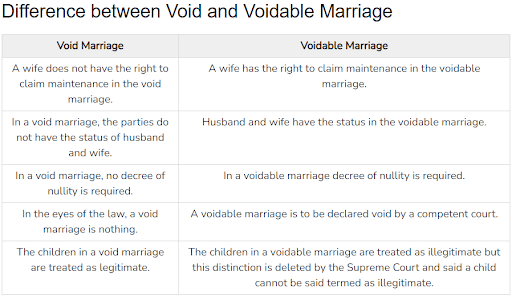
What does the Hindu Succession law say about void marriage?
- In a void marriage, the man and woman do not have the status of husband and wife from the very beginning. No decree of nullity is required to annul the marriage.
- In a voidable marriage, the man and woman are considered husband and wife until the marriage is legally annulled through a decree of nullity.
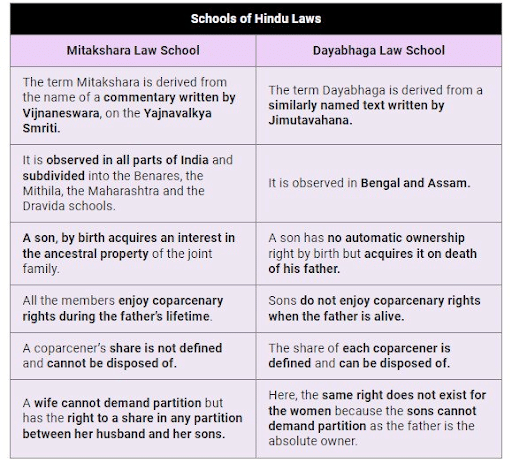
Mitakshara Law of Succession
- Mitakshara coparcenary is one of the Hindu law schools that governs the succession of property in a Hindu family.
- The Mitakshara school of thought holds that the son, grandson, and grandson's son have a right to the family property through birth.
- Mitakshara law of succession governing Hindu Undivided Families applies to the whole of India except West Bengal and Assam.
(*Click this link to read prelims specific weekly current affairs articles)
FAQs
Question: What is Hindu Marriage Act?
Answer:
The Hindu Marriage Act is a law in India that governs marriages among Hindus, Buddhists, Jains, and Sikhs. It provides rules and regulations for solemnizing and registering marriages. The act specifies conditions for a valid marriage, rights and obligations of spouses, and grounds for divorce.
Question: What is a void marriage?
Answer:
In a void marriage, the man and woman do not have the status of husband and wife from the very beginning. No decree of nullity is required to annul the marriage.
Question: What is the legitimacy of children of void and voidable marriage Sec 16?
Answer:
The Hindu Marriage Act of 1955 distinguishes between invalid and voidable marriages. According to Section 16 of the Act, children of void and annulled voidable marriages are legal, but they are only entitled to their parents' property.
MCQ
Question: With reference to the history of ancient India, which of the following statements is/are correct? (UPSC 2021)
- Mitakshara was the civil law for upper castes and Dayabhaga was the civil law for lower castes.
- In the Mitakshara system, the sons can claim right to the property during the lifetime of the father, whereas in the Dayabhaga system, it is only after the death of the father that the sons can claim right to the property.
- The Mitakshara system deals with the matters related to the property held by male members only of a family, whereas the Dayabhaga system deals with the matters related to the property held by both male and female members of a family.
Select the correct answer using the code given below:
(a) 1 and 2
(b) 2 only
(c) 1 and 3
(d) 3 only
Answer: (b) See the Explanation
- Mitakshara is the oldest schools of Hindu law and is practiced in India except in the state of West Bengal and Assam. Dayabhaga is also an important schools of Hindu law mainly practiced in Assam and West Bengal. Both laws deal with upper and lower castes. Hence, statement 1 is incorrect.
- In the Mitakshara school of inheritance, property rights are conferred upon successors (coparceners) from the moment of their birth within the family. Consequently, they can inherit during their father's lifetime. Conversely, under the Dayabhaga school of inheritance, property is inherited by successors (coparceners) only upon the property holder's death. Hence, statement 2 is correct.
- Both Mitakshara and Dayabhaga deal with male and female property rights. Mitakshara school is orthodox school. It is biased against women and gives them very less right to inherit property. Dayabhaga is also biased, but it is a liberal school and it gives more rights to women to inherit property compared to Mitakshara. Hence, statement 3 is incorrect.
Therefore, option (b) is the correct answer.
Download the PREPP App and attempt FREE IAS Exam Mock Tests and get complete study material!

Full Test - 04: UPSC CSE Prelims CSAT (Paper-II)
Full Test - 03: UPSC CSE Prelims CSAT (Paper-II)
UPSC CSE Prelims 2026 GS Paper 1 Question Paper (24-May-2026)
UPSC CSE Prelims 2026 CSAT Paper 2 Question Paper (24-May-2026)

17 February 2025 | The Hindu Must Read Articles | Current Affairs

16 February 2026 | The Hindu Must Read Articles | Current Affairs

13 February 2026 | The Hindu Must Read Articles | Current Affairs









Comments