Electronic Voting Machine – Indian Polity Notes
Electronic Voting Machine (EVM) means a machine that is used to conduct elections. Electronic Voting Machine has two units: a control unit and a balloting unit. EVM displays the names and symbols of the candidates in a constituency. Electronic Voting Machine (EVM) in India are manufactured by Electronics Corporation of India Limited (ECIL) and Bharat Electronics Corporation of India Limited (BEL) The topic “Electronic Voting Machine (EVM)” is an important part of the UPSC/IAS Exam Polity and Governance syllabus which is discussed in this article in detail.
|
Table of Contents |
What is an Electronic Voting Machine?
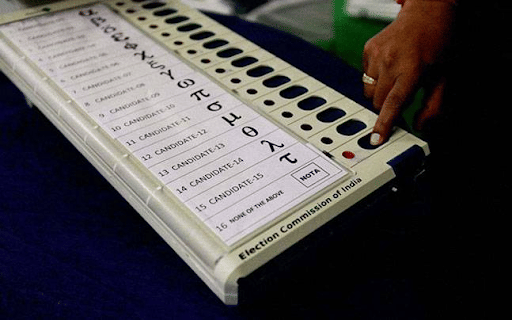
- An Electronic Voting Machine (EVM) is a simple electronic device that is used to record votes instead of the ballot papers and boxes that were previously used in traditional voting systems.
- EVMs were first used in elections to the Assemblies of Rajasthan, Madhya Pradesh, and Delhi in 1998 on an experimental basis in selected constituencies.
- In 1999, EVMs were used for the first time in general elections (state-wide) to the Goa Assembly.
- To ensure free and fair elections, the Election Commission has begun using tamper-proof electronic voting machines (EVMs).
- An EVM is composed of two components: the control unit and the balloting unit.
- A cable connects these units together.
- The EVM control unit is kept with the presiding officer or polling officer.
- The balloting unit is kept in the voting compartment so that voters can cast their ballots.
- This is done to ensure that your identity is verified by the polling officer.
- Instead of issuing a ballot paper with the EVM, the polling officer will press the Ballot Button, allowing the voter to vote.
- A list of candidate names and/or symbols will be displayed on the machine, along with a blue button.
- The voter can vote by pressing the button next to the candidate's name. An EVM has a maximum capacity of 2,000 votes.
- If an EVM fails, it is replaced with a new one, and all votes cast up to that point are saved in the control unit's memory.
- The result can be stored in the control unit's memory until it is deleted or cleared.
| Other Relevant Links | |
|---|---|
| District Election Officer (DEO) | Chief Election Commissioner of India |
| Electronically Transmitted Postal Ballot System (ETPBS) | Chief Electoral Officer (CEO) |
Historical Background
- The Electronics Corporation of India Ltd. (ECIL), Hyderabad, was tasked with designing and developing it after it was first conceived by the Election Commission in 1977.
- On August 6, 1980, the Election Commission demonstrated a prototype to representatives of political parties.
- Once a broad consensus was reached on the introduction of EVMs, another public-sector undertaking, Bharat Electronic Ltd. (BEL), Bangalore, was co-opted with ECIL to manufacture them.
- The first use of EVMs occurred in a general election in Kerala in May 1982; however, due to the lack of a specific law mandating their use, the Supreme Court overturned that election.
- Following that, in 1989, Parliament amended the Representation of the People Act, 1951 to include a provision for the use of electronic voting machines (EVMs) in elections.
- Only in 1998 was a general agreement reached on its use in 25 Legislative Assembly constituencies spread across three states: Madhya Pradesh, Rajasthan, and Delhi.
- Its use was expanded to 45 Parliamentary Constituencies in 1999, and then to 45 Assembly Constituencies in Haryana Assembly elections in February 2000.
- EVMs were used in all Assembly Constituencies in the May 2001 State Assembly elections in Tamil Nadu, Kerala, Pondicherry, and West Bengal.
- Since then, the Commission has used EVMs in every State Assembly election.
- EVMs (more than one million) were used in all 543 Parliamentary Constituencies in the country during the 2004 General Election to the Lok Sabha.
Provisions
- In March 1989, the Parliament amended the Representation of the People Act, 1951, introducing Section 61 (A) in the said Act, which provided for the recording of votes on voting machines in such manner as may be prescribed and may be adopted in such constituencies or constituencies as the Election Commission may specify.
- In accordance with the foregoing provisions, the Central Government amended the Conduct of Election Rules, 1961, by inserting a new Chapter II [Rules 49(a) to 49(x)] to make the use of Electronic Voting Machines easier.
Significance
Eliminates Ballot Paper
- EVM voting has simplified the process because it eliminates the need to mark a ballot paper and place it in a ballot box.
- The voter simply presses the blue button against the candidate and symbol of his choice on an EVM, and the vote is recorded.
No Possibility of Invalid Votes
- There are both audio and visual indicators to ensure that the voter's vote was correctly recorded. When a voter presses the blue button, the lamp next to the symbol of his or her preferred candidate glows red and a long beep is heard.
- It eliminates the possibility of invalid and questionable votes, which are frequently the root causes of controversies and election petitions.
- It speeds up the voting process compared to the traditional system.
Economically Viable
- It significantly reduces the amount of paper used, saving a large number of trees and making the process environmentally friendly.
- It reduces printing costs (to almost nothing) because each Polling Station only requires one sheet of ballot paper.
Criticisms
Hacking of Votes
- There is a possibility of hacking the remotely altered control unit display through wireless communication.
- It is alleged that voting data can be altered by clipping a memory manipulator integrated circuit (IC) to the memory chip where vote data is stored.
- Replacement of microcontroller/memory chip or motherboard before poll/counting.
- Tampering of source code by ‘Trojan’.
- Vote stuffing after poll closure.
- Inadequate and flawed electoral rolls and voter identification lead to rigging and the denial of voting rights to a large number of citizens.
Booth Capturing & Muscle Power
- There is the prevalence of booth capturing, as well as fraudulent voting through rigging and impersonation.
- Using raw muscle power to intimidate voters into voting against their will or not voting at all, thus robbing large sections of society of their right to vote freely and distorting the outcome.
- Involvement of officials and local administration in subverting the electoral process.
- Engineered errors in vote counting.
Way Forward
- The Commission recommends that EVMs be implemented in all constituencies across the country as soon as possible for all elections.
- Since 1998, the Commission has increasingly relied on Electronic Voting Machines (EVMs) rather than ballot boxes.
- In 2003, EVMs were used in all states and by-elections. Encouraged by this, the Commission made the historic decision to use only EVMs in the 2004 Lok Sabha election.
- More than a million electronic voting machines (EVMs) were used in this election.
- During the general elections to the Fifteenth Lok Sabha (2009) and simultaneous Assembly elections in some States, the Commission introduced similar Braille signage features on the Electronic Voting Machines.
Conclusion
Electronic Voting Machines have thus been used successfully in sensitive constituencies and in bye-elections in a few cases. Not only were the EVMs satisfactorily demonstrated to all politician members, but several electronic experts from the Government of India also testified that the machines could be used without reservation in all of our elections.
| Other Relevant Links | |
|---|---|
| Indian Polity UPSC Notes | Elections |
| Election Process | Electoral Reforms |
| Electoral System | Pressure Groups |
FAQs
Question: What is an Electronic Voting Machine (EVM)?
Answer: An Electronic Voting Machine (EVM) is a device used to electronically record votes during elections. It consists of two main parts: the control unit and the ballot unit. The control unit is operated by the polling officer, while the ballot unit allows voters to cast their votes. The EVM ensures that the voting process is efficient, secure, and accurate, reducing the chances of human error and fraudulent activities that can occur with traditional paper-based voting methods.
Question: How does an EVM work?
Answer: An EVM works through a simple process:
- Control Unit: The control unit is operated by the polling officer, who ensures that the machine is set up for voting and is functioning correctly.
- Ballot Unit: The ballot unit is where the voter casts their vote. It contains a list of candidates with their respective party symbols. The voter selects their preferred candidate by pressing a button next to their name and symbol.
- Recording the Vote: When the voter presses a button, the vote is electronically recorded in the EVM's memory, and a light indicator shows that the vote has been successfully cast.
- Counting the Votes: After the voting is completed, the EVM is sealed and transported to the counting center. The votes are counted electronically, ensuring a fast and accurate result.
Question: What are the advantages of using Electronic Voting Machines (EVMs)?
Answer: EVMs offer several advantages over traditional voting methods:
- Efficiency: EVMs speed up the voting process and allow for faster counting of votes, leading to quicker results.
- Accuracy: The use of electronic recording reduces the chances of human error in counting votes, making the election process more accurate.
- Security: EVMs are tamper-proof and designed to prevent vote manipulation. They are also secured by various safety measures to protect the integrity of the voting process.
- Cost-Effective: In the long run, EVMs reduce the costs associated with printing paper ballots and manual counting.
- Environmentally Friendly: The use of EVMs reduces the need for paper, making the process more sustainable.
Question: What are the challenges associated with the use of Electronic Voting Machines?
Answer: Despite their many advantages, EVMs face certain challenges:
- Voter Awareness: Many voters, especially in rural areas, may not be familiar with how to operate the EVMs, which could cause confusion and delays during voting.
- Technical Issues: Like any electronic device, EVMs are susceptible to technical malfunctions, such as battery failures or software glitches, which can disrupt the voting process.
- Security Concerns: Although EVMs are generally secure, there are concerns about the potential for hacking or tampering. There have been allegations of EVMs being manipulated, although these have not been conclusively proven.
- Legal and Political Debate: The use of EVMs has been the subject of legal and political debate, with some political parties questioning their fairness and calling for more transparency in the system.
Question: How does the Election Commission ensure the security and integrity of EVMs?
Answer: The Election Commission of India has implemented several measures to ensure the security and integrity of EVMs:
- Sealing and Storage: After the voting process, the EVMs are sealed and stored in a secure location until the counting process.
- Mock Polls: Before the actual election, mock polls are conducted to ensure that the EVMs are functioning correctly.
- Paper Trail: The introduction of Voter Verified Paper Audit Trails (VVPAT) has added an additional layer of security. VVPAT allows voters to verify their vote on paper, ensuring transparency.
- Randomized Selection: The Election Commission ensures that EVMs are randomly selected for use in elections, and all processes are transparent and well-documented.
MCQs
1. What is the primary purpose of an Electronic Voting Machine (EVM)?
A) To reduce the cost of elections
B) To conduct elections more efficiently and securely
C) To promote voter awareness
D) To store voter data electronically
Answer: (B) See the Explanation
Explanation: The primary purpose of an EVM is to conduct elections efficiently, securely, and with greater accuracy compared to traditional paper-based voting methods.
2. Which part of the EVM is operated by the polling officer?
A) Ballot Unit
B) Control Unit
C) Voter Unit
D) Counting Unit
Answer: (B) See the Explanation
Explanation: The control unit of the EVM is operated by the polling officer, while the ballot unit is where the voter casts their vote.
3. What does VVPAT stand for in relation to EVMs?
A) Voter Verified Paper Audit Trail
B) Voter Verification Process
C) Vote Validation and Paper Audit
D) Voter Voting Process and Audit Trail
Answer: (A) See the Explanation
Explanation: VVPAT stands for Voter Verified Paper Audit Trail, which allows voters to verify their vote on paper, adding an extra layer of security and transparency to the EVM process.
4. Which of the following is a feature of Electronic Voting Machines?
A) Electronic voting records are stored in the cloud
B) Voters receive a printed receipt of their vote
C) The control unit is used by the voter
D) Ballot units can store data remotely
Answer: (B) See the Explanation
Explanation: The VVPAT system allows voters to receive a printed receipt of their vote, which they can verify before casting their final vote.
5. What is the major benefit of using EVMs over traditional paper ballots?
A) Increased transparency
B) Increased voter participation
C) Faster results and reduced manual errors
D) Increased cost of elections
Answer: (C) See the Explanation
Explanation: EVMs provide faster results and reduce manual errors in vote counting, making the election process more efficient and accurate.
GS Mains Questions and Model Answers
Q1: Evaluate the role of Electronic Voting Machines (EVMs) in enhancing the integrity of elections in India.
Answer: EVMs have significantly enhanced the integrity of elections in India by reducing human error, preventing vote tampering, and speeding up the voting and counting process. The use of EVMs ensures that votes are cast and recorded electronically, making it difficult for fraudulent activities like vote stuffing or manipulation to occur. Furthermore, the introduction of Voter Verified Paper Audit Trails (VVPAT) has added an additional layer of transparency and accountability. Despite some criticisms, EVMs have contributed to increasing voter confidence and have made the election process more efficient and secure.
Q2: How do Electronic Voting Machines (EVMs) ensure fairness and security during elections?
Answer: EVMs ensure fairness and security during elections by incorporating various safeguards. The machines are tamper-proof and sealed with security measures, making them resistant to external manipulation. The use of the VVPAT system allows voters to verify their vote, further increasing transparency. Additionally, EVMs reduce the chances of human error in vote counting and minimize the possibility of ballot stuffing or other fraudulent activities that could occur in manual voting systems. The Election Commission has also introduced protocols for the proper handling and storage of EVMs to ensure their integrity throughout the election process.
Q3: Discuss the challenges faced by the Election Commission of India in the adoption of Electronic Voting Machines (EVMs) and how they have been addressed.
Answer: The adoption of Electronic Voting Machines (EVMs) by the Election Commission of India has faced several challenges, including technical issues, concerns over transparency, and political skepticism. Initially, there were doubts about the security of EVMs, with some parties alleging that the machines could be tampered with. To address these concerns, the Election Commission introduced VVPAT systems, allowing voters to verify their vote on paper. Additionally, EVMs undergo rigorous testing and mock polling before each election to ensure their reliability. The Election Commission also implemented strict procedures for the storage and transportation of EVMs to ensure their security. These measures have helped build trust in the system, although challenges still remain in some quarters regarding the complete transparency of the process.
Previous Year Questions on EVMs
1. UPSC CSE Prelims 2020:
Question: What does VVPAT stand for in the context of Electronic Voting Machines?
A) Voter Verified Paper Audit Trail
B) Vote Verification Paper Audit Trail
C) Verified Voting Paper Audit Trial
D) Voter Voting Paper Audit Trail
Answer: (A)
Explanation: VVPAT stands for Voter Verified Paper Audit Trail, which allows voters to verify their vote on paper to ensure transparency and accuracy in the voting process.
2. UPSC CSE Mains 2019 (GS Paper 2):
Question: "Discuss the impact of Electronic Voting Machines (EVMs) on the electoral process in India."
Answer: Electronic Voting Machines (EVMs) have revolutionized the electoral process in India by ensuring greater accuracy, security, and efficiency. EVMs reduce the chances of human error and fraud that were prevalent in traditional paper-based voting systems. With the introduction of VVPAT, the transparency and trust in the system have been further enhanced, ensuring that voters can verify their votes. Moreover, EVMs expedite the vote counting process, leading to faster election results. Despite some challenges, EVMs have become an essential tool in India's electoral process, contributing to more free and fair elections.
Download the PREPP App and attempt FREE IAS Exam Mock Tests and get complete study material!

Full Test - 04: UPSC CSE Prelims CSAT (Paper-II)
Full Test - 03: UPSC CSE Prelims CSAT (Paper-II)
UPSC CSE Prelims 2026 GS Paper 1 Question Paper (24-May-2026)
UPSC CSE Prelims 2026 CSAT Paper 2 Question Paper (24-May-2026)

17 February 2025 | The Hindu Must Read Articles | Current Affairs

16 February 2026 | The Hindu Must Read Articles | Current Affairs

13 February 2026 | The Hindu Must Read Articles | Current Affairs









Comments