Electronically Transmitted Postal Ballot System (ETPBS) – Indian Polity Notes
The Electronically Transmitted Postal Ballot System (ETPBS) is a one-way electronic transmission of postal ballots to Service Voters. The Service Voter then casts their ballot and mails it to the relevant returning officer. To guarantee safe transmission, the entire procedure is safeguarded by several checks and transmission protocols. It was created by the Election Commission of India with the assistance of the Centre for Development of Advanced Computing (C-DAC) for the use of voters. This application was released on October 21st, 2016. This article explains the Electronically Transmitted Postal Ballot System (ETPBS) which is helpful for UPSC Preparation.
| To Read update on this topic: |
|
Table of Contents |
What is an Electronically Transmitted Postal Ballot System (ETPBS)?
- The one-way electronic transmission of postal ballots to Service Voters is known as the Electronically Transmitted Postal Ballot System (ETPBS).
- The Service Voter then casts their ballot and mails it to the appropriate returning officer.
- ETPBS is a completely safe system with two security levels. The usage of OTP and PIN ensures voting confidentiality, and the unique QR Code prevents repetition of casted ETPB.
- This technique allows service voters to vote on an electronically sent postal ballot from anywhere outside their district, eliminating the possibility of missing out on a voting opportunity.
- The online system's goal was to develop a straightforward and simple online mechanism for Defense Personnel to become Service Voters.
- With the tagline "no voter left behind," the Election Commission of India's ETPBS has empowered and safeguarded the constitutional right of all qualified service electors to vote while fulfilling their duty for the nation.
| Other Relevant Links | |
|---|---|
| District Election Officer (DEO) | Chief Election Commissioner of India |
| Electronic Voting Machine | Chief Electoral Officer (CEO) |
Historical Background
- The Returning Officer sent the postal ballot paper to the service voters after printing the ballot for each and every service voter in the Constituency and placing it in an envelope labeled with the Record Office address of each service voter.
- This requires a significant amount of resources, effort, and time, which increases the possibility of error because each ballot must be printed and placed in the appropriate envelope.
- Since the electoral roll was not uptodate, the Record Officer had difficulty identifying the current place of posting of the service voter, resulting in a failure to deliver the postal ballot to the concerned service voters on time.
- This resulted in a low turnout of service voters of about 3-4 percent in the 2014 Lok Sabha General Election.
ETPBS – Objective
- To ensure safe transmission, the entire process is secured by multiple checks and a transmission protocol.
- Voters who choose this decision will be eligible for a postal ballot transmitted via electronic media for a certain election.
- The designed system works in tandem with the existing postal ballot system. Voters will get their postal ballots via electronic means.
- It allows people to vote on an electronically obtained postal ballot from their preferred location, even if it is outside their original voting constituency.
- Because the time limitation for mailing postal ballots has been solved, this approach would be a simpler alternative for facilitating voting by electors.
ETPBS – Process
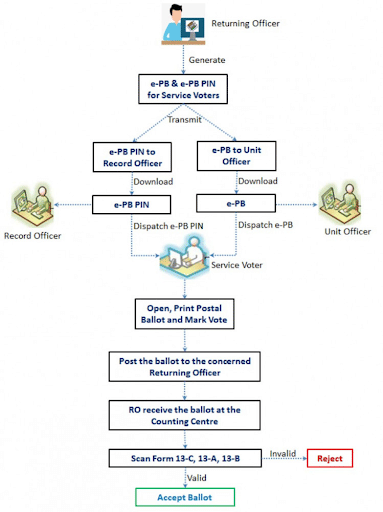
- When the postal ballot arrives at the counting centres, the returning officer compares it to the transmitted system using a series of QR codes.
- Service voters include members of the Central Forces under the Arms Act and government officials stationed in embassies outside the country.
- The Commission has now implemented an Electronically Transmitted Postal Ballot System (EPTBS) for service voters following an amendment to Rule 23 of the Conduct of Election Rules, 1961.
ETPBS – Significance
- The Electronically Transmitted Postal Ballot System (ETPBS) will be sent to service voters via electronic means.
- It allows people to vote on an electronically obtained postal ballot from their preferred location, even if it is outside their original voting constituency.
- Because the time limitation for mailing postal ballots has been solved, this approach gives a simpler alternative for facilitating voting by electors.
- It was created for the benefit of Service voters.
- It is a secure system with two layers of security.
- Secrecy is maintained through the use of OTP and PIN.
- Due to the unique QR Code, no duplication of votesis possible.
- Service voters who are eligible can vote electronically from locations other than their home districts.
- Service voters may use the ETPBS service from any location outside their constituency.
- The system makes it easier to create service voter electoral roll data.
Postal ballot facility for Overseas voters - Recent Updates
- On March 25 2020, the Union Minister for Law and Justice indicated in Lok Sabha that the administration was looking into the potential of enabling non-resident Indians (NRI) to vote online.
- The Election Commission of India (ECI) planned in 2020 to extend postal balloting to qualified NRIs.
- Postal ballots were to be distributed electronically to NRIs, who were to return them through post after selecting their candidate.
- So yet, the ETPBS function is only available to service voters, which include members of the armed forces and central armed police forces stationed outside their home constituencies, as well as personnel of Indian embassies and diplomatic posts.
- The EC requested the government in 2020 that the ETPBS facility be extended to qualified abroad Indian voters as well.
- The Ministry of External Affairs informed ECI in March 2021 that the execution might face "major logistical hurdles" and requires "a realistic evaluation of requirements."
- A postal ballot method that allows for correct ballot validation at approved consular/embassy offices, as well as an efficient postal system, could make this procedure easier for NRIs, although restrictions for eligibility based on time spent away from the nation must be explicitly defined.
Conclusion
The Electronically Transmitted Postal Ballot System (ETPBS) transmits postal ballots to service voters in a single direction using electronic means. The Electronically Transmitted Postal Ballot System (ETPBS) is a first-of-its-kind achievement made by the Election Commission of India during the just completed Lok Sabha Election 2019. The ETPBS has empowered and ensured that all qualified service electors may exercise their constitutional right to vote while carrying out their obligations to the country under the slogan "no voter to be left behind."
| Other Relevant Links | |
|---|---|
| Indian Polity UPSC Notes | Elections |
| Election Process | Electoral Reforms |
| Electoral System | Pressure Groups |
FAQs
Question. What is the Electronically Transmitted Postal Ballot System (ETPBS)?
Answer: ETPBS is a secure and efficient system developed by the Election Commission of India to facilitate the postal voting process for service voters, enabling them to cast their votes remotely.
Question. Who are eligible to use ETPBS?
Answer: ETPBS is primarily available for service voters, including members of the armed forces, paramilitary forces, government officials serving abroad, and their spouses.
Question. How does ETPBS work?
Answer: Through ETPBS, service voters receive their postal ballots electronically. They can download the ballot, mark their vote, and return it to the returning officer via post within the stipulated time.
Question. What are the advantages of ETPBS?
Answer: ETPBS ensures speed, accuracy, and transparency in the voting process. It reduces delays in postal services, provides convenience to service voters, and enhances the participation of eligible voters in elections.
Question. Is the Electronically Transmitted Postal Ballot System secure?
Answer: Yes, ETPBS is designed with multiple layers of security to ensure confidentiality and prevent tampering. It uses encrypted data transmission to protect voter information and ballot integrity.
MCQs
- What is the primary purpose of the ETPBS?
A) To facilitate voting for urban voters
B) To simplify voting for overseas citizens of India
C) To enable postal voting for service voters
D) To replace Electronic Voting Machines (EVMs)
Answer: (C) See the Explanation
ETPBS is designed to ensure service voters, such as members of the armed forces, can participate in elections remotely.
- Which organization developed the ETPBS?
A) National Informatics Centre (NIC)
B) Election Commission of India (ECI)
C) Ministry of Home Affairs
D) Defence Research and Development Organisation (DRDO)
Answer: (B) See the Explanation
The Election Commission of India developed the ETPBS to enhance the voting process for service voters.
- Who among the following are eligible for ETPBS?
A) Members of the armed forces
B) Government officials serving abroad
C) Spouses of service voters
D) All of the above
Answer: (D) See the Explanation
ETPBS is available for members of the armed forces, government officials serving abroad, and their spouses.
- What is the main advantage of ETPBS over the traditional postal ballot system?
A) It eliminates the need for physical polling stations
B) It ensures faster and secure transmission of ballots
C) It increases the voter turnout among urban populations
D) It replaces electronic voting machines
Answer: (B) See the Explanation
ETPBS speeds up the process by electronically transmitting the ballot, reducing delays associated with traditional postal systems.
- What ensures the security of the ETPBS system?
A) Use of blockchain technology
B) End-to-end encryption and secure transmission
C) Biometric verification
D) Double-layer authentication
Answer: (B) See the Explanation
ETPBS uses encrypted data transmission and secure protocols to ensure the confidentiality and integrity of the voting process.
GS Mains Questions and Model Answers
Q1: Discuss the significance of ETPBS in strengthening democracy in India.
Answer: ETPBS plays a crucial role in strengthening democracy by ensuring that service voters, including armed forces personnel and overseas officials, can participate in the electoral process. It addresses logistical challenges associated with traditional postal ballots by providing a faster and more reliable system. The electronic transmission reduces delays and ensures that ballots are received and returned within the stipulated time, thus safeguarding the principle of universal adult franchise. By increasing the participation of service voters, ETPBS enhances inclusivity and transparency in elections.
Q2: Explain the challenges associated with implementing ETPBS and suggest solutions.
Answer: While ETPBS is a significant innovation, it faces challenges such as ensuring 100% secure transmission, maintaining voter confidentiality, and managing technical issues in remote locations. Lack of awareness among eligible voters about the system is another concern. To address these challenges, robust cybersecurity measures and training programs for voters are essential. Additionally, regular audits and feedback mechanisms can help identify and resolve implementation issues, ensuring the system operates smoothly and effectively.
Q3: Evaluate the impact of ETPBS on voter turnout among service voters.
Answer: ETPBS has positively impacted voter turnout among service voters by simplifying the voting process. The traditional postal ballot system often led to delays and low participation due to logistical hurdles. By enabling faster and more efficient ballot transmission, ETPBS has increased accessibility for service voters, empowering them to exercise their democratic rights. This has strengthened the overall electoral framework and contributed to more representative election outcomes, especially in constituencies with significant service voter populations.
Previous Year Questions on ETPBS
1. UPSC CSE Prelims 2021
Question: Which of the following categories of voters are eligible to use the Electronically Transmitted Postal Ballot System (ETPBS)?
- Armed forces personnel
- Government officials posted abroad
- Overseas citizens of India
A) 1 and 2 only
B) 2 and 3 only
C) 1, 2, and 3
D) 1 only
Answer: (A) See the Explanation
ETPBS is specifically designed for service voters, including members of the armed forces and government officials posted abroad. Overseas citizens of India are not eligible to use this system.
2. UPSC CSE Mains 2019
Question: Analyze the role of the Electronically Transmitted Postal Ballot System (ETPBS) in enhancing the electoral process in India.
Answer: ETPBS has significantly enhanced India’s electoral process by addressing the challenges faced by service voters. The system allows eligible voters to download their postal ballots electronically, ensuring faster and more efficient participation. By reducing dependence on traditional postal services, ETPBS minimizes delays and ensures ballots are returned on time. Its secure and transparent design prevents tampering, instilling confidence in the electoral system. However, challenges such as cybersecurity concerns and the need for voter awareness persist. Strengthening these aspects will further consolidate the role of ETPBS in ensuring inclusive and transparent elections.
Download the PREPP App and attempt FREE IAS Exam Mock Tests and get complete study material!

Full Test - 04: UPSC CSE Prelims CSAT (Paper-II)
Full Test - 03: UPSC CSE Prelims CSAT (Paper-II)
UPSC CSE Prelims 2026 GS Paper 1 Question Paper (24-May-2026)
UPSC CSE Prelims 2026 CSAT Paper 2 Question Paper (24-May-2026)

17 February 2025 | The Hindu Must Read Articles | Current Affairs

16 February 2026 | The Hindu Must Read Articles | Current Affairs

13 February 2026 | The Hindu Must Read Articles | Current Affairs









Comments