Fundamental Duties - Indian Polity Notes
Fundamental duties are the moral obligations that all citizens of a country have, and in India, the list of fundamental duties that are contained in Part IV-A of the Constitution to foster patriotism and strengthen India's unity. The Fundamental Duties in the Indian Constitution are modelled after the Constitution of the erstwhile USSR.
Sardar Swaran Singh Committee was established in 1976 to make recommendations on fundamental duties. The committee recommended that the Constitution should include a separate chapter on fundamental duties. The 42nd Constitutional Amendment Act, 1976 added a new part, namely, Part IVA to the Constitution. This part contained only one Article i.e., Article 51A, which for the first time specified a code of ten fundamental duties of citizens. Later on, one more fundamental duty was added by the 86th Amendment Act in 2002.
The UPSC Indian Polity and Governance Syllabus includes the 11 Fundamental Duties which is described in this article.
Table of Contents
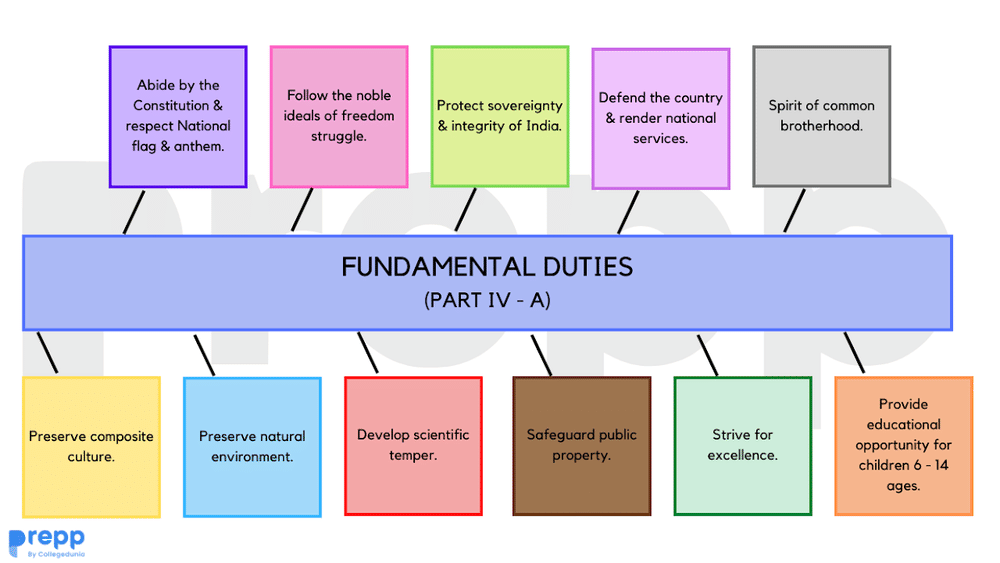
11 Fundamental Duties
List Of Fundamental Duties
The chart below lists the 11 Fundamental Duties under Article 51-A that every Indian citizen must follow:
| S.No | 11 Fundamental Duties |
|---|---|
| 1 | Respect the Indian Constitution's values and institutions, as well as the National Flag and National Anthem. |
| 2 | Keep in mind and uphold the great principles that motivated the nation's fight for independence. |
| 3 | Maintain and safeguard India's sovereignty, unity, and integrity. |
| 4 | When called upon, defend the country and perform national service. |
| 5 | Promote tranquilly and a feeling of universal brotherhood among all Indians, regardless of religious, linguistic, regional, or sectional differences, and condemn behaviours that are demeaning to women's dignity. |
| 6 | To appreciate and protect the rich heritage of the country’s diverse culture |
| 7 | To preserve and develop the natural environment, including woods, lakes, rivers, and wildlife, as well as to have compassion for all living things. |
| 8 | Develop a scientific temperament, humanism, and an inquiring and reforming mentality. |
| 9 | To protect public property and to avoid violence |
| 10 | To strive for excellence in all spheres of individual and collective activity, so that the nation is always striving for greater levels of success and endevour. |
| 11 | Provide educational opportunities for his kid or ward between the ages of six and fourteen. The 86th Constitutional Amendment Act of 2002 added this duty. |
| Other Relevant Links | |
|---|---|
| 11 Fundamental Duties | Verma Committee Observations |
| constitutional amendments | Basic Structure Doctrine |
| Procedure for Amendment | Significance of Fundamental Duties |
|
"Fundamental duties are the moral obligations on all citizens to promote a spirit of patriotism and to uphold the unity of India, thus strengthening the roots of our democracy." |
Importance of Fundamental Duties
Fundamental responsibilities are inextricably linked to fundamental rights. The significance of each is listed in the table below:
- They remind Indian citizens of their responsibilities to their society, fellow citizens, and country.
- They warn citizens about anti-national and anti-social acts.
- They motivate residents and instil in them a feeling of discipline and devotion.
- They assist courts in reviewing and determining whether a law is constitutionally valid.
- The Parliament can impose an appropriate penalty or punishment if any of them is not fulfiled.
Criticism Of Fundamental Duties
- The list of duties is not exhaustive because it does not include other important responsibilities such as voting, paying taxes, family planning, and so on.
- Some of the duties are unclear, ambiguous, and difficult for the average person to grasp. For example, phrases like 'noble ideals,' 'composite culture,"scientific temper,' and so on can all be interpreted differently.
- Due to their non-justiciable nature, critics have referred to them as a code of moral precepts.
- Their inclusion in the Constitution was deemed superfluous by critics. This is due to the fact that the duties enumerated in the Constitution as fundamental would be performed by the people even if they were not enumerated in the Constitution.
- The inclusion of fundamental duties as an appendix to Part IV of the Constitution has diminished their value and significance. They should have been added after Part III to be on par with Fundamental Rights.
Conclusion
The moral value of fundamental duties was to establish a democratic balance by making people aware of their duties in the same way that they are aware of their rights'. The necessity and desirability of including the Fundamental Duties in the Constitution was eventually agreed upon. This is made clearer by the addition of one more Fundamental Duty by the 86th Amendment Act in 2002.
FAQs
Q1: What are Fundamental Duties in the Indian Constitution?
Answer: Fundamental Duties are a set of moral obligations enshrined in Article 51A of the Indian Constitution that every citizen is expected to observe. They were added to the Constitution by the 42nd Amendment in 1976 and serve to promote patriotism and strengthen the spirit of the nation.
Q2: How many Fundamental Duties are there in India?
Answer: There are eleven Fundamental Duties listed in Article 51A of the Indian Constitution. These duties encompass a range of responsibilities, from promoting harmony and spirit of common brotherhood to safeguarding public property.
Q3: Are the Fundamental Duties legally enforceable?
Answer: No, the Fundamental Duties are not legally enforceable in a court of law. However, they serve as a guiding principle for citizens and can influence legislative measures and policies. They aim to promote responsible citizenship and uphold the values enshrined in the Constitution.
Q4: What is the significance of Fundamental Duties in Indian democracy?
Answer: Fundamental Duties play a crucial role in promoting civic responsibility among citizens. They serve as a reminder of the moral obligations that individuals owe to the nation and encourage active participation in the democratic process. By fulfilling these duties, citizens contribute to national unity and integrity.
Q5: Can Fundamental Duties be amended?
Answer: Yes, Fundamental Duties can be amended by a constitutional amendment. However, any such amendment would require a significant political consensus as they are integral to the principles of governance and citizenship in India.
MCQs
- In which year were the Fundamental Duties added to the Indian Constitution?
A) 1950
B) 1976
C) 1986
D) 1991
Answer: (B) See the Explanation
- How many Fundamental Duties are outlined in Article 51A of the Indian Constitution?
A) 9
B) 10
C) 11
D) 12
Answer: (C) See the Explanation
- Which of the following is NOT a Fundamental Duty under Article 51A?
A) To promote harmony and the spirit of common brotherhood
B) To defend the country and render national service
C) To vote in elections
D) To develop a scientific temper
Answer: (C) See the Explanation
- What is the purpose of Fundamental Duties in the Indian Constitution?
A) To restrict individual freedoms
B) To promote patriotism and civic responsibility
C) To outline the rights of citizens
D) To enforce legal obligations
Answer: (B) See the Explanation
- Which Article of the Indian Constitution enshrines Fundamental Duties?
A) Article 19
B) Article 21
C) Article 51A
D) Article 44
Answer: (C) See the Explanation
GS Mains Questions and Model Answers
Q1. Analyze the importance of Fundamental Duties in strengthening the Indian democracy.
Answer: Fundamental Duties, enshrined in Article 51A of the Indian Constitution, play a vital role in strengthening Indian democracy by fostering a sense of responsibility among citizens. They remind individuals that rights and privileges come with inherent responsibilities towards the nation and society. By emphasizing duties such as promoting harmony, safeguarding public property, and respecting the Constitution, these duties encourage active citizenship and participation in democratic processes.
The significance of Fundamental Duties is manifold. They serve as a moral compass for citizens, guiding their actions and fostering a culture of accountability. In a diverse society like India, where communal harmony is essential for national integrity, these duties promote unity and common brotherhood. They also emphasize the need for citizens to engage in the democratic process, thus reinforcing the foundations of democracy.
Furthermore, while Fundamental Duties are not legally enforceable, they can influence legislative measures and public policies aimed at promoting responsible citizenship. By nurturing a sense of duty, the Constitution seeks to create a proactive citizenry that actively participates in governance and nation-building. Ultimately, the Fundamental Duties contribute to the overall health of democracy by cultivating a spirit of civic engagement and social responsibility.
Q2. Discuss the relationship between Fundamental Rights and Fundamental Duties in the Indian Constitution.
Answer: The relationship between Fundamental Rights and Fundamental Duties in the Indian Constitution is integral and complementary. Fundamental Rights, enshrined in Part III of the Constitution, provide citizens with certain essential freedoms and protections, including the right to equality, freedom of speech, and protection from discrimination. These rights are meant to safeguard individual liberties and ensure that citizens can participate fully in the democratic process.
On the other hand, Fundamental Duties, outlined in Article 51A, emphasize the responsibilities of citizens towards the nation and society. They remind individuals that the exercise of rights comes with corresponding duties, such as promoting harmony, protecting the environment, and respecting the Constitution. This interplay between rights and duties is critical in fostering a balanced and responsible approach to citizenship.
The Constitution envisages that a healthy democracy is built on both rights and responsibilities. While Fundamental Rights empower individuals to assert their freedoms, Fundamental Duties call for active engagement and contribution to the collective good. The effective exercise of rights can be hindered without the fulfillment of duties, as societal harmony and cooperation are essential for the realization of individual freedoms.
In conclusion, the relationship between Fundamental Rights and Duties is symbiotic; rights empower citizens, while duties encourage them to uphold the values and principles enshrined in the Constitution, thus promoting a vibrant and responsible democracy.
Q3. Evaluate the challenges in the implementation of Fundamental Duties in India.
Answer: The implementation of Fundamental Duties in India faces several challenges that hinder their effective realization. One major challenge is the lack of awareness and understanding among citizens regarding these duties. Many individuals are familiar with their Fundamental Rights but may not fully comprehend the importance of their corresponding responsibilities. This gap in knowledge limits civic engagement and reduces the motivation to fulfill these duties.
Another challenge is the absence of legal enforceability. While Fundamental Duties are essential moral obligations, their non-enforceable nature means that there are no legal repercussions for failing to adhere to them. This can lead to apathy and a lack of accountability among citizens regarding their responsibilities.
Furthermore, social and economic inequalities also impact the implementation of Fundamental Duties. Marginalized communities may prioritize survival and basic needs over civic responsibilities, making it difficult for them to engage actively in fulfilling their duties. Issues such as poverty, illiteracy, and lack of access to resources can hinder participation in civic life.
Additionally, political and administrative challenges, including corruption and bureaucratic inefficiencies, can obstruct the realization of Fundamental Duties at the grassroots level. Without effective governance and community engagement, the spirit of these duties may not translate into meaningful action.
In conclusion, while Fundamental Duties are crucial for fostering responsible citizenship, their implementation requires concerted efforts to enhance awareness, accountability, and inclusivity, ensuring that all citizens can contribute to the nation's progress.
Previous Year Questions on List Of Fundamental Duties
1. UPSC CSE 2020
Question. "The Fundamental Duties of citizens are essential for the strengthening of democracy." Discuss.
Answer: The assertion that Fundamental Duties are essential for strengthening democracy holds significant merit. Enshrined in Article 51A of the Indian Constitution, these duties serve as a reminder that rights and responsibilities go hand in hand. In a democratic setup, while citizens enjoy various rights, such as freedom of speech, equality, and protection against discrimination, the fulfillment of these rights often depends on the active participation and responsible behavior of individuals.
Fundamental Duties promote civic consciousness and accountability, urging citizens to respect the Constitution, promote harmony, and safeguard public property. By encouraging active engagement in societal issues, these duties help cultivate a spirit of cooperation and collective responsibility among citizens. This is especially vital in a diverse nation like India, where communal harmony and social cohesion are essential for national integration.
Moreover, the emphasis on duties can lead to a more informed citizenry that understands the implications of its rights and engages meaningfully in the democratic process. As citizens fulfill their responsibilities, they contribute to a more vibrant democracy characterized by active participation, mutual respect, and social solidarity.
In conclusion, the Fundamental Duties not only reinforce the moral fabric of society but also enhance the overall functioning of democracy by fostering responsible citizenship and promoting active involvement in governance and nation-building.
2. UPSC CSE 2018
Question. What are the roles of Fundamental Duties in the context of the current socio-political landscape in India?
Answer: Fundamental Duties, as articulated in Article 51A of the Indian Constitution, play a crucial role in shaping the socio-political landscape of contemporary India. In a rapidly changing environment characterized by globalization, social media influence, and diverse cultural dynamics, these duties serve as a moral compass for citizens, guiding their actions and interactions within society.
In the current socio-political context, where issues like communalism, social inequality, and environmental degradation are prevalent, Fundamental Duties provide a framework for fostering unity and collective responsibility. By emphasizing duties such as promoting harmony, protecting the environment, and developing a scientific temper, citizens are encouraged to contribute positively to societal well-being. This is particularly significant in combating divisive narratives and promoting social cohesion.
Moreover, the growing importance of civic engagement in governance highlights the relevance of Fundamental Duties. As citizens become more aware of their rights, they must also recognize their responsibilities towards the nation. This awareness can lead to increased participation in democratic processes, such as voting, community service, and advocacy for social issues.
Furthermore, in an age where misinformation can easily spread, promoting a scientific temper becomes crucial in ensuring informed decision-making among citizens. This aligns with the need for a responsible citizenry that can critically assess information and engage in constructive dialogue.
In conclusion, Fundamental Duties are not merely legal mandates but essential elements for nurturing a vibrant and cohesive society. They encourage citizens to actively contribute to the nation’s progress, fostering a culture of responsibility and collective action in addressing the challenges of contemporary India.
*email: contactus@prepp.in
Download the PREPP App and attempt FREE IAS Exam Mock Tests and get complete study material!

Full Test - 04: UPSC CSE Prelims CSAT (Paper-II)
Full Test - 03: UPSC CSE Prelims CSAT (Paper-II)
UPSC CSE Prelims 2026 GS Paper 1 Question Paper (24-May-2026)
UPSC CSE Prelims 2026 CSAT Paper 2 Question Paper (24-May-2026)

17 February 2025 | The Hindu Must Read Articles | Current Affairs

16 February 2026 | The Hindu Must Read Articles | Current Affairs

13 February 2026 | The Hindu Must Read Articles | Current Affairs









Comments