Constitutional Amendments - Indian Polity Notes
Constitutional amendments are crucial to maintaining the dynamic and responsive nature of the country's legal framework. Since the adoption of the Constitution on January 26, 1950, India has made numerous amendments to address changing socio-economic conditions, rectify issues, and fulfil the evolving needs of its citizens
Article 368 (Part XX) deals with the procedure and powers of Parliament to amend the Constitution. The Indian Constitution's amendment procedure was inspired by the South African Constitution. In India, the procedure of Constitutional Amendment is blend of flexible as well as rigid methods. In article “Constitutional Amendments” you will read about the procedure of constitutional amendments and types in detail, which is very important concept in the UPSC/IAS Polity and Governance syllabus.
Table of Contents
Constitutional Amendments
What are Constitutional Amendments?
- Making changes to the constitution, which is the governing law of the land, is known as a constitutional amendment.
- To change or alter the constitution, requires a formal modification to the written text of the constitution.
- It includes the addition of a new article or clause, the deletion of an existing article or clause, or the improvement of existing articles.
- In some areas, even the text of the constitution has also been modified.
- The amendment to the constitution requires it to go through a specific procedure, which includes passing it via multiple legislative assemblies before being sent to the president for final approval and signature.
|
"Constitutional amendments are the tools by which state refines its principles, correcting past oversights and charting a course towards a more just and equitable future." |

Constitutional Provisions
- Part XX, Article 368 of the Indian constitution deals with the procedure and powers of Parliament to amend the Constitution. It keeps the Parliament's arbitrary power under check.
- Article 368 of the Constitution sets forth the mechanism for amending the Constitution, which states that an amendment can only be commenced by introducing a Bill in either House of Parliament, which must be passed by both.
- The Bill must be passed by both houses with a total majority (regardless of vacancies or absentees) and a majority of not less than 2/3rds of those present and voting.
- In the case of disagreement, there is no provision for a joint sitting.
- It must be ratified by not less than half of the states in order to alter provisions stated in Article 368, such as amending federal features.
| Other Relevant Links | |
|---|---|
| Swaran Singh Committee | Verma Committee |
| 11 Fundamental Duties | Significance of Fundamental Duties |
| Procedure for Amendment | Basic Structure Doctrine |
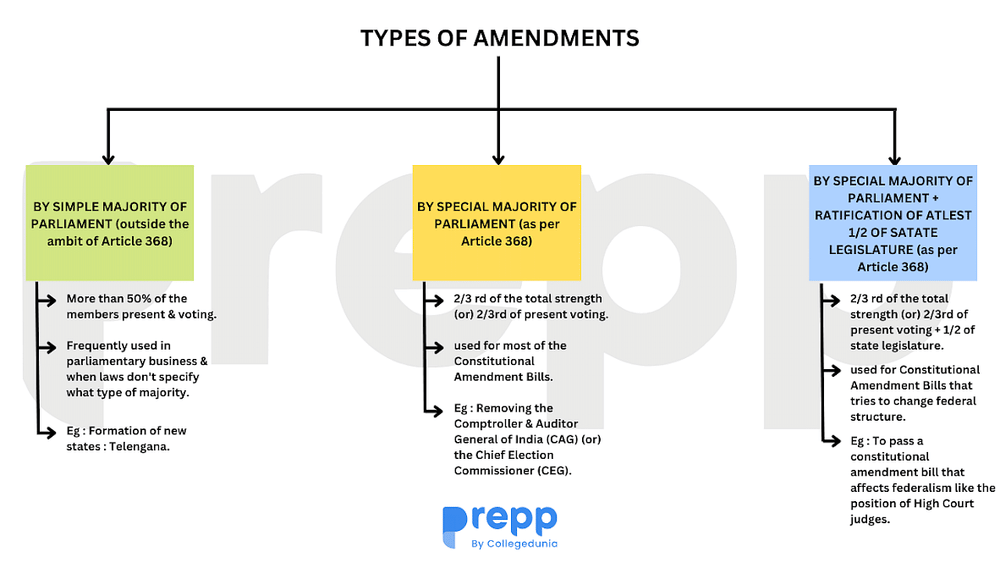
Types of Amendments
The Constitution can be amended in one of three ways:
- Amendment by a simple majority of the Parliament
- Amendment by a special majority of the Parliament
- Amendment by a special majority of the Parliament and at least half of the state legislatures' ratification
Procedure for Amendment of Constitution
- Only by introducing a bill in either house of the Parliament with the intended objective can an amendment be started.
- It doesn't need the President's approval to be introduced; either a minister or a private member may do so.
- A special majority, defined as a majority of the entire membership of the house and a majority of two-thirds of the members present and voting, is required for the bill to pass in each house.
- The bill must be approved by each house separately. There is no provision for a Joint sitting of the houses if there is any disagreement.
- If a law tries to change the provisions of the constitution, it must be approved by a simple majority of the legislatures of half of the states.
- The law is forwarded to the President for his approval after passing both houses.
- The president must give his assent to the bill.He can neither withhold his assent nor return the bill for reconsideration of the Parliament.
- After the President’s assent, the bill becomes the Act and the Constitution is altered in line with the Act's terms.
The flexibility of the Indian Constitution
- To reflect on changing society, most parts of the Indian Constitution can be amended without the concurrence of states or by a simple majority in Parliament under Article 368, such as considering the right to privacy or the right to choose one's life partner as fundamental rights under the right to life (Article 21).
- It provides for different interpretations depending on changing socioeconomic circumstances, such as ensuring that women are not discriminated against when exercising their freedom to worship, as was the situation in Sabarimala.
- It enables the evolution of legal and constitutional measures such as the reservation system's creamy layer.
Criticism
- No provision for a special body: There is no provision for a special body to change the Constitution, such as a Constitutional Convention (as in the United States) or a Constitutional Assembly.
- Inability of state legislatures: The Parliament has the sole authority to propose a constitutional modification. Except in one situation, when passing a resolution seeking the creation or elimination of legislative councils in the states, state legislatures are unable to introduce any bill or proposal to modify the Constitution.
- Major say of the Parliament: The majority of the Constitution can be changed by Parliament alone, using either a special majority or a simple majority. The approval of state legislatures is required only in a few circumstances, and even then, only in half of them.
- No provision for state legislatures to ratify or reject: The Constitution makes no provision for the state legislatures to ratify or reject an amendment that is presented to them. It is also silent on the question of whether nations can revoke their permission after giving it.
- No provision for joint sitting: If there is a deadlock over the passage of a constitutional change bill, there is no provision for a joint sitting of both Houses of Parliament.
- Amendment procedure: The procedure for amending a document is comparable to the procedure for enacting legislation. The constitutional amendment legislation must be carried by Parliament in the same way as other laws, with the exception of the special majority requirement.
- Court’s intervention: They give a lot of room for the courts to intervene.
Conclusion
Despite shortcomings, the method for Amending the Constitution has shown to be straightforward and easy to implement, and it has met the changing demands and situations. The method is not so adaptable that the ruling parties may modify it at their leisure. It is also not so inflexible as to be incapable of adapting to changing demands. It, as K.C. Wheare correctly stated, "strikes a reasonable balance between flexibility and stiffness."
FAQs
Question: What are Constitutional Amendments in India?
Answer: Constitutional Amendments in India refer to the formal changes made to the Constitution of India, allowing for adjustments to its provisions. These amendments can alter, add, or repeal existing articles and are crucial for addressing changing social, political, and economic contexts. The process of amending the Constitution is outlined in Article 368, which provides for different procedures depending on the nature of the amendment. This flexibility is essential for the Constitution to remain relevant and responsive to the needs of the nation.
Question: How many types of amendments are there in the Indian Constitution?
Answer: There are three primary types of amendments in the Indian Constitution:
- Simple Majority Amendments: These amendments can be passed by a simple majority of the members present and voting in both Houses of Parliament. Examples include amendments related to the organization of the states.
- Special Majority Amendments: These require a special majority, which means more than half of the total membership of each House and a majority of those present and voting. Many important amendments fall under this category.
- Ratification by States: Certain amendments, particularly those affecting federal structure, require ratification by at least half of the state legislatures after being passed by Parliament.
Question: What is the significance of the 42nd Amendment?
Answer: The 42nd Amendment, enacted in 1976, is significant as it brought about extensive changes to the Constitution during the Emergency period. It is often referred to as the "mini-Constitution" due to the comprehensive nature of the amendments made. Key changes included the introduction of the Fundamental Duties of citizens, changes to the procedure for amending the Constitution, and the assertion of the primacy of the Directive Principles of State Policy over Fundamental Rights. This amendment aimed to strengthen the government's authority but faced criticism for curtailing civil liberties and centralizing power.
Question: What role do Constitutional Amendments play in Indian democracy?
Answer: Constitutional Amendments play a vital role in the evolution of Indian democracy by allowing the Constitution to adapt to the changing needs of society. They facilitate the incorporation of new rights and principles, enhance the framework for governance, and reflect the aspirations of the people. Amendments can address emerging issues, such as social justice and equality, thereby strengthening the democratic fabric of the nation. Furthermore, the amendment process itself reinforces democratic values by requiring broad consensus and debate among representatives of the people.
Question: What challenges are associated with the process of amending the Constitution?
Answer: The process of amending the Constitution faces several challenges, including:
- Political Consensus: Achieving a broad consensus among diverse political parties can be difficult, particularly on contentious issues.
- Judicial Review: Amendments are subject to judicial scrutiny, and the Supreme Court may strike down amendments if found to violate the basic structure of the Constitution.
- Public Awareness: There may be limited public awareness regarding the implications of amendments, leading to a lack of engagement in the amendment process.
- Balancing Rights: Ensuring that amendments do not infringe upon Fundamental Rights while promoting social justice can be challenging.
- Federal Balance: Amendments affecting the distribution of powers between the Centre and states can lead to disputes regarding federalism.
MCQs
1. What is the primary process for amending the Indian Constitution?
A) Legislative approval
B) Presidential decree
C) Judicial order
D) Referendum
Answer: (A) See the Explanation
Explanation: The primary process for amending the Indian Constitution involves legislative approval, specifically by Parliament.
2. Which amendment is known for the introduction of Fundamental Duties?
A) 44th Amendment
B) 42nd Amendment
C) 86th Amendment
D) 61st Amendment
Answer: (B) See the Explanation
Explanation: The 42nd Amendment introduced the Fundamental Duties of citizens into the Indian Constitution.
3. What type of majority is required for a Constitutional Amendment affecting the federal structure?
A) Simple majority
B) Absolute majority
C) Special majority and ratification
D) No majority required
Answer: (C) See the Explanation
Explanation: A Constitutional Amendment affecting the federal structure requires a special majority in Parliament and ratification by at least half of the state legislatures.
4. Which of the following articles provides the procedure for amending the Constitution?
A) Article 356
B) Article 368
C) Article 370
D) Article 14
Answer: (B) See the Explanation
Explanation: Article 368 provides the procedure for amending the Constitution of India.
5. Which amendment is referred to as the "mini-Constitution"?
A) 61st Amendment
B) 73rd Amendment
C) 42nd Amendment
D) 86th Amendment
Answer: (C) See the Explanation
Explanation: The 42nd Amendment is often referred to as the "mini-Constitution" due to its extensive changes to the Constitution.
GS Mains Questions and Model Answers
Q1: Analyze the significance of Constitutional Amendments in maintaining the relevance of the Indian Constitution.
Answer: Constitutional Amendments play a vital role in ensuring that the Indian Constitution remains relevant and responsive to the evolving needs of society. They provide a mechanism for adapting the legal framework to contemporary issues, reflecting changes in social, political, and economic landscapes. Through amendments, important concepts such as Fundamental Rights and Duties can be reinforced, while provisions can be added or modified to enhance governance and democracy. Moreover, amendments address the aspirations of citizens and protect their rights, contributing to social justice. This dynamic aspect of the Constitution allows it to evolve while retaining its core principles, ensuring a balance between stability and progress in Indian democracy.
Q2: Discuss the challenges and controversies surrounding the process of amending the Constitution.
Answer: The process of amending the Constitution in India faces several challenges and controversies that can impact its effectiveness. One major challenge is the need for broad political consensus, particularly on contentious issues, which can result in protracted debates and delays. Additionally, the complex nature of some amendments may lead to legal ambiguities, prompting judicial scrutiny regarding their validity. Controversies often arise from perceived overreach by the Parliament, particularly in amendments that might affect the basic structure of the Constitution. This raises concerns about the balance of power between the legislature and judiciary. Furthermore, public awareness and engagement regarding the implications of amendments are often limited, hindering informed discussions. Addressing these challenges requires transparent processes and active public discourse to ensure that amendments reflect the collective aspirations of the society.
Q3: Evaluate the role of the judiciary in the context of Constitutional Amendments.
Answer: The judiciary plays a crucial role in the context of Constitutional Amendments by ensuring that any changes made do not violate the fundamental principles and basic structure of the Constitution. The Supreme Court has the authority to review amendments and determine their constitutionality, providing a check against potential legislative overreach. Landmark judgments, such as the Kesavananda Bharati case, established the doctrine of the basic structure, affirming that certain fundamental rights and principles cannot be altered or destroyed through amendments. This judicial oversight is vital for upholding the rule of law and protecting individual rights, ensuring that the Constitution evolves while maintaining its foundational integrity. By interpreting and enforcing constitutional provisions, the judiciary safeguards democracy and reinforces the significance of the Constitution as the supreme law of the land.
Previous Year Questions on Constitutional Amendments
1. UPSC CSE Prelims 2021:
Question: Which article of the Indian Constitution deals with the amendment procedure?
A) Article 356
B) Article 368
C) Article 370
D) Article 14
Answer: (B)
Explanation: Article 368 provides the procedure for amending the Indian Constitution.
2. UPSC CSE Mains 2019 (GS Paper 1):
Question: Evaluate the impact of the 42nd Amendment on the Indian Constitution.
Answer: The 42nd Amendment significantly impacted the Indian Constitution by introducing extensive changes during the Emergency period. It emphasized the primacy of the Directive Principles of State Policy over Fundamental Rights, which raised concerns about the balance between individual rights and state authority. The amendment also added the Fundamental Duties of citizens, fostering a sense of responsibility towards the nation. However, it faced criticism for its authoritarian implications, as it sought to centralize power and restrict civil liberties. The 42nd Amendment is often referred to as the "mini-Constitution" due to the comprehensive nature of its changes, making it a pivotal moment in the constitutional history of India.
*email: contactus@prepp.in
Download the PREPP App and attempt FREE IAS Exam Mock Tests and get complete study material!

Full Test - 04: UPSC CSE Prelims CSAT (Paper-II)
Full Test - 03: UPSC CSE Prelims CSAT (Paper-II)
UPSC CSE Prelims 2026 GS Paper 1 Question Paper (24-May-2026)
UPSC CSE Prelims 2026 CSAT Paper 2 Question Paper (24-May-2026)

17 February 2025 | The Hindu Must Read Articles | Current Affairs

16 February 2026 | The Hindu Must Read Articles | Current Affairs

13 February 2026 | The Hindu Must Read Articles | Current Affairs









Comments