Types of Amendments - Indian Polity Notes
Article 368 in Part XX of the constitution provides the amending powers to the parliament. The constitution-makers were aware of the fact that the needs of the growing democracy are dynamic, and hence the constitution should have space to accommodate new needs. So they made the amendment procedure flexible enough to meet these needs and rigid enough that it is not easy to amend everything.
Constitutional Amendment is an important topic for the UPSC Exam. An Aspirant is expected to know the various types of Amendments available for the lawmakers and what type of Amendment is used in different scenarios.
|
Table of Contents |
What are Constitutional Amendments?
- Making changes to the constitution, which is the governing law of the land, is known as a constitutional amendment.
- Changing or altering the constitution necessitates a formal modification to the written text of the country's constitution. It entails the addition of a new article or clause, the deletion of an existing article or clause, or the improvement of existing articles.
- The text of the constitution has also been modified in other areas. The constitution's amendment requires it to go through a specific procedure, which includes passing it via multiple legislative assemblies before being sent to the president for final approval and signature.
|
“Constitutional amendments are crucial to maintaining the dynamic and responsive nature of the country's legal framework.” |
Constitutional Provisions
- Part XX, Article 368, deals with Parliament's power to modify the Constitution and the procedure for doing so. It keeps the Indian Parliament's arbitrary power under check.
- Article 368 of the Constitution sets forth the mechanism for amending the Constitution, which states that an amendment can only be commenced by introducing a Bill in either House of Parliament, which must be passed by both.
- The Bill must be passed by both houses with a total majority (regardless of vacancies or absentees) and a majority of not less than 2/3rds of those present and voting.
- In the event of disagreement, there is no provision for a joint sitting.
- It must be ratified by not less than half of the states in order to alter provisions stated in Article 368, such as amending federal features.
| Other Relevant Links | |
|---|---|
| Procedure for Amendment | Criticism of the Amendment Procedure |
| 11 Fundamental Duties | Procedure for Amendment |
Types of Amendments
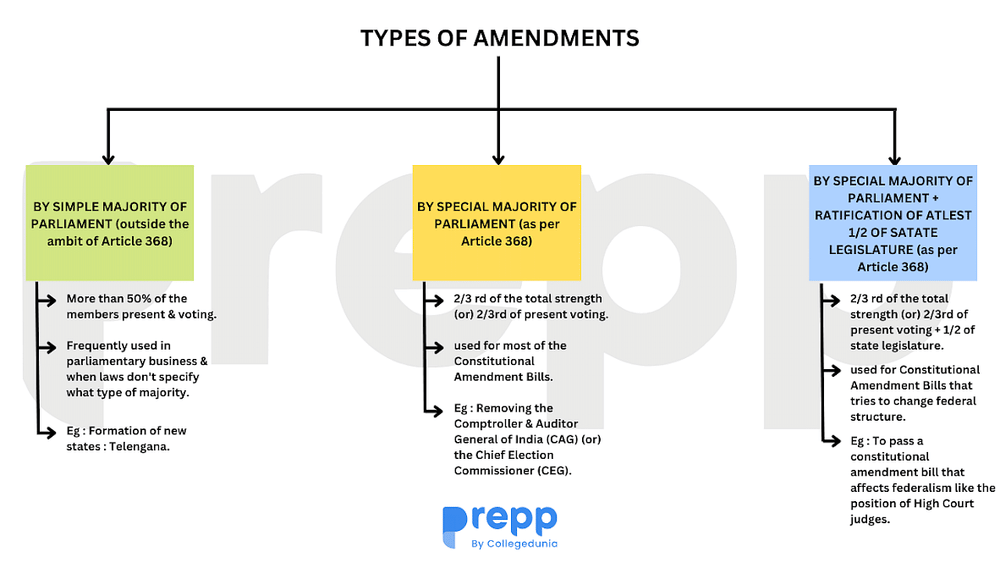
The Constitution can be amended in one of three ways:
Amendment by a simple majority of the Parliament
A simple majority of the two houses of Parliament can change a number of provisions in the Constitution, which is outside the ambit of Article 368. The following are some of the provisions:
- Admission or establishment of new states
- New states are formed, and existing states' areas, boundaries, and names are changed.
- Legislative councils are abolished or created in states.
- Second Schedule-emoluments, allowances, and privileges of the president, governors, Speakers, and judges, among others.
- Parliament quorum.
- Members of Parliament's salaries and benefits.
- The rules of procedure of the Parliament
- Parliamentary privileges, members' privileges, and committee privileges.
- Use of the English language in Parliament
- A number of puisne judges in the Supreme Court.
- Conferment of more jurisdiction on the Supreme Court.
- Citizenship: acquisition and termination
- Elections to the Parliament and state legislatures.
- Constituency delimitation.
- Union Territories
- Administration of scheduled territories and scheduled tribes is the fifth schedule.
- Administration of tribal territory is covered by the Sixth Schedule.
Amendment by a special majority of the Parliament
The procedures outlined in Article 368 may be used to change the Constitution's provisions other than those mentioned above. Here's how it'll work:
- Only in either House of the Union Parliament can an amendment to the Constitution be proposed as a Bill.
- The Bill will be forwarded to the President for his assent when it has been passed by a majority of that House's total membership and by not less than two-thirds of the House's membership present and voting.
- The president must give his assent to the bill. He/She can neither withhold assent nor return the bill for reconsideration of the Parliament.
- After the President’s assent, the bill becomes the Act and the Constitution is altered in line with the Act's terms.
Amendment by a special majority of the Parliament and at least half of the state legislatures' ratification
- Provisions related to the federal structure of the polity can be amended by a special majority with ratification by half of states with a simple majority.
- There is no time limit described for states to give consent,the moment half of the states give their consent,the formality is completed.
Following provisions fall in this category
- Election of President and its manner.(Article 54 & 55).
- Extent of executive power of the Union and the State (Article 73 and 162).
- Distribution of legislative powers between the Union and the states.
- Lists in the 7th Schedule.
- Provision pertaining to the Supreme Court (Part V- Chapter 4).
- Provision pertaining to the High Courts (Part VI- Chapter 5).
- Representation of State in the Parliament (Articles 80 & 81)
- Provision dealing with the amendment of the Constitution (Article 368) itself.
Conclusion
Despite shortcomings, the method for Amending the Constitution has shown to be straightforward and easy to implement, and it has met the changing demands and situations. The method is not so adaptable that the ruling parties may modify it at their leisure. It is also not so inflexible as to be incapable of adapting to changing demands. It, as K.C. Wheare correctly stated, "strikes a reasonable balance between flexibility and stiffness."
FAQs
Question: What are the different types of amendments in the Indian Constitution?
Answer: The Indian Constitution provides for amendments through various procedures laid down in Article 368. There are primarily three types of amendments:
- Simple Amendments: These are made by a simple majority in both Houses of Parliament. These amendments do not affect the federal structure or the basic structure of the Constitution.
- Special Amendments: These require a special majority of Parliament (a majority of the members present and voting) and, in certain cases, the ratification of at least half of the state legislatures.
- Amendments with Ratification: Some amendments require the approval of not only the Parliament but also at least half of the state legislatures, especially those that affect the federal balance or the powers of the states.
Question: What is the significance of Article 368 in the Indian Constitution?
Answer: Article 368 of the Indian Constitution is crucial as it provides the procedure for amending the Constitution. It lays down the framework for both simple and complex amendments. Article 368 empowers the Parliament to amend the Constitution, but some amendments require the approval of a special majority or ratification by the states. This article ensures that the Constitution can evolve over time to meet the changing needs of the nation while preserving the basic principles and structure.
Question: How does the amendment process differ from ordinary legislation in India?
Answer: The amendment process in India is different from the process of ordinary legislation in several ways. While ordinary laws are made by Parliament through a simple majority, constitutional amendments require either a special majority or, in some cases, the approval of state legislatures. Furthermore, certain amendments cannot be made by Parliament alone but require ratification by the states, especially those affecting the federal structure. The Constitution provides a detailed process to safeguard the fundamental principles and ensure that significant changes are made only through a more rigorous process.
Question: Can the basic structure of the Indian Constitution be amended?
Answer: No, the basic structure of the Indian Constitution cannot be amended. The basic structure doctrine was established by the Supreme Court in the Kesavananda Bharati case (1973). According to this doctrine, while the Constitution can be amended to address practical needs, any amendment that alters the basic structure—such as the supremacy of the Constitution, the rule of law, and the separation of powers—is unconstitutional. This ensures that the fundamental principles of democracy, justice, and equality are protected from any arbitrary or drastic changes.
Question: How has the amendment process been used to address evolving political and social needs in India?
Answer: The amendment process has been used extensively to address the changing political, social, and economic needs of India. Key amendments have included the introduction of the reservation system, the creation of new states, the abolition of privy purses, and changes to the powers of the President. These amendments reflect the adaptability of the Constitution and the role of Parliament in responding to new challenges and aspirations. For example, the 42nd Amendment (1976) brought significant changes to the Constitution, emphasizing the importance of the Directive Principles of State Policy and giving primacy to the rule of law.
MCQs
1. Which of the following types of amendments requires ratification by at least half of the state legislatures?
A) Simple amendments
B) Special amendments
C) Amendments affecting the federal structure
D) All amendments
Answer: (C) See the Explanation
Explanation: Amendments affecting the federal structure or the powers of the states require ratification by at least half of the state legislatures in addition to being passed by Parliament.
2. What is the minimum majority required to amend the Indian Constitution under Article 368?
A) Simple majority
B) Special majority
C) Absolute majority
D) Unanimous consent
Answer: (B) See the Explanation
Explanation: A special majority is required to amend most parts of the Indian Constitution, as laid out in Article 368. A special majority means a majority of the total membership of each House of Parliament and a majority of the members present and voting.
3. Which part of the Indian Constitution cannot be amended under any circumstances?
A) Preamble
B) Directive Principles of State Policy
C) Fundamental Rights
D) Basic Structure
Answer: (D) See the Explanation
Explanation: The basic structure of the Indian Constitution cannot be amended. This principle was established by the Supreme Court in the Kesavananda Bharati case in 1973, which set the limits on constitutional amendments.
4. Which of the following amendments abolished the Privy Purses?
A) 42nd Amendment
B) 44th Amendment
C) 52nd Amendment
D) 86th Amendment
Answer: (B) See the Explanation
Explanation: The 44th Amendment (1978) abolished the Privy Purses, which were payments made to the former rulers of princely states.
5. Which article of the Indian Constitution deals with the amendment process?
A) Article 368
B) Article 369
C) Article 370
D) Article 371
Answer: (A) See the Explanation
Explanation: Article 368 of the Indian Constitution lays down the procedure for amending the Constitution, specifying the requirements for both simple and special amendments.
GS Mains Questions and Model Answers
Q1: Explain the process of amending the Indian Constitution. How does it ensure both flexibility and stability?
Answer: The process of amending the Indian Constitution is defined under Article 368, and it is designed to allow for both flexibility and stability. Amendments can be made by Parliament with a special majority, and in some cases, ratification by state legislatures is required. This dual requirement ensures that while the Constitution remains adaptable to new circumstances, it cannot be changed too easily, preserving its stability and fundamental principles. The amendment process also distinguishes between changes that affect the federal structure and those that do not, requiring more stringent procedures for the former.
Q2: Discuss the significance of the basic structure doctrine in the context of constitutional amendments in India.
Answer: The basic structure doctrine, established in the Kesavananda Bharati case (1973), asserts that certain features of the Indian Constitution, such as its democratic framework, the rule of law, and judicial independence, cannot be altered through amendments. This principle ensures that while the Constitution can be amended to address evolving needs, its core values and structures are preserved. The doctrine has played a critical role in safeguarding the fundamental integrity of the Constitution, preventing any changes that might undermine its democratic and secular nature.
Q3: How have constitutional amendments shaped the political and social landscape of India?
Answer: Constitutional amendments have played a pivotal role in shaping India's political and social landscape. Amendments have addressed issues such as the rights of citizens, the role of the state, and the balance of power between different branches of government. For instance, the 42nd Amendment (1976) emphasized the Directive Principles of State Policy, while the 44th Amendment (1978) reduced the powers of the President and abolished the Privy Purses. Such amendments have made the Constitution more reflective of the changing needs of society, while also ensuring that its core values remain intact.
Previous Year Questions on Constitutional Amendments
1. UPSC CSE Prelims 2021:
Question: Which of the following types of constitutional amendments require ratification by the state legislatures?
A) Simple amendments
B) Amendments affecting the federal structure
C) Amendments to the Fundamental Rights
D) None of the above
Answer: (B)
Explanation: Amendments that affect the federal structure, such as changes to the distribution of powers between the Centre and states, require ratification by at least half of the state legislatures.
2. UPSC CSE Mains 2017 (GS Paper 1):
Question: "Discuss the role of Article 368 in the constitutional amendment process in India."
Answer: Article 368 outlines the procedure for amending the Indian Constitution. It provides the framework for Parliament to make amendments, subject to the conditions specified in the article. Some amendments require a simple majority, while others require a special majority or ratification by the state legislatures. This article ensures that constitutional amendments can address new challenges while maintaining the integrity of the Constitution's core principles.
*email: contactus@prepp.in
Download the PREPP App and attempt FREE IAS Exam Mock Tests and get complete study material!

Full Test - 04: UPSC CSE Prelims CSAT (Paper-II)
Full Test - 03: UPSC CSE Prelims CSAT (Paper-II)
UPSC CSE Prelims 2026 GS Paper 1 Question Paper (24-May-2026)
UPSC CSE Prelims 2026 CSAT Paper 2 Question Paper (24-May-2026)

17 February 2025 | The Hindu Must Read Articles | Current Affairs

16 February 2026 | The Hindu Must Read Articles | Current Affairs

13 February 2026 | The Hindu Must Read Articles | Current Affairs









Comments