Sustainable Development – Indian Economy Notes
Sustainable development is a multidimensional concept that emphasizes achieving economic progress, social equity, and environmental protection while ensuring that the needs of the present generation are met without compromising the ability of future generations to meet their own needs. It recognizes the interdependence between economic growth, social well-being, and environmental sustainability. When it comes to production, using recycled materials or renewable resources is an example of sustainable development. “Sustainable Development” is one of the important concepts in the UPSC/IAS 2023 Economy syllabus which is discussed in this article in detail.
What exactly is Sustainable Development?
- Sustainable development is an approach that aims to achieve human development objectives while allowing natural systems to support human needs for essential ecosystem services and natural resources.
- Sustainable development was first defined in the Brundtland Commission in its report Our Common Future in the year 1987.
- Sustainable development (SD) includes a concerted effort to create a future for people and the planet that is inclusive, sustainable, and resilient.
- Sustainable development aims to strike a balance between economic, social, and environmental aspects to ensure a harmonious and equitable future for all.
- It emphasizes long-term thinking, responsible resource management, and inclusive growth.
- Sustainable development is not just about economic growth; it's a broader concept that takes into account the long-term well-being of people and the planet.
- It necessitates responsible decision-making that considers economic, social, and environmental implications.
- For instance, a project that boosts economic growth but harms the environment may not be sustainable in the long run.
- Technology and innovation play a crucial role in advancing sustainable development.
- Renewable energy technologies, efficient waste management systems, and digital platforms for education and healthcare are examples of how technology can contribute to a sustainable future.
|
|
|
|---|---|
| Human Development Index | Classification of Countries |
| Human Capital and Human Development | Sources of Human Capital |
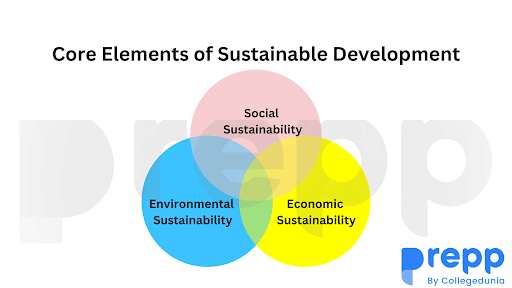
Core Elements of Sustainable Development
The three core elements of sustainable development are Economic sustainability, social sustainability, and environmental sustainability.
Environmental Sustainability
- Environmental Sustainability guarantees that nature is not treated as an unending supply of resources and that it is protected and used responsibly.
- Environmental conservation, renewable energy investment, water conservation, sustainable transportation support, and sustainable construction and design innovation all contribute to achieving environmental sustainability on multiple levels.
Social Sustainability
- Social Sustainability has the potential to promote gender equality, the development of people, communities, and cultures, as well as a fair and equitable distribution of quality of life, healthcare, and education around the world.
Economic Sustainability
- Economic Sustainability focuses on achieving equitable economic growth that provides wealth for all while minimizing environmental damage.
- Economic resources should be invested in and distributed equally.
- Poverty in all of its forms and dimensions must be eradicated.
Achieving Sustainable Development
The following principles may aid the society in attaining sustainable development:
- Limiting human activity.
- Instead of utilizing input, technological development should be input-effective.
- Consumption should not occur at a faster rate than redemption.
- The rate of consumption of renewable resources should not outpace the rate of generation of renewable alternatives.
- Pollution of all kinds ought to be minimized.
- It can be accomplished by using natural resources strategically.
Global Issues Related to Sustainable Development
- Climate Change: One of the most pressing global challenges, climate change is driven by human activities that emit greenhouse gases into the atmosphere. Rising temperatures, melting ice caps, sea level rise, and extreme weather events pose threats to ecosystems, economies, and communities worldwide.
- Biodiversity Loss: The loss of biodiversity due to habitat destruction, pollution, and overexploitation of resources has far-reaching consequences. It affects ecosystems, disrupts food chains, and reduces the resilience of ecosystems to environmental changes.
- Poverty and Inequality: Many parts of the world still grapple with extreme poverty and economic disparities. Ensuring access to basic needs like clean water, healthcare, education, and decent work for all is crucial for achieving sustainable development.
- Water Scarcity: Water scarcity is a growing concern as population growth and increased water consumption stress available water resources. This affects agriculture, sanitation, and access to clean drinking water.
- Energy Transition: The transition from fossil fuels to renewable energy sources is essential to reduce carbon emissions and combat climate change. Access to affordable and clean energy is vital for sustainable development.
- Urbanization: Rapid urbanization can strain infrastructure, lead to slum development, and result in inadequate access to basic services. Well-planned urban growth is critical for sustainable development.
- Food Security: Ensuring food security for a growing global population while minimizing the environmental impact of agriculture is a complex challenge. Sustainable agricultural practices and reducing food waste are key solutions.
- Health and Well-being: Improving healthcare, reducing disease burdens, and ensuring access to quality medical services contribute to human development and overall well-being.
- Gender Equality: Achieving gender equality is essential for sustainable development. Empowering women and girls economically, socially, and politically has a positive impact on communities and economies.
- Oceans and Marine Conservation: Overfishing, pollution, and habitat degradation threaten marine ecosystems and the livelihoods of coastal communities. Sustainable ocean management is crucial for maintaining marine biodiversity and supporting fisheries.
- Circular Economy: Transitioning from a linear economy to a circular one involves minimizing waste, promoting recycling, and designing products for durability and reusability.
- Education: Ensuring access to quality education for all is vital for human development. Education equips individuals with the skills needed for personal growth and contributing to society.
- Digital Divide: The digital divide refers to the gap in access to technology and the internet between different regions and socio-economic groups. Bridging this divide is essential for equitable development in the digital age.
Addressing these global issues requires international cooperation, policy reforms, technological innovation, and concerted efforts to promote sustainable practices at individual, community, and governmental levels.
Global Initiatives on Sustainable Development
- The Stockholm Conference,1972: It was the first step towards putting environmental issues on the international agenda. It resulted in the Stockholm Declaration, which included principles and an Action Plan with environmental policy suggestions.
- UNEP was established in 1972 to act as a catalyst for the development and coordination of an environmental focus in other organizations' programmes.
- The Brundtland Commission's Report was a direct result of the Earth Summit in 1992. Rio de Janeiro hosted the event. The following documents were produced as a result of the Conference:
- The Framework Convention on Climate Change (UNFCCC)
- The Convention on Biological Diversity
- The Statement on Forest Principles
- The Rio Declaration
- Agenda 21
- Rio +10, 2002: The World Summit on Sustainable Development (WSSD) in Johannesburg was a 10-year evaluation of the Rio outcomes (Rio +10).
- Ramsar Convention, 1971
- The 1972 World Heritage Convention: It is responsible for identifying and preserving the world's cultural and natural treasures. It compiles a list of "heritage sites," which are cultural, natural, or combined regions of "great universal importance" that must be maintained for the sake of all people.
List of Other Important Initiatives:
- Convention on International Trade in Endangered Species of Wild Fauna and Flora (CITES), 1973
- Convention on the Conservation of Migratory Species of Wild Animals (CMS), 1979
- Vienna Convention for the Protection of the Ozone Layer, 1985
- Montreal Protocol on Substances that Deplete the Ozone Layer, 1987
- Basel Convention, 1989
- Convention on Biological Diversity, 1992
- United Nations Convention to Combat Desertification, 1994
- Rotterdam Convention, 1998
- Stockholm Convention on Persistent Organic Pollutants, 2001
- Global Tiger Forum, 1993
- International Whaling Commission, 1946
- Kyoto Protocol, 1997
- Minamata Convention, 2013
- Climate change mitigation strategies: Carbon sequestration, Carbon sink, Carbon Credit, Carbon trading, Carbon offsetting, Carbon Tax, Geo-engineering
- United Nations Environment Programme (UNEP)
- UN Commission on Sustainable Development (CSD)
- United Nations Convention on the Law of the Sea (UNCLOS)
- Climate Finance Architecture: Green Climate Fund (GCF), Adaptation Fund (AF) and Global Environment Facility (GEF)
- Reducing Emissions from Deforestation and Forest Degradation (REDD) and REDD+
- Paris Agreement 2015
- The Clean Development Mechanism is a way to reduce greenhouse gas (GHGs) emissions through efficient and sound technologies
- Global Alliance for Climate-Smart Agriculture (GACSA)
- Partnership for Action on Green Economy (PAGE)
What are Sustainable Development Goals (SDGs)?
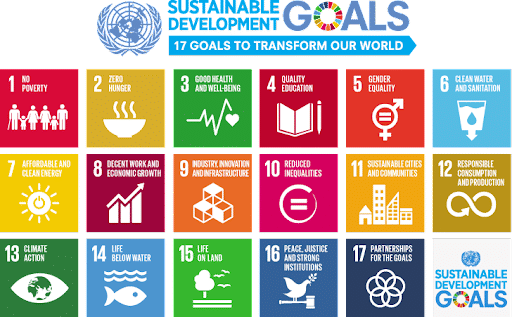
- Sustainable Development Goals (SDGs), also called development goals, are a collection of 17 objectives.
- SDGs are intended to act as a "common blueprint for peace and prosperity for people and the planet today and into the future."
- The United Nations (UN) launched the 2030 Agenda for Sustainable Development Goals (SDGs) to mainstream sustainable development.
- Over the next 15 years, this comprehensive, integrated, and revolutionary agenda intends to encourage measures that will end poverty and establish a more sustainable world.
- By 2030, these 17 goals and 169 specific milestones must be accomplished. To achieve the goals, governments, corporations, civic society, and individuals from all walks of life must all work together.
- The Sustainable Development Goals (SDGs) are not legally binding.
*To know more about the topic, click this link Sustainable Development Goals (SDGs)
Conclusion
Sustainable Development and Sustainable Development Goals are the blueprints for achieving a better, more sustainable future for everybody. To make the process of sustainable development feasible and operational, it is important to establish a common focus that can integrate the perspectives and efforts of various development participants around the world, while taking into account the diversity of geography, society, economics, science, and technology capabilities and capacities, and educational standards and levels.
|
|
|
|---|---|
| Indian Economics Notes | Human Development |
| Inclusive Growth | Human Capital |
| Economic Growth vs Economic Development | Monetary Policy |
FAQs
Question: What is sustainable development?
Answer: Sustainable development refers to the practice of meeting current needs without compromising the ability of future generations to meet their own needs, balancing economic growth, environmental protection, and social equity.
Question: What are the key goals of sustainable development?
Answer: The Sustainable Development Goals (SDGs) aim to address global challenges like poverty, inequality, climate change, environmental degradation, and peace.
Question: How does sustainable development promote environmental conservation?
Answer: Sustainable development encourages the responsible use of resources, reducing pollution, promoting renewable energy, and conserving biodiversity to maintain ecological balance.
Question: What role does India play in global sustainable development efforts?
Answer: India actively participates in global initiatives like the Paris Agreement, the SDGs, and has implemented various national policies like Swachh Bharat Mission and National Solar Mission to promote sustainability.
Question: What is the relationship between economic growth and sustainable development?
Answer: While economic growth focuses on increasing wealth and improving living standards, sustainable development ensures that this growth is environmentally friendly and socially inclusive, reducing inequality and environmental damage.
MCQs
- Which of the following is a primary objective of sustainable development?
a) Maximizing industrial output
b) Balancing economic, social, and environmental goals
c) Prioritizing short-term economic gains
d) Exploiting natural resources
Answer: (B) See the Explanation
Sustainable development aims to ensure a balance between economic growth, environmental protection, and social equity.
- Which global initiative focuses on achieving sustainable development by 2030?
a) Kyoto Protocol
b) Paris Agreement
c) Sustainable Development Goals (SDGs)
d) Basel Convention
Answer: (C) See the Explanation
The Sustainable Development Goals (SDGs) are a set of 17 global goals set by the United Nations to be achieved by 2030.
- Which of the following is NOT a principle of sustainable development?
a) Intergenerational equity
b) Environmental conservation
c) Economic exploitation
d) Social equity
Answer: (C) See the Explanation
Sustainable development promotes responsible use of resources and ensures that economic activities do not harm the environment or society.
- Which Indian mission is aimed at promoting renewable energy as part of sustainable development?
a) Make in India
b) National Solar Mission
c) Skill India
d) Atal Innovation Mission
Answer: (B) See the Explanation
The National Solar Mission aims to promote the use of solar energy to support sustainable development and reduce dependence on fossil fuels.
- What is the focus of the Paris Agreement in relation to sustainable development?
a) Trade liberalization
b) Climate change mitigation
c) Gender equality
d) Poverty eradication
Answer: (B) See the Explanation
The Paris Agreement focuses on addressing climate change by limiting global temperature rise and reducing greenhouse gas emissions as part of a sustainable future.
GS Mains Questions and Model Answers
Q1: Analyze the role of sustainable development in addressing global environmental challenges.
Answer: Sustainable development plays a crucial role in addressing global environmental challenges by promoting responsible use of natural resources, reducing carbon emissions, and encouraging renewable energy. By integrating environmental concerns into economic policies, sustainable development ensures that growth does not lead to resource depletion or environmental degradation. Additionally, it promotes the conservation of biodiversity and helps in mitigating the impact of climate change, creating a balance between economic growth and environmental protection.
Q2: Discuss how sustainable development can lead to social equity in developing countries.
Answer: Sustainable development aims to create a society that is socially equitable by ensuring that economic growth benefits everyone, particularly the marginalized sections. It promotes policies that address poverty, education, healthcare, and employment, creating opportunities for the underprivileged. By focusing on inclusive growth and reducing inequality, sustainable development helps build more resilient societies. In developing countries, these initiatives ensure that the benefits of economic development are shared equitably, leading to long-term social stability.
Q3: Evaluate the impact of the Paris Agreement on India’s sustainable development goals.
Answer: The Paris Agreement has had a significant impact on India’s pursuit of sustainable development goals, particularly in the realm of climate change mitigation. India committed to reducing its carbon emissions intensity and increasing the share of renewable energy in its energy mix. Initiatives like the National Solar Mission and Clean Energy Program aim to reduce reliance on fossil fuels and promote sustainable energy. By aligning its national policies with the global climate goals, India has strengthened its capacity for sustainable growth while addressing environmental challenges.
Previous Year Questions on Sustainable Development
1. UPSC CSE Prelims 2018:
Question: Which of the following is a primary goal of the Sustainable Development Goals (SDGs)?
A. Eliminate fossil fuel usage
B. Achieve gender equality
C. Promote economic exploitation
D. Increase military expenditure
Answer: B
Explanation: One of the 17 SDGs set by the United Nations is to promote gender equality and empower all women and girls globally by 2030.
2. UPSC CSE Mains 2016 (GS Paper 3):
Question: Discuss the importance of sustainable development in achieving long-term economic stability and environmental protection.
Answer: Sustainable development ensures that economic growth does not come at the expense of the environment or social well-being. It integrates environmental conservation into the economic planning process by promoting responsible use of natural resources, reducing carbon emissions, and enhancing biodiversity protection. Sustainable practices like renewable energy adoption and waste management lead to long-term economic stability by preventing resource depletion and reducing environmental degradation, making economies resilient to future challenges.
3. UPSC CSE Prelims 2017:
Question: The Paris Agreement is associated with which of the following global issues?
A. Free trade agreements
B. Arms reduction
C. Climate change mitigation
D. Refugee crisis
Answer: C
Explanation: The Paris Agreement is a global accord under the United Nations Framework Convention on Climate Change (UNFCCC) aimed at reducing global warming and addressing climate change by reducing carbon emissions.
Download the PREPP App and attempt FREE IAS Exam Mock Tests and get complete study material!

Full Test - 04: UPSC CSE Prelims CSAT (Paper-II)
Full Test - 03: UPSC CSE Prelims CSAT (Paper-II)
UPSC CSE Prelims 2026 GS Paper 1 Question Paper (24-May-2026)
UPSC CSE Prelims 2026 CSAT Paper 2 Question Paper (24-May-2026)

17 February 2025 | The Hindu Must Read Articles | Current Affairs

16 February 2026 | The Hindu Must Read Articles | Current Affairs

13 February 2026 | The Hindu Must Read Articles | Current Affairs









Comments