Human Development Index (HDI) – Indian Economy Notes
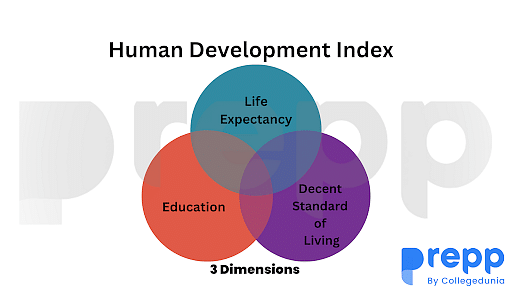
Human Development Index (HDI) measures a country’s social and economic development on the basis of three dimensions: health of people, level of education, and decent standard of living. HDI is published by the United Nations Development Programme (UNDP). “Human Development Index (HDI)” is one of the important concepts in the UPSC/IAS 2023 Economy syllabus which is discussed in this article in detail.
| To Read update on this topic: |
|
Table of Contents |

What is the Human Development Index (HDI)?
- The Human Development Index (HDI) measures the level and changes in quality of life by combining indicators of life expectancy, education or access to knowledge, and income or standard of living.
- This measure was introduced by two renowned economists from Pakistan and India, Mahbub ul Haq and Amartya Sen respectively.
- HDI was created as a complement to the gross domestic product because it emphasizes the importance of human development in the growth process.
- The higher the country’s HDI score, the higher the people’s lifespan, the education level, and the gross national income GNI (PPP) per capita and vice versa.
|
India’s HDI
|
|
|
|
|---|---|
| Classification of Countries- Developed Countries, UDCS And LDCS | Sources of Human Capital |
| Human Capital and Human Development | What is Human Capital |
Dimensions of Human Development Index
Long and Healthy Life
- Life expectancy at birth is used to calculate the dimension of a long and healthy life.
- The life expectancy at birth is a statistical measure of how long an average person is expected to live based on demographic factors such as birth year and current age.
Education
- The HDI's second dimension is education. The expected years of schooling and the mean years of schooling are the education indicators.
- According to the United Nations, the average maximum number of years of schooling is 18 years, while the mean maximum number of years of schooling is 15 years.
Standard of Living
- The gross national income (GNI) per capita is commonly used to assess the standard of living.
- The GNP measures the total domestic and foreign output generated by a country's residents.
Importance of Human Development Index
- Comprehensive Measurement: The HDI takes into account multiple dimensions of development, including life expectancy, education, and per capita income. This provides a more holistic understanding of a country's development than purely economic indicators like GDP.
- Human-Centric Approach: By focusing on life expectancy and education alongside income, the HDI emphasizes the well-being and capabilities of people. It reflects the fact that development is ultimately about improving the lives of individuals.
- Global Comparisons: The HDI allows for easy comparisons between countries, enabling policymakers and researchers to assess where a country stands in terms of human development relative to others. This helps identify best practices and areas for improvement.
- Policy Guidance: Governments and organizations can use the HDI to identify areas that need attention and allocate resources to improve overall human well-being. It guides policy decisions by highlighting gaps in education, healthcare, and income.
- Accountability: The HDI holds governments accountable for the well-being of their citizens. It provides a basis for international discussions on development goals and progress.
Criticisms of Human Development Index
- Simplification: The HDI combines diverse indicators into a single index, potentially oversimplifying complex realities and interactions among dimensions of development.
- Limited Indicators: While the HDI captures important aspects of development, it does not consider factors like inequality, environmental sustainability, and political freedoms, which are also crucial for overall well-being.
- Weights and Aggregation: The method used to combine different indicators and assign weights can be debated. Some argue that the weights assigned to each dimension may not accurately reflect their relative importance.
- Data Quality: HDI calculations depend on the availability and accuracy of data, which may vary across countries and regions. Inaccurate or outdated data can distort the assessment of human development.
- Urban-Rural Disparities: The HDI can mask disparities between urban and rural areas within a country. National averages may not reflect the different challenges faced by different segments of the population.
- Subjective Factors: The HDI's indicators are objective, but the index does not consider people's subjective well-being, personal satisfaction, or happiness.
- Development vs. Sustainability: The HDI does not account for the environmental impact of development or a country's sustainable practices.
Progress Made by India
Reasons For India’s Underperformance on HDIIndia is ranked 132nd in the 2021-22 HDI. Deep-rooted societal and economic disadvantages account for a poor ranking for an economy that is in the world's top six in terms of size. The following causes can be attributed to India's poor HDI performance:
|
Conclusion
The Human Development Index is a valuable tool for assessing and comparing human development across countries, and it has played a significant role in shaping development policies and discussions. However, it is essential to recognize its limitations and consider other measures and indicators to ensure a more comprehensive understanding of development.
|
|
|
|---|---|
| Indian Economics Notes | Human Development |
| Inclusive Growth | Human Capital |
| Economic Growth vs Economic Development | Sustainable Development |
FAQs
Question: What is the Human Development Index (HDI)?
Answer: The Human Development Index (HDI) is a composite statistic that assesses a country’s overall achievement in three key dimensions: health (life expectancy), education (mean years of schooling and expected years of schooling), and standard of living (GNI per capita).
Question: Who publishes the HDI?
Answer: The United Nations Development Programme (UNDP) publishes the HDI annually as part of its Human Development Report.
Question: What are the key components of HDI?
Answer: The three components of HDI are life expectancy, education level, and per capita income.
Question: What is the range of the HDI score?
Answer: HDI is measured on a scale from 0 to 1, where 0 represents the lowest level of development and 1 represents the highest.
Question: What does a low HDI score indicate?
Answer: A low HDI score indicates poor performance in areas of life expectancy, education, and standard of living, signaling underdevelopment.
MCQs
- Which organization is responsible for publishing the Human Development Index (HDI)?
a) World Bank
b) United Nations Development Programme (UNDP)
c) International Monetary Fund (IMF)
d) World Health Organization (WHO)
Answer: (B) See the Explanation
The UNDP publishes the Human Development Index annually as part of its Human Development Report.
- What are the three dimensions of HDI?
a) Education, health, income
b) Agriculture, industry, services
c) Environment, health, education
d) Population, GDP, employment
Answer: (A) See the Explanation
The HDI is a composite measure that includes education, health, and income to assess the overall human development of a country.
- Which component of the HDI is used to measure the health dimension?
a) Literacy rate
b) Life expectancy
c) Infant mortality
d) GDP per capita
Answer: (B) See the Explanation
Life expectancy at birth is used as an indicator of the health dimension in the HDI.
- What is the maximum score a country can achieve on the HDI scale?
a) 0.5
b) 1
c) 100
d) 10
Answer: (B) See the Explanation
The HDI is measured on a scale from 0 to 1, where 1 represents the highest level of human development.
- Which of the following does NOT contribute to the HDI score?
a) Gross National Income (GNI) per capita
b) Life expectancy at birth
c) Expected years of schooling
d) Military expenditure
Answer: (D) See the Explanation
Military expenditure is not considered in the calculation of HDI, which focuses on life expectancy, education, and income.
GS Mains Questions and Model Answers
Q1: Examine the limitations of the Human Development Index (HDI) as a measure of development.
Answer: While the Human Development Index (HDI) provides a broad measure of development by considering health, education, and income, it has certain limitations. It does not account for inequality, environmental factors, or cultural diversity within countries. The HDI also overlooks subjective well-being and does not capture differences in gender equality or distribution of wealth. Moreover, it is a static index, offering a snapshot without reflecting changes over time. Despite these drawbacks, HDI remains a valuable tool for comparing development across nations.
Q2: Discuss the role of the Human Development Index (HDI) in shaping policy decisions in developing countries.
Answer: The HDI plays a crucial role in guiding policy decisions in developing countries by highlighting areas needing improvement in health, education, and income levels. Governments use HDI data to prioritize sectors such as public healthcare, schooling, and job creation programs. The index helps policymakers design interventions to address inequality and improve living standards. Additionally, the HDI enables governments to track progress toward sustainable development goals (SDGs) and compare their performance globally.
Q3: Evaluate the impact of the Human Development Index on global development rankings and international aid distribution.
Answer: The HDI significantly influences global development rankings, shaping perceptions of a country’s overall progress and attracting international aid. Higher HDI rankings can boost foreign investment and improve access to global funding, while lower-ranked nations may receive targeted aid for improving education, healthcare, and economic opportunities. However, the focus on HDI rankings may lead some countries to prioritize improvements in areas measured by the index, potentially overlooking other important sectors like environmental sustainability or human rights.
Previous Year Questions on Human Development Index (HDI)
1. UPSC CSE Prelims 2017:
Question: Which of the following indices measures human development by combining indicators of life expectancy, educational attainment, and income?
A. Human Development Index (HDI)
B. Gini Coefficient
C. Gender Inequality Index (GII)
D. Multidimensional Poverty Index (MPI)
Answer: A
Explanation: The Human Development Index (HDI) measures human development by combining indicators of life expectancy, educational attainment, and income levels.
2. UPSC CSE Mains 2016 (GS Paper 2):
Question: Discuss the relevance of the Human Development Index in assessing the overall development of a country.
Answer: The Human Development Index (HDI) offers a more comprehensive assessment of a country’s development than just economic metrics like GDP. It accounts for life expectancy, education, and per capita income, providing insights into the well-being of citizens. HDI is particularly useful for comparing countries' development levels and identifying areas for policy improvement. However, it has limitations, such as not considering inequality, environmental sustainability, or subjective well-being, which may also influence the quality of life.
3. UPSC CSE Prelims 2018:
Question: Which dimension of HDI is measured by Gross National Income (GNI) per capita?
A. Education
B. Health
C. Standard of Living
D. Environment
Answer: C
Explanation: The Gross National Income (GNI) per capita is used to measure the standard of living in the HDI.
Download the PREPP App and attempt FREE IAS Exam Mock Tests and get complete study material!

Full Test - 04: UPSC CSE Prelims CSAT (Paper-II)
Full Test - 03: UPSC CSE Prelims CSAT (Paper-II)
UPSC CSE Prelims 2026 GS Paper 1 Question Paper (24-May-2026)
UPSC CSE Prelims 2026 CSAT Paper 2 Question Paper (24-May-2026)

17 February 2025 | The Hindu Must Read Articles | Current Affairs

16 February 2026 | The Hindu Must Read Articles | Current Affairs

13 February 2026 | The Hindu Must Read Articles | Current Affairs









Comments