Human Capital and Human Development – Indian Economy Notes
Human capital refers to the skills, training, experience, education, knowledge, know-how, and competencies that humans bring to a company, whereas human development in an economy is determined by a composite statistic that includes life expectancy, education, and per capita income. In economics, the terms "human capital" and "human development" are used to describe human resources. This is a crucial economic concept that deals with how human resources are viewed in these terms. “Human Capital and Human Development” is one of the important concepts of UPSC/IAS 2023 Economy syllabus which is discussed in this article in detail.
|
Table of Contents |
What exactly is Human Capital?
- Human capital is a measurement of labour capabilities that encompass skills, working capacity, education, health, and intelligence.
- The concept of human capital emphasizes the fact that not all resources are equal, but that this gap may be bridged with sufficient training and investment.
- Employee skills, experience, and education are immensely valuable to a business, as they generate economic value for the company and the economy as a whole.
- Human capital is valued in the corporate world because it aids in enhancing productivity, which is linked to profitability.
- As a result, according to the human capital notion, a company might become more profitable by investing more in its personnel.
Human Capital - Role of GovernmentThere is little political will and investment in this sector because it is difficult to establish a clear cause-and-effect relationship between human capital growth (education, health, etc.) and economic growth. However, human capital investments cannot be completely outsourced to private players. Government intervention is required in this area because:
|
| Other Relevant Links | |
|---|---|
| Human Development Index | Classification of Countries |
| Human Capital and Human Development | Sources of Human Capital |
Human Development
What exactly is Human Development?
- Human development means the process of improving people's choices, such as education, health care, income, and empowerment.
- Human development covers the complete dimension of human choices from a healthy physical environment to economic, social, and political freedom.
- In other words, human development refers to the prosperity of human life, independent of the wealth of the economy in which people live.
- As a result, the most important part of human progress is expanding people's choices.
- People's choices may include a variety of issues, but living a long and healthy life, being educated, and having access to resources necessary for a decent standard of living, such as political freedom, guaranteed human rights, and personal self-respect, are all considered non-negotiable aspects of human development.
|
Human Development - Agenda of the Government
Human Development Report
|
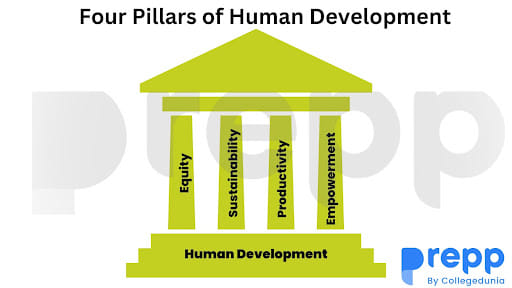
Four Pillars of Human Development
Difference Between Human Capital and Human Development
| Basis of Difference | Human Capital | Human Development |
|---|---|---|
| Concept | Human Capital is a comparatively narrow concept. | Human Development is a comparatively broader concept |
| Central theme | Human Capital considers that health and education are the most effective ways to increase labour productivity. | Human Development believes that health and education contribute to an individual's total growth, as a healthy person with good knowledge may make decisions that will help them live a happy and healthy life. |
| Welfare | When it comes to human capital, health, and education are ineffective unless they lead to increased production. | It considers that human welfare is increased by having good health and proper education even if they do not result in any improvements in productivity |
| Example | High-skilled workers who have relevant work experience may earn better salaries on the labour market and make greater contributions to the economy since they have important human capital. | Initiatives for human development may concentrate on giving people access to high-quality training, medical care, clean water, and sanitation in order to improve their general well-being and increase their possibilities in life. |
Conclusion
Human capital and human development are closely linked but not identical ideas. Human capital refers to the stock of a nation's human talents and expertise at a certain point in time, whereas human development refers to a national human capital's holistic development and well-being.
| Other Relevant Links | |
|---|---|
| Indian Economics Notes | Human Development |
| Inclusive Growth | Human Capital |
| Economic Growth vs Economic Development | Sustainable Development |
FAQs
Question: What is the difference between human capital and human development?
Answer: Human capital refers to the stock of skills, knowledge, and abilities possessed by individuals that contribute to their productivity and economic output. It is primarily concerned with education, skills development, and training. Human development, on the other hand, is a broader concept that emphasizes improving the quality of life and well-being of individuals. It involves enhancing the capabilities of people to live a long, healthy, and productive life. While human capital focuses on economic aspects, human development includes social, political, and environmental factors.
Question: How does human capital contribute to economic growth?
Answer: Human capital contributes to economic growth by increasing labor productivity. When people are healthier, better educated, and more skilled, they are able to work more efficiently and produce more goods and services. Investment in education, training, and health leads to a more knowledgeable workforce, which is essential for technological advancements and innovation. Additionally, a well-developed human capital base attracts investments, boosts economic competitiveness, and improves national income.
Question: What role does human development play in poverty reduction?
Answer: Human development plays a crucial role in poverty reduction by improving the living standards of the marginalized sections of society. By focusing on education, healthcare, nutrition, and social security, human development policies enhance individuals’ capabilities, enabling them to access better employment opportunities, contribute to economic growth, and break the cycle of poverty. The Human Development Index (HDI), which includes factors like life expectancy, education level, and income, is a key measure of poverty alleviation through human development.
Question: What is the role of government policies in fostering human capital development in India?
Answer: Government policies in India have a significant role in fostering human capital development by promoting access to education, healthcare, and skills training. Programs such as the "Sarva Shiksha Abhiyan" and "Rashtriya Swasthya Bima Yojana" focus on increasing education and healthcare access, respectively. Additionally, initiatives like "Skill India" aim to enhance the employability of the youth by providing vocational training. Government investment in infrastructure, such as sanitation and clean drinking water, also contributes to improving human health, a crucial component of human capital.
Question: How does human development impact inequality in India?
Answer: Human development can help reduce inequality by providing equitable access to education, healthcare, and economic opportunities. In India, disparities in access to these services often correlate with income inequality, caste, and regional disparities. By improving human capabilities through inclusive development programs, disadvantaged communities can access better employment opportunities, improve their standard of living, and contribute to economic growth. However, the government must ensure that these programs target the most marginalized groups to effectively address inequality.
MCQs
1. Which of the following best describes human capital?
A) Knowledge, skills, and education that contribute to productivity
B) Health and well-being of individuals
C) Social and economic welfare of citizens
D) Infrastructure and physical assets
Answer: (A) See the Explanation
Explanation: Human capital refers to the knowledge, skills, and education of individuals that enhance their ability to contribute to economic activities, thus boosting productivity and economic growth.
2. What does the Human Development Index (HDI) measure?
A) Levels of industrialization
B) Overall social development
C) Levels of literacy
D) Life expectancy, education, and income
Answer: (D) See the Explanation
Explanation: The Human Development Index (HDI) is a composite index that measures a country's average achievements in three key dimensions: life expectancy (health), education (mean years of schooling), and standard of living (income per capita).
3. Which of the following is NOT a key factor in human development?
A) Education
B) Healthcare
C) Physical infrastructure
D) Political rights
Answer: (C) See the Explanation
Explanation: Human development primarily focuses on education, healthcare, and political rights, which directly impact people's quality of life. While physical infrastructure is important for economic development, it is not directly part of human development.
4. How does human capital development impact the economy?
A) It leads to an increase in income inequality
B) It decreases the overall productivity of the country
C) It raises labor productivity and economic growth
D) It reduces the need for government investment in health
Answer: (C) See the Explanation
Explanation: Human capital development increases labor productivity, which in turn fosters economic growth by creating a more skilled, efficient, and innovative workforce.
5. What is the primary objective of India’s “Skill India” program?
A) To enhance access to health services
B) To improve the literacy rate
C) To provide vocational training and improve employability
D) To improve agricultural productivity
Answer: (C) See the Explanation
Explanation: The "Skill India" program focuses on providing vocational training to improve the employability of the youth and create a skilled workforce, which is essential for economic growth.
GS Mains Questions and Model Answers
Q1: Discuss the relationship between human capital and economic development. How does improving human capital contribute to the overall growth of a nation?
Answer: Human capital, which refers to the knowledge, skills, and abilities of the workforce, is a fundamental driver of economic development. A well-educated and healthy workforce is more productive, innovative, and capable of driving technological advancements. Human capital development contributes to economic growth by enhancing labor productivity, fostering entrepreneurial activities, and attracting foreign investments. Moreover, investing in human capital leads to a more equitable distribution of wealth and opportunities, further supporting inclusive growth. The quality of human capital impacts not only the workforce but also the broader economic system, including industrial growth, trade, and technological progress.
Q2: Evaluate the role of government policies in improving human development in India. What are the challenges and successes in this area?
Answer: Government policies in India have played a crucial role in improving human development by focusing on key areas such as education, healthcare, and poverty alleviation. Initiatives like "Sarva Shiksha Abhiyan," "Pradhan Mantri Jan Arogya Yojana," and "Atal Mission for Rejuvenation and Urban Transformation" have contributed to enhancing human development indicators. However, challenges such as regional disparities, inequality in access to services, and limited resources hinder the full realization of human development goals. Despite these challenges, India has made significant progress in improving life expectancy, literacy rates, and per capita income, which are key indicators of human development.
Q3: Analyze the link between human capital development and inequality in India. How can policies be designed to reduce inequality while promoting growth?
Answer: The link between human capital development and inequality in India is complex. While human capital development, such as access to quality education and healthcare, can reduce inequality by creating equal opportunities for all, socio-economic and regional disparities still persist. Marginalized communities often have limited access to resources, which hampers their ability to participate in economic growth. Policies aimed at improving access to education, vocational training, and healthcare, particularly for underprivileged groups, can help reduce inequality. Moreover, social welfare programs, land reforms, and rural development initiatives are essential to ensure that the benefits of growth reach all sections of society.
Previous Year Questions on Human Capital and Human Development
1. UPSC CSE Prelims 2020:
Question: What does the term "Human Capital" primarily refer to in economic theory?
A) Total wealth of a nation
B) Quality of healthcare services
C) Knowledge, skills, and abilities of the workforce
D) Technological advancements in an economy
Answer: (C)
Explanation: Human capital refers to the stock of knowledge, skills, and abilities that individuals possess, contributing to their productivity and the overall economy.
2. UPSC CSE Mains 2019 (GS Paper 2):
Question: "Examine the role of human development in achieving sustainable economic growth. How does it affect social welfare and equality?"
Answer: Human development is a crucial aspect of sustainable economic growth as it focuses on improving the quality of life and well-being of individuals. Through investments in education, healthcare, and social security, human development policies create a productive workforce and contribute to the overall economic output. Additionally, by addressing inequalities in access to resources, human development promotes social welfare and inclusive growth, ensuring that the benefits of economic progress are shared by all.
Download the PREPP App and attempt FREE IAS Exam Mock Tests and get complete study material!

Full Test - 04: UPSC CSE Prelims CSAT (Paper-II)
Full Test - 03: UPSC CSE Prelims CSAT (Paper-II)
UPSC CSE Prelims 2026 GS Paper 1 Question Paper (24-May-2026)
UPSC CSE Prelims 2026 CSAT Paper 2 Question Paper (24-May-2026)

17 February 2025 | The Hindu Must Read Articles | Current Affairs

16 February 2026 | The Hindu Must Read Articles | Current Affairs

13 February 2026 | The Hindu Must Read Articles | Current Affairs









Comments