Sources of Human Capital – Indian Economy Notes
Human capital refers to the knowledge, skills, abilities, and other attributes that individuals acquire through education, training, and experience. It is a critical driver of economic and social development as it contributes to productivity, innovation, and overall well-being. The sources of human capital play a vital role in shaping the capabilities of a nation's workforce. Education is considered to be one of the most important sources of human capital. Investments in health, on-the-job training, migration, and information are some of the other ways to develop human capital. The topic “Sources of Human Capital” is one of the important concepts in the UPSC/IAS 2023 Economy syllabus which is discussed in this article in detail.
|
Table of Contents |
What exactly is Human Capital?
- Human Capital is the monetary value of a person's knowledge, skills, and competencies.
- Examples of human capital include education, training, intelligence, skills, health, and other qualities valued by employers, such as loyalty and punctuality.
- As a result, it is an intangible asset or a characteristic that does not (and cannot) appear on a company's balance sheet.
- Human capital is considered to boost productivity and consequently profits.
- The more a firm invests in its personnel, the better its prospects of productivity and success increase.
What are the Sources of Human Capital?
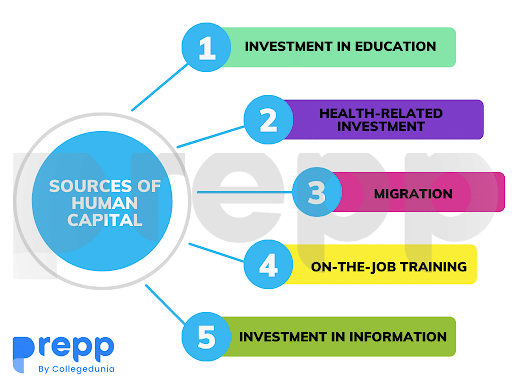
Education, along with other sources such as health, migration, on-the-job training, and knowledge, is recognised as one of the most important sources of human capital. Let's discuss them one by one.
Investment in Education
- Formal education, ranging from primary school to higher education institutions, provides individuals with fundamental knowledge, critical thinking abilities, and specialized skills that are essential for their personal and professional growth.
- The most effective strategy to develop and expand the state's productive workforce is to strengthen and expand the educational system.
- It is recognized as the foundation for the development of human capital, which is why parents and the government invest more in education.
- The following are some of the reasons why individuals and governments invest more in education:
- To increase their future earnings.
- To increase manpower and improve technical capabilities, hence increasing worker productivity and resulting in economic growth.
- Reduce the birth rate and make the most resources accessible each person to manage the population growth rate.
- It is possible to impart knowledge and education to others, resulting in social benefits.
Health-related Investments
- The health sector is the second most important source of human capital formation.
- Providing clean and safe drinking water, and medicinal drugs, are a few examples of health-related investments.
- Adequate access to quality healthcare and proper nutrition during childhood and adolescence is crucial for physical and cognitive development.
- Good health enhances individuals' ability to learn, work, and contribute to society.
Migration
- Individuals migrate from their native place to another place in order to obtain higher salaries and better jobs.
- Unemployment is the primary driver of rural-urban migration in India.
- Other professionals, such as doctors and engineers, relocate from one country to another in pursuit of better possibilities.
- In both cases, migration costs include transportation costs, as well as the cost of living in the relocated location.
- Increased earnings in the new location outweigh the costs of migration. As a result, migration investment is another source of human capital formation.
- Exposure to different cultures, societies, and work environments through migration and global interactions can broaden an individual's perspectives, enhance their adaptability, and provide opportunities for learning and growth.
On-the-Job Training
- On-the-job experience and exposure contribute to the development of practical skills, problem-solving abilities, and industry-specific knowledge.
- Experience enables individuals to apply theoretical knowledge in real-world scenarios.
- Internship programs provided by companies and organizations offer students valuable practical experience before entering the job market.
- Many businesses provide on-the-job training to boost labour productivity.
- This is a costly source of income, and employers suffer significant costs for delivering on-the-job training.
- In-house training, training under the supervision of a professional supervisor, and off-campus training are some examples.
Investment in Information
- Access to information through technology and the internet enables individuals to acquire knowledge and skills beyond formal education, empowering them to pursue self-directed learning and stay updated with current trends.
- A commitment to continuous learning throughout one's life enables individuals to adapt to changing circumstances, acquire new skills, and stay relevant in a rapidly evolving world.
- Spending money can provide access to information on education and health. For example, data on salaries is prepared for various markets.
|
|
|
|---|---|
| Human Development Index | Classification of Countries |
| Human Capital and Human Development | What is Human Capital |
Problems of Human Capital Formation
- Population growth: Rapid population growth, particularly in emerging nations, can have an impact on the quality of human capital formation. It reduces the current facility per capita availability. A huge population necessitates additional investments.
- Long process: Because skill growth takes time, the approach used for human development is a long process. As a result, the procedure becomes unusually slow.
- Gender inequality and high regional disparity: Gender inequality and wide regional disparities have an impact on human growth ability.
- Insufficient on-the-job training: In the agriculture industry, workers do not receive on-the-job training to operate sophisticated equipment.
- Poverty: Poverty is widespread in India, with a huge fraction of the population living in poverty. As a result, they have limited access to primary health care and education.
Conclusion
Human capital is a valuable asset that drives economic growth and societal progress. The diverse sources of human capital, including education, training, healthcare, work experience, and innovation, collectively contribute to building a skilled and capable workforce. As nations continue to invest in their people, they pave the way for sustainable development and global competitiveness.
|
|
|
|---|---|
| Indian Economics Notes | Human Development |
| Inclusive Growth | Human Capital |
| Economic Growth vs Economic Development | Sustainable Development |
FAQs
Question: What are the key sources of human capital in India?
Answer: The key sources of human capital in India include education, healthcare, skill development, and social factors. Education plays a vital role in enhancing the knowledge and skills of the workforce. Healthcare improves the physical and mental well-being of individuals, which is essential for productivity. Skill development programs, including vocational training and apprenticeships, provide specialized skills that contribute to the labor force. Additionally, social factors such as the empowerment of women and the improvement of living standards are also critical in strengthening human capital.
Question: How does education contribute to human capital development in India?
Answer: Education is a fundamental source of human capital, providing individuals with the necessary knowledge and skills to participate in the economy. In India, both primary and higher education contribute to improving literacy rates and increasing employability. Investments in quality education help in producing a more skilled workforce, which is essential for innovation, technological advancements, and overall economic growth. Additionally, higher education institutions contribute significantly to research and development, which further boosts the country’s competitive advantage in the global market.
Question: How does healthcare improve human capital in India?
Answer: Healthcare is an essential source of human capital because it directly affects the productivity and potential of individuals. A healthy population is more capable of contributing to the economy. In India, improving access to healthcare services, reducing disease burden, and promoting preventive healthcare can enhance the efficiency and output of the labor force. Better health leads to fewer sick days, longer life expectancy, and higher productivity, all of which are crucial for economic growth.
Question: What role does skill development play in building human capital?
Answer: Skill development plays a significant role in human capital by providing individuals with the practical skills necessary for various industries. In India, initiatives such as the National Skill Development Mission and skill development programs for youth help in bridging the gap between education and employment. Skill development leads to higher employability, better income opportunities, and overall economic development, particularly in sectors like manufacturing, technology, and services.
Question: How does the social structure of India influence human capital?
Answer: The social structure of India, including factors such as caste, gender, and socioeconomic status, plays a significant role in shaping human capital. Disparities in access to education, healthcare, and employment opportunities hinder the development of human capital for certain groups, particularly women and marginalized communities. Social inclusion policies and empowerment programs are essential to ensure that all sections of society can contribute to the economy, thereby enhancing the overall human capital of the nation.
MCQs
1. Which of the following is a direct source of human capital?
A) Technological advancements
B) Education
C) Capital investment
D) Natural resources
Answer: (B) See the Explanation
Explanation: Education is a direct source of human capital as it enhances the skills, knowledge, and capabilities of individuals, making them more productive in the workforce.
2. What is the main objective of India’s National Skill Development Mission?
A) To provide subsidies to farmers
B) To improve educational standards
C) To train youth with employable skills
D) To promote research and development
Answer: (C) See the Explanation
Explanation: The National Skill Development Mission aims to train youth with the skills required for various industries, thus improving their employability and contributing to the country’s human capital development.
3. Which factor is most directly associated with improving human capital in India?
A) Increasing foreign direct investment
B) Improving healthcare and education
C) Increasing capital investment
D) Expanding infrastructure
Answer: (B) See the Explanation
Explanation: Improving healthcare and education are the most direct ways to enhance human capital, as they directly affect the productivity and well-being of individuals in the economy.
4. How does women empowerment contribute to human capital?
A) By reducing the workforce
B) By increasing the population
C) By enhancing the participation of women in the workforce
D) By increasing unemployment
Answer: (C) See the Explanation
Explanation: Women empowerment enhances human capital by increasing the participation of women in the workforce, improving family income, and contributing to overall economic development.
5. Which of the following is an essential factor in the development of human capital in India?
A) Expansion of basic infrastructure
B) High foreign exchange reserves
C) Political stability
D) Investments in education and healthcare
Answer: (D) See the Explanation
Explanation: Investments in education and healthcare directly contribute to human capital development by enhancing the skills, health, and productivity of individuals.
GS Mains Questions and Model Answers
Q1: Evaluate the role of education and healthcare in the development of human capital in India. How do these sectors contribute to economic growth?
Answer: Education and healthcare are fundamental to the development of human capital in India. Education enhances skills, knowledge, and productivity, making individuals more capable of participating in the economy. It fosters innovation, drives industrial growth, and enables individuals to contribute meaningfully to society. Healthcare ensures that the workforce remains healthy and productive, reducing absenteeism and improving life expectancy. Together, these sectors not only improve the quality of life for individuals but also contribute to higher economic output, thereby driving the country's overall economic growth.
Q2: Discuss the challenges faced in developing human capital in India and suggest measures to overcome these challenges.
Answer: India faces several challenges in developing human capital, including inadequate access to quality education and healthcare, particularly in rural areas, and the persistence of socio-economic disparities. These challenges are compounded by poor infrastructure, insufficient investments in skill development, and gender inequality. To overcome these issues, there needs to be an increased focus on improving the quality of education, expanding healthcare services to underserved areas, and promoting skill development programs. Additionally, targeted interventions to promote gender equality and empower marginalized communities will help unlock the full potential of the country's human capital.
Q3: How does the skill development initiative in India contribute to the growth of human capital? Analyze its impact on the labor market.
Answer: The skill development initiative in India, through programs like the National Skill Development Mission, plays a crucial role in equipping the labor force with the skills required in a rapidly changing economy. It provides vocational training in sectors such as manufacturing, services, and technology, thus improving the employability of individuals. The initiative also reduces the mismatch between job market demands and available skills, contributing to the growth of human capital. Moreover, by increasing the skill levels of the workforce, these programs promote higher wages, better job security, and increased productivity, which ultimately leads to economic growth.
Previous Year Questions on Human Capital in India
1. UPSC CSE Prelims 2021:
Question: What is a primary source of human capital in the context of India?
A) Natural resources
B) Infrastructure
C) Education and healthcare
D) Political stability
Answer: (C)
Explanation: Education and healthcare are primary sources of human capital as they enhance the skills, knowledge, and health of individuals, leading to greater economic productivity.
2. UPSC CSE Mains 2020 (GS Paper 3):
Question: "Evaluate the role of skill development programs in enhancing human capital in India. How do they contribute to reducing unemployment?"
Answer: Skill development programs in India provide essential skills that improve employability and reduce unemployment. These programs help bridge the gap between education and industry needs, equipping individuals with practical skills required in sectors such as manufacturing, IT, and services. By enhancing employability, these programs contribute to a more productive and competitive workforce, which ultimately reduces unemployment and supports economic growth.
Download the PREPP App and attempt FREE IAS Exam Mock Tests and get complete study material!

Full Test - 04: UPSC CSE Prelims CSAT (Paper-II)
Full Test - 03: UPSC CSE Prelims CSAT (Paper-II)
UPSC CSE Prelims 2026 GS Paper 1 Question Paper (24-May-2026)
UPSC CSE Prelims 2026 CSAT Paper 2 Question Paper (24-May-2026)

17 February 2025 | The Hindu Must Read Articles | Current Affairs

16 February 2026 | The Hindu Must Read Articles | Current Affairs

13 February 2026 | The Hindu Must Read Articles | Current Affairs









Comments