Human Development - Indian Economy Notes
Human development can be defined as the process of improving people's well-being through increasing their freedoms and possibilities. Human development focuses on enhancing people's lives rather than expecting that increased economic growth will result in increased happiness for all. “Human Development” is one of the important concepts in the UPSC/IAS Economy syllabus which is discussed in this article in detail.
|
Table of Contents |
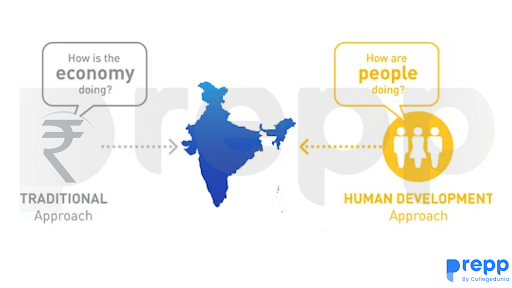
Human Development Approach
What is Human Development?
- Human development means the process of improving people's choices, such as education, health care, income, and empowerment.
- Human development covers the complete dimension of human choices from a healthy physical environment to economic, social, and political freedom.
- In other words, human development refers to the prosperity of human life, independent of the wealth of the economy in which people live.
- As a result, the most important part of human progress is expanding people's choices.
- People's choices may include a variety of issues, but living a long and healthy life, being educated, and having access to resources necessary for a decent standard of living, such as political freedom, guaranteed human rights, and personal self-respect, are all considered non-negotiable aspects of human development.
| Other Relevant Links | |
|---|---|
| Human Development index | Human Capital |
| Sustainable Development | Inclusive Growth |
The Four Pillars of Human Development
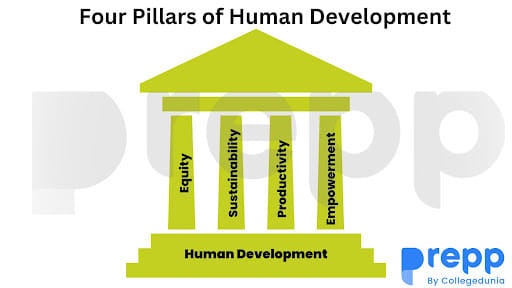
Four Pillars of Human Development
Productivity
- Productivity refers to human labour productivity or productivity in terms of human effort in this context.
- People's capacities must be continually enhanced in order to maintain high levels of production. People are, in the end, a country's most valuable resource.
- As a result, efforts to improve their knowledge or provide better health facilities result in increased productivity.
Equity
- Equity refers to ensuring that all people have access to the same opportunities.
- People must have equal access to opportunities regardless of their gender, ethnicity, income, social position, or, in India's case, caste. However, this is not always the case, and it occurs in practically every community.
- For instance — It's fascinating to examine which demographic accounts for the majority of school dropouts in any country. This should lead to a better understanding of why such conduct occurs.
- In India, a substantial number of women and people from economically and socially disadvantaged backgrounds drop out of school.
- This demonstrates how a lack of access to knowledge limits the options available to these populations.
Sustainability
- Sustainability refers to the availability of opportunities remaining constant.
- To achieve long-term human growth, each generation must have equal access to decision-making possibilities.
- Sustainable development necessitates the utilization of all environmental, financial, and human resources with the future in mind.
- If any of these resources are misused, subsequent generations will have fewer chances.
- The necessity of sending girls to school is an excellent example.
- If a community does not emphasize the value of sending girls to school, these young girls will miss out on many chances.
- Their professional options will be limited, which will have an impact on other elements of their lives.
- As a result, it is critical for each generation to ensure that future generations have access to options and opportunities.
Empowerment
- Empowerment means the ability to make decisions.
- Increased freedom and capability to select are the sources of such power.
- To empower individuals, good governance and people-centered policies are essential.
- Empowerment of socially and economically marginalised populations is particularly important.
Approaches to Human Development
The four approaches to Human Development are the basic needs approach, income approach, capacity approach, and welfare approach.
Basic Needs Approach
- The International Labour Organization (ILO) was the first to advocate this strategy.
- Six fundamental needs were identified: health, education, food, water supply, sanitation, and shelter.
- The issue of individual choice is neglected, and the focus is instead on meeting the basic requirements of specific groups.
Income Approach
- This approach is one of the oldest approaches to human development.
- Income is thought to be linked to human growth.
- The concept is that an individual's amount of freedom is reflected in his or her income.
- The more one's income, the higher one's level of human development.
Capability Approach
- This approach is associated with Prof. Amartya Sen.
- The key to enhancing human development is to improve human capacities in the areas of health, education, and resource access.
Welfare Approach
- Human beings are seen as beneficiaries or goals of all developmental efforts in this paradigm, which advocates for more government spending on education, health, and basic necessities.
- People are merely passive recipients, not active players.
- The government is exclusively accountable for boosting human development levels through maximising welfare spending.
Measuring Human Development
Human Development Index (HDI)
- The Human Development Index (HDI) is a statistical tool used to quantify a country's overall accomplishment in its social and economic dimensions, and it is published annually by the United Nations Development Programme (UNDP).
- The health of people, their level of education, and their style of life determine a country's social and economic characteristics.
- The economist Mahbub Ul Haq developed a human development method that is based on Nobel Laureate Amartya Sen's work on human capacities.
- Its goal was to "move development economics away from national income accounting and toward people-centered policy."
- HDI is broken down into four tiers–
- Very high human development
- High human development
- Medium human development
- Low human development
- HDI measures the average success of a country in three basic dimensions of human development:
- A long and healthy life
- Access to knowledge
- A decent standard of living
*To know more about the topic, click this link Human Development Index (HDI)
Conclusion
Human development is thus a multidimensional concept. People must be able to enhance and utilise their strengths in order to achieve human development. The key elements of human development are represented by the three variables used by the UN in the Human Development Index (HDI): long and healthy life, knowledge, and a fair level of living. When these important dimensions are provided initially, the prospects for advancement and improvement in other aspects of human life will expand as well.
| Other Relevant Links | |
|---|---|
| Indian Economics Notes | Economic Growth vs Economic Development |
| Economic Systems | Monetary Policy |
FAQs
Question: What is human development in economic terms?
Answer: Human development refers to improving the well-being of people, focusing on enhancing health, education, and standard of living.
Question: What is the Human Development Index (HDI)?
Answer: The HDI is a composite index measuring life expectancy, education, and per capita income to assess human development.
Question: Who publishes the Human Development Report?
Answer: The United Nations Development Programme (UNDP) publishes the Human Development Report annually.
Question: Why is human development important for economic growth?
Answer: Human development fosters better health, education, and skills, which improve productivity and contribute to sustainable economic growth.
Question: What are the components of human development?
Answer: The main components include health, education, and income, as they reflect an individual’s overall quality of life.
MCQs
- Which organization releases the Human Development Index?
a) World Bank
b) IMF
c) UNDP
d) WTO
Answer: (C) See the Explanation
The Human Development Index is published annually by the United Nations Development Programme (UNDP) to assess human development globally.
- Which of the following is not a component of the Human Development Index?
a) Life expectancy
b) Literacy rate
c) Per capita income
d) Trade deficit
Answer: (D) See the Explanation
The HDI considers life expectancy, education levels, and per capita income but does not account for trade deficits.
- What is the purpose of the Human Development Index?
a) Measure military strength
b) Assess economic development
c) Evaluate quality of life
d) Compare inflation rates
Answer: (C) See the Explanation
The HDI evaluates the overall quality of life by assessing health, education, and living standards.
- Which country typically ranks high on the Human Development Index?
a) Afghanistan
b) Norway
c) Sudan
d) Haiti
Answer: (B) See the Explanation
Norway often ranks among the highest due to its high life expectancy, education standards, and income levels.
- Why is education a key component of human development?
a) It helps increase tax revenue
b) It boosts consumer demand
c) It improves productivity and skill levels
d) It reduces the need for imports
Answer: (C) See the Explanation
Education equips individuals with the skills needed to improve productivity, innovation, and economic growth.
GS Mains Questions and Model Answers
Q1: Examine the role of the Human Development Index (HDI) in evaluating the progress of nations.
Answer: The HDI provides a holistic measure of a nation's development by focusing on health (life expectancy), education, and income levels. It shifts the focus from economic growth alone to the overall quality of life, making it an essential tool for comparing global development. By emphasizing human well-being, the HDI encourages policymakers to invest in education and healthcare. However, the index has limitations, as it does not consider income inequality, environmental degradation, or social and political stability, which also impact development outcomes.
Q2: Discuss the importance of education and health in human development and how they contribute to economic growth.
Answer: Education and health are critical components of human development. A well-educated population with access to good healthcare has higher productivity, innovation, and the ability to adapt to technological changes, which drives economic growth. Healthier individuals live longer, work more effectively, and contribute to economic output. Investment in education leads to a more skilled workforce, while better health reduces absenteeism and improves labor participation rates. Together, these factors contribute to a more sustainable and inclusive development process.
Q3: Analyze the limitations of the Human Development Index (HDI) in capturing the complete picture of a nation’s development.
Answer: While the HDI is valuable in assessing basic aspects of human well-being, it has notable limitations. It does not account for income inequality, meaning countries with high economic disparities may still rank high despite widespread poverty. The HDI also overlooks environmental sustainability and political factors like governance and human rights, which are crucial for long-term development. Additionally, the index is based on national averages, which can mask regional disparities and differences within social groups, offering an incomplete view of development
Previous Year Questions on Human Development
1. UPSC CSE Prelims 2018:
Question: Which of the following are components of the Human Development Index (HDI)?
A. Life expectancy, education, and income
B. Population density, GDP growth, and unemployment
C. Literacy rate, inflation, and imports
D. Health services, defense expenditure, and industrial output
Answer: A
Explanation: The HDI is composed of life expectancy (health), education (mean years of schooling), and per capita income, reflecting quality of life.
2. UPSC CSE Mains 2017 (GS Paper 2):
Question: Discuss the significance of human development as a measure of a nation’s progress and its limitations.
Answer: Human development emphasizes well-being by considering health, education, and living standards, providing a more holistic view of development beyond economic growth. However, the HDI does not account for income inequality, environmental sustainability, or political stability, which are also important indicators of a nation’s overall progress. The focus on averages can obscure disparities within countries, and the index’s simplicity may oversimplify complex aspects of development.
3. UPSC CSE Prelims 2017:
Question: The Human Development Index (HDI) primarily focuses on which of the following indicators?
A. GDP, tax revenue, and employment
B. Life expectancy, education, and income
C. Health infrastructure, energy consumption, and inflation
D. Industrial output, literacy rate, and defense expenditure
Answer: B
Explanation: The HDI assesses a country's life expectancy, education levels, and per capita income to measure overall human development.
Download the PREPP App and attempt FREE IAS Exam Mock Tests and get complete study material!

Full Test - 04: UPSC CSE Prelims CSAT (Paper-II)
Full Test - 03: UPSC CSE Prelims CSAT (Paper-II)
UPSC CSE Prelims 2026 GS Paper 1 Question Paper (24-May-2026)
UPSC CSE Prelims 2026 CSAT Paper 2 Question Paper (24-May-2026)

17 February 2025 | The Hindu Must Read Articles | Current Affairs

16 February 2026 | The Hindu Must Read Articles | Current Affairs

13 February 2026 | The Hindu Must Read Articles | Current Affairs









Comments