Economic System – Indian Economy Notes
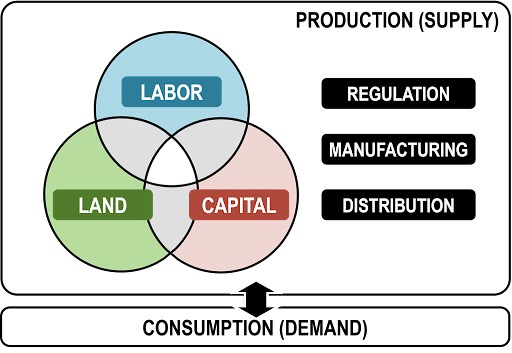
An economic system is a tool that the government uses to plan and distribute accessible services, resources, and commodities across the country. The factors of production, such as land, capital, labour, and physical resources, are regulated by economic systems. A community's economic system is made up of a variety of institutions, organisations, entities, decision-making mechanisms, and consumption patterns. The topic “Economic System” is one of the important concepts in the UPSC/IAS 2023 Economy syllabus which is discussed in this article in detail.
|
Table of Contents |
What exactly is an Economic System?
- An economic system serves as the foundation upon which a nation's economic activities are structured and organized.
- An economic system or economic order, is a method used by organizations or governments to coordinate and distribute resources, services, and goods throughout a territory or nation.
- It delineates how resources are allocated, goods and services are produced, distributed, and consumed, and the overall economic landscape functions.
- Economic systems combine wealth, labour, physical resources, and business personnel to handle production factors.
Types of Economic Systems
-
Capitalist Economy
- In a capitalist society, items are distributed among individuals based on purchasing power, which is the ability to buy goods and services, rather than on what they want.
- This implies that a person must have sufficient funds to purchase products and services.
- For example, low-cost housing for the poor is desperately needed, yet there will be little demand in the market because the poor lack the purchasing ability to support it.
- As a result, the goods will not be produced and distributed according to market forces.
| Other Relevant Links | |
|---|---|
| Capitalist Economy | Socialist Economy |
| Mixed Economy | Difference between Capitalist and Socialist economic systems |
-
Socialist Economy
- In a socialist economy, the government decides what products should be made to meet society's needs.
- It is assumed that the government is aware of what is appropriate for the country's population. As a result, individual purchasers' passions aren't given much consideration.
- The government makes decisions about how items are made and how they are disposed of.
- In theory, sharing under socialism is based on what each individual requires rather than what they can afford.
- Because everything is controlled by the government in a socialist regime, there is no separate estate.
-
Mixed Economy
- The characteristics of both the socialist and capitalist economic systems can be found in mixed systems.
- Mixed economic systems are also called dual economic systems for this reason.
- A genuine approach to determining a mixed system, on the other hand, does not exist.
- In some parts of the economy, this term refers to a market system that is subject to rigorous administrative regulation.
Characteristics of an Economic System
All economic systems must address the following four fundamental economic problems:
What goods should be produced?
- Pricing theory serves as the foundation for this important economic issue.
- In this context, the theory of pricing deals with the economic trade-offs between producing capital goods and consumer goods in the face of resource scarcity.
- In this regard, it is crucial to critically assess the demands of society in light of population demographics such as age, sex, occupation, and geography.
How should the goods be produced?
- The main problem of how things should be produced is heavily dependent on the least-expensive method of production that should be used as profitably unique to the economically determined commodities and services to be produced.
- Broadly speaking, labor-intensive and resource-intensive techniques of production are the options.
How should be the produced goods distributed?
- When the final consumers receive the goods, production is said to be finished.
- In order to minimize bottlenecks and clogs in the chain of distribution of economic resources and to maximize consumer happiness, this fundamental problem of how the output will be dispersed aims to determine the best possible medium.
When should be the goods produced?
- Given that the forces of supply and demand are highly dependent on time, seasonal analysis plays a role in consumer satisfaction.
- A thorough examination of time dynamics and seasonal fluctuation in relation to the fulfillment of consumer needs is necessary to solve this fundamental economic challenge.
- It is important to note that the type of economic system might influence the solutions to these fundamental issues.

Major Sectors of Economic System
There are three major economic sectors that make up the overall economy. They are:
- Primary Sector:The primary sector encompasses activities directly tied to the extraction of natural resources from the earth, water, and air. Agriculture, mining, forestry, and fishing stand as core activities within the primary sector, each contributing to a nation's resource base and livelihoods.
- Secondary Sector:The secondary sector, often known as the industrial sector, plays a vital role in converting raw materials extracted from the primary sector into finished products. This sector encompasses manufacturing, construction, and energy production activities that add value to resources and contribute significantly to a nation's economic growth.
- Tertiary Sector: Tertiary Sector, also known as the service sector is responsible for providing services to both businesses and final consumers. The tertiary sector offers a diverse array of services, from healthcare and education to finance, entertainment, and tourism.
*To know more about the topic, click this link Sectors of Indian Economy
Differences between Capitalist, Socialist, and Mixed Economies
| Parameters | Capitalist Economy | Socialist Economy | Mixed Economy |
|---|---|---|---|
| Ownership of property | Private ownership | Public ownership | Both private and public ownership |
| Price determination | Prices are determined by the market forces of demand and supply. | The central planning authority determines prices. | The central planning authority, as well as demand and supply, determine prices. |
| Motive of production | Profit motive | Social welfare | In the private sector, profit is the motivating factor, while in the public sector, welfare is the motivating factor. |
| Role of government | No role | Complete role | Full role in the public sector and limited role in the private sector |
| Competition | Exists | No competition | Exists only in the private sector |
| Distribution of income | Very unequal | Quite equal | Considerable inequalities exist |
Conclusion
Economic systems shape the destiny of nations, influencing resource allocation, production, distribution, and ultimately, the quality of life for citizens. India's mixed economy approach, coupled with strategic efforts, aims to achieve balanced growth and inclusivity. As nations navigate the complexities of economic systems, the goal remains to foster prosperity while safeguarding the well-being of current and future generations.
| Other Relevant Links | |
|---|---|
| Indian Economics Notes | Sectors of Indian Economy |
| What is Economics | Micro Economics |
| National Income Accounting | Macro Economics |
FAQs
Question: What is meant by the economic system in India?
Answer: The economic system of India refers to the framework of policies and principles that govern the production, distribution, and consumption of goods and services in the country. India follows a mixed economic system, where both private and public sectors coexist. The government plays a crucial role in regulating and controlling key industries, public services, and social welfare programs. It aims to balance market-driven forces with welfare and equality-focused policies, ensuring economic development, poverty reduction, and sustainable growth. The system has evolved from a centrally planned economy to a more market-oriented one since the 1991 economic reforms.
Question: What are the main features of the Indian economic system?
Answer: The main features of the Indian economic system include: 1. Mixed Economy: India has a mixed economy, which includes both the private and public sectors. The private sector operates freely in many areas, while the public sector controls essential industries like defense, railways, and energy. 2. Government Role: The Indian government plays a significant role in regulating industries, formulating policies, and providing public services like healthcare and education. 3. Planned Economic Development: Initially, India adopted a planned economic model with five-year plans focusing on industrialization and poverty alleviation. This model has shifted to a more liberalized, market-driven approach in recent decades. 4. Social Welfare Programs: The Indian economic system also includes measures to address social inequalities and poverty, through schemes like the Mahatma Gandhi National Rural Employment Guarantee Act (MGNREGA).
Question: How has India's economic system changed over time?
Answer: India's economic system has undergone significant changes, especially since the economic reforms of 1991. Prior to this, India followed a socialist-oriented economic model with a strong emphasis on public sector control and centralized planning. However, after 1991, India introduced liberalization, privatization, and globalization, moving toward a more market-oriented economy. Key reforms included reducing import tariffs, allowing foreign investment, and encouraging private sector growth. These reforms spurred rapid economic growth, improved infrastructure, and increased India's participation in the global economy, although challenges like income inequality and unemployment persist.
Question: What is the role of the public and private sectors in India's economic system?
Answer: In India's mixed economy, both the public and private sectors have crucial roles: 1. Public Sector: The government controls key industries that are vital for national security and welfare, such as defense, railways, and energy. Public enterprises also play a significant role in providing essential services like healthcare, education, and transportation. 2. Private Sector: The private sector is the engine of growth in India, driving innovation, employment, and economic diversification. It is active in industries such as information technology, manufacturing, and services. The private sector's role in economic development has been enhanced through liberalization and foreign investment. The balance between the two sectors aims to combine the efficiency and innovation of the private sector with the welfare objectives of the public sector.
Question: How does the Indian economic system aim to reduce poverty and inequality?
Answer: The Indian economic system addresses poverty and inequality through a combination of government intervention, social welfare programs, and economic reforms. The government implements direct poverty alleviation programs such as the National Rural Employment Guarantee Act (NREGA) and provides subsidies for food, fuel, and housing. Economic policies, including affirmative action programs, aim to uplift marginalized communities like Scheduled Castes, Scheduled Tribes, and Other Backward Classes. Additionally, inclusive growth strategies focus on improving access to education, healthcare, and employment opportunities for all citizens, especially in rural and underdeveloped areas.
MCQs
1. What type of economic system does India follow?
A) Capitalist Economy
B) Socialist Economy
C) Mixed Economy
D) Market Economy
Answer: (C) See the Explanation
Explanation: India follows a mixed economy, where both private and public sectors coexist, with government intervention in certain areas for social welfare and economic planning.
2. What major change did India adopt after the 1991 economic reforms?
A) More control by the public sector
B) Complete privatization of industries
C) A shift toward a market-oriented economy
D) A shift to a completely socialist system
Answer: (C) See the Explanation
Explanation: After the 1991 economic reforms, India shifted towards a more market-oriented economy, with liberalization, privatization, and globalization promoting private sector growth.
3. Which of the following is NOT a key feature of India's economic system?
A) Mixed economy
B) Centralized economic planning
C) High government control over all industries
D) Private sector participation in economic growth
Answer: (C) See the Explanation
Explanation: India no longer follows a model of high government control over all industries. While the public sector plays a significant role, the economy has moved towards liberalization, allowing private sector growth.
4. What is the primary objective of India's mixed economic system?
A) To encourage only government-run industries
B) To maximize profits for private enterprises
C) To balance welfare objectives with market-driven economic growth
D) To eliminate private sector participation
Answer: (C) See the Explanation
Explanation: India's mixed economic system aims to balance the welfare objectives of the public sector with the efficiency and innovation driven by the private sector.
5. Which of the following is a major source of economic inequality in India?
A) High government spending
B) Lack of social welfare programs
C) Unequal distribution of resources and opportunities
D) Complete government control over the economy
Answer: (C) See the Explanation
Explanation: Unequal distribution of resources, opportunities, and access to basic services like education and healthcare is a major cause of economic inequality in India.
GS Mains Questions and Model Answers
Q1: Discuss the role of the public and private sectors in India’s mixed economy and how they contribute to economic growth.
Answer: In India’s mixed economy, both the public and private sectors play significant roles in driving economic growth. The public sector focuses on providing essential services such as healthcare, education, and infrastructure, particularly in sectors where the private sector may not have a strong interest, like defense, railways, and energy. On the other hand, the private sector is the primary driver of innovation, industrial growth, and foreign investment. The liberalization policies of the 1990s enabled the private sector to flourish, particularly in areas like information technology, manufacturing, and services. The combination of both sectors has helped India sustain robust economic growth, although challenges like poverty and inequality remain. The government continues to regulate key sectors to ensure equitable development and social welfare while encouraging private enterprise to create jobs and wealth.
Q2: Evaluate the impact of economic liberalization on the Indian economy since 1991.
Answer: Economic liberalization in 1991 marked a significant turning point for India’s economic growth, shifting the country from a socialist-oriented planned economy to a more market-driven economy. The introduction of reforms such as reduced tariffs, de-licensing of industries, and encouragement of foreign investment opened up various sectors to competition and innovation. As a result, India witnessed substantial growth in industries such as technology, manufacturing, and services. This led to an increase in foreign direct investment (FDI), improved exports, and enhanced global integration. However, the benefits of liberalization have not been equally distributed, with rural areas and marginalized sections of society often left behind. The challenge now is to ensure that the gains from liberalization reach all sectors of society and contribute to sustainable, inclusive growth.
Q3: Analyze the role of social welfare programs in addressing economic inequality in India.
Answer: Social welfare programs in India play a crucial role in addressing economic inequality by providing financial support and access to essential services for the most vulnerable sections of society. Programs such as the Mahatma Gandhi National Rural Employment Guarantee Act (MGNREGA), Public Distribution System (PDS), and direct cash transfers have been designed to improve living standards in rural and economically backward areas. These programs aim to reduce poverty, create employment opportunities, and provide subsidies for basic necessities such as food, fuel, and housing. However, challenges remain in the form of misallocation of resources, bureaucratic inefficiencies, and gaps in coverage, which hinder the full potential of these programs. Nonetheless, these social welfare schemes are crucial for promoting social equity and helping reduce the widening income gap in India.
Previous Year Questions on Economic System
1. UPSC CSE Prelims 2020:
Question: The economic system of India is best described as:
A) A capitalist economy
B) A socialist economy
C) A mixed economy
D) A planned economy
Answer: (C)
Explanation: India follows a mixed economy, where both public and private sectors coexist to promote economic growth and welfare.
2. UPSC CSE Mains 2021 (GS Paper 3):
Question: "Assess the impact of the economic reforms of 1991 on India’s growth trajectory."
Answer: The 1991 economic reforms were a turning point in India's growth trajectory, opening up the economy to global markets, enhancing the role of the private sector, and attracting foreign investment. The reforms introduced a more market-oriented approach, with deregulation, trade liberalization, and reductions in tariffs. These reforms resulted in rapid growth in sectors like IT, telecommunications, and services, transforming India into one of the world’s fastest-growing economies. However, the benefits of these reforms have been uneven, with rural and underdeveloped regions lagging behind. As a result, while India’s overall GDP has grown significantly, challenges related to income inequality, job creation, and infrastructure development persist.
Download the PREPP App and attempt FREE IAS Exam Mock Tests and get complete study material!

Full Test - 04: UPSC CSE Prelims CSAT (Paper-II)
Full Test - 03: UPSC CSE Prelims CSAT (Paper-II)
UPSC CSE Prelims 2026 GS Paper 1 Question Paper (24-May-2026)
UPSC CSE Prelims 2026 CSAT Paper 2 Question Paper (24-May-2026)

17 February 2025 | The Hindu Must Read Articles | Current Affairs

16 February 2026 | The Hindu Must Read Articles | Current Affairs

13 February 2026 | The Hindu Must Read Articles | Current Affairs









Comments