Sectors of Indian Economy – Indian Economy Notes
There are three main sectors of the Indian economy: primary sector, secondary sector, and tertiary sector i.e., agriculture, manufacturing, and service sectors. According to the most recent 'World Economic League Table 2020' report, India has surpassed both France and the United Kingdom to become the world's fifth-largest economy in 2019. India is expected to be the world's second-largest economy by 2050. The topic “Sectors of Indian Economy” is one of the important topics in the UPSC/IAS 2023 Economy syllabus which is discussed in this article in detail.
|
Table of Contents |

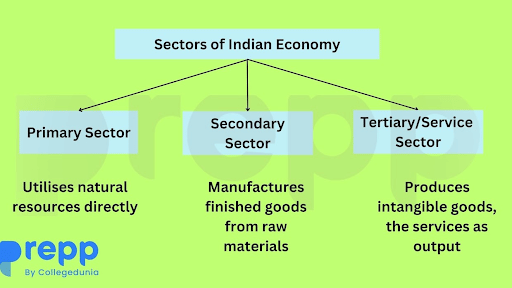
Primary, Secondary, and Tertiary Sectors
What are Sectors in the Economy?
- The Indian economy operates within a diverse framework of sectors, each playing a crucial role in its growth and development.
- These sectors, each with its unique characteristics and contributions, form the backbone of India's economic landscape.
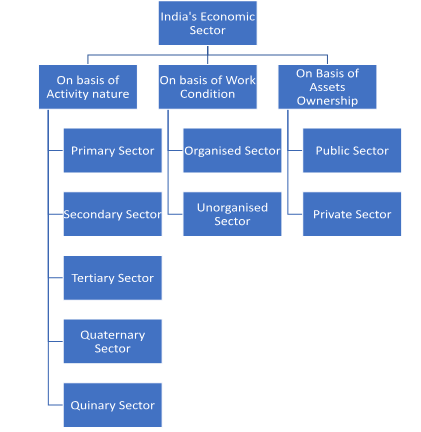
- On the basis of ownership, labour conditions, and the nature of the operations, the Indian economy can be divided into numerous sectors.
- But the three main sectors of the Indian Economy are: the primary sector, the secondary sector, and the tertiary sector are discussed below.
- During the early stages of civilization, the primary sector accounted for all economic activity.
- People's demand for other items grew as a result of the surplus food production, resulting in the growth of the secondary sector.
- During the nineteenth century's industrial revolution, the secondary sector expanded its significance.
- To facilitate industrial activities, a support system was required. Certain industries, such as transportation and finance, were critical in sustaining industrial activity.
Main Sectors in India’s Economy
On the Basis of Activity Nature, the three main sectors of the Indian Economy are the primary sector, the secondary sector, and the tertiary sector.
Primary Sector
- The activities of the primary sector of the economy are carried out by utilising natural resources directly.
- Agriculture, mining, fishing, forestry, dairy, and other industries fall into this category.
- It is thus named because it serves as the foundation for all other sectors.
- About 54.6 percent of the total workforce in the country is still engaged in agricultural and allied sector activities.
- Agriculture, together with fisheries and forestry collectively make up one-third of India's GDP. The primary sector generates 18.20 percent of the GDP.
- India's economy has always been based primarily on agriculture. In addition, India is the second-largest producer of groundnuts, wheat, sugar, freshwater fish, and milk in the world.
- It is also known as the Agriculture and Allied Sector since agriculture, dairy, forestry, and fishing provide the majority of the natural items we consume.
- Due to the nature of their profession, people who engage in primary activities are referred to as red-collar employees.
- Underemployment and covert employment are the two main problems this industry is dealing with.
Secondary Sector
- The secondary Sector covers industries that manufacture finished goods from natural materials harvested in the primary sector.
- This sector includes operations such as industrial production, cotton fabric manufacture, sugar cane production, and so on.
- As a result, rather than producing raw materials, it is the sector of a country's economy that manufactures goods.
- This sector is often known as the industrial sector because it is involved with various types of industries.
- Blue-collar employees are those who engage in secondary activities.
- The contribution of the industrial sector has been constantly declining since 2011-12.
Tertiary Sector/Service Sector
- The Tertiary Sector covers the services provided in the economy and not the goods or tangible items.
- The services sector’s significance in the Indian economy has been steady, with the sector now accounting for over 54 percent of the economy and almost four-fifths of total FDI inflows.
- The activities of this sector contribute to the growth of the primary and secondary sectors.
- Economic activities in the tertiary sector do not produce things on their own, but they do help or assist production.
- The sector includes goods transported by trucks or trains, as well as banking, insurance, and finance.
- It adds value to a product in the same way that the secondary sector does.
- These sector jobs are called white-collar jobs.
Quaternary Sector
Quinary Sector
|
Why did India shift from the primary sector to the services sector and not the secondary sector?
- A country's normal economic path is from agrarian to industrial to a service economy, but India has jumped ahead of the curve from agrarian to service economy.
- Diversification towards services has been a notable element of India's recent prosperity, with the services sector accounting for the majority of GDP.
- India has become a prominent services exporter thanks to its success in software and IT-enabled services (ITeS), with its share of global services exports rising from 0.6 percent in 1990 to 3.3 percent in 2013.
- Other factors for the country's quick expansion in the service industry include well-educated and vast human resources, fluency in English, and the availability of cheap labour.
- On the other hand, low growth in the Secondary sector can be attributed to:
- The license Raj
- Restrictions on foreign investment
- Lack of measures to promote private industry
- Power Deficit
- Stringent Labour laws
- Lack of skilled labour
- Delays in Land Acquisition and environmental Clearances
- Import of cheap manufactured goods etc.
- Despite its low per capita income, India's percentage of GDP from services is approaching the worldwide norm. However, unlike the global average, the contribution of services to employment was much lower.
- Because the manufacturing sector is labour-intensive, greater emphasis on manufacturing through initiatives such as 'Make in India' would help to remedy this anomaly and increase employment in line with GDP growth.
| Other Relevant Links | |
|---|---|
| Primary Sector | Secondary Sector |
| Tertiary Sector | Quaternary Sector |
| Quinary Sector | Branches of Economics |
Other Sectors in India’s Economy
1) On the Basis of Work Condition
Organised Sector
- In this industry, employment terms are set and consistent, and employees are guaranteed work and social security.
- It can also be characterised as a sector that is registered with the government and is subject to a variety of laws. The organised sector includes schools and hospitals.
- Workers in the organised sector have more job security.
- They are only required to work a set amount of hours. If they work longer hours, the company must compensate them with overtime pay.
Unorganised Sector
- A home-based worker, a self-employed worker, or a wage worker in the unorganised sector is considered an unorganised worker, as is a worker in the organised sector who is not covered by any of the welfare schemes listed in Schedule II of the Unorganized Workers Social Security Act, 2008.
- Due to the transient and seasonal nature of employment and the dispersed placement of businesses, wage-paid labour in this sector is typically non-unionized.
- Low wages, insecure and irregular employment, and a lack of protection from legislation or trade unions characterise this industry.
- The unorganised industry relies primarily on labour-intensive and locally developed technology.
- Workers in the unorganised sector are so dispersed that the legislation's execution is woefully inadequate and ineffectual. In this industry, there are few unions to function as watchdogs.
- However, as compared to the organised sector, the unorganised sector makes a significant contribution to national income.
- It contributes more than 60% of national income, whereas the organised sector contributes about half of that, depending on the industry.
2) On the Basis of Asset Ownership
Public Sector
- The government owns the majority of the assets in the sector, and it is the segment of the economy responsible for providing various governmental services.
- The public sector does not exist solely to make money.
- Governments raise funds through taxes and other means to cover the costs of the services they provide.
Private Sector
- Asset ownership and service delivery are in the hands of private individuals or organisations in the private sector.
- It is also known as the citizen sector, and it is administered by private persons or groups, usually for profit, and is not governed but regulated by the government.
- The private sector's activities are guided by the desire to make money. We must pay money to these people and companies in order to obtain such services.
Conclusion
The sectors of the Indian economy, interwoven like threads in a tapestry, collectively contribute to the nation's progress. The primary sector anchors livelihoods, the secondary sector builds infrastructure, and the tertiary sector catalyzes innovation and services. India's efforts and initiatives reflect its commitment to balanced growth across sectors, aiming to create a robust and self-reliant economy that benefits all its citizens.
| Other Relevant Links | |
|---|---|
| Indian Economics Notes | Micro Economics |
| Economic Systems | Macro Economics |
| What is Economics | Economic Growth and Economic Development |
FAQs
Q1: What are the main sectors of the Indian economy?
Answer: The Indian economy is primarily divided into three sectors: Primary (agriculture and allied activities), Secondary (manufacturing and industrial activities), and Tertiary (services such as banking, IT, and healthcare). Each sector plays a crucial role in India's overall economic development.
Q2: What is the contribution of the primary sector to the Indian economy?
Answer: The primary sector, which includes agriculture, forestry, fishing, and mining, contributes around 15-20% of India's GDP. It employs the largest proportion of the population, particularly in rural areas, making it vital to India's economy.
Q3: How does the secondary sector contribute to India's economy?
Answer: The secondary sector includes industries such as manufacturing, construction, and electricity generation. It contributes around 25-30% to India's GDP. It is crucial for industrialization, creating jobs, and adding value to raw materials produced by the primary sector.
Q4: What is the significance of the tertiary sector in India?
Answer: The tertiary sector, also known as the services sector, has become the largest contributor to India’s GDP, contributing over 50%. It includes IT, banking, transport, healthcare, education, and tourism, and it drives urbanization, technological advancement, and economic growth.
Q5: How has the service sector transformed the Indian economy?
Answer: The service sector has experienced significant growth in recent decades, driven by IT, financial services, and healthcare. It has contributed to GDP growth, job creation, and exports. India is now a global leader in IT services and business process outsourcing (BPO).
MCQs
- Which sector contributes the highest share to India’s GDP?
a) Primary sector
b) Secondary sector
c) Tertiary sector
d) Quaternary sector
Answer: (C) See the Explanation
- What is included in the primary sector of the Indian economy?
a) Agriculture, forestry, mining
b) Construction, manufacturing
c) Banking, IT, tourism
d) Education, healthcare
Answer: (A) See the Explanation
- Which sector is known for its role in value addition to raw materials?
a) Primary sector
b) Secondary sector
c) Tertiary sector
d) Quaternary sector
Answer: (B) See the Explanation
- What is the primary driver of the tertiary sector in India?
a) Agriculture
b) Information Technology (IT) and services
c) Mining
d) Textile production
Answer: (B) See the Explanation
- Which sector employs the largest proportion of the Indian workforce?
a) Tertiary sector
b) Secondary sector
c) Primary sector
d) Quaternary sector
Answer: (C) See the Explanation
GS Mains Questions and Model Answers
Q1: Analyze the structural transformation of the Indian economy with reference to the shift from the primary to the tertiary sector.
Answer: India has undergone significant structural transformation since independence, characterized by a shift in the contribution of different sectors to the GDP. Initially, the primary sector (agriculture) was the dominant contributor, but its share has steadily declined due to rapid industrialization and the growth of the services sector.
The secondary sector, including manufacturing and construction, grew in importance during the 1980s and 1990s, contributing to urbanization and job creation. However, in recent decades, the tertiary sector has emerged as the largest contributor to GDP, driven by rapid growth in IT, finance, healthcare, and education. This shift highlights the growing importance of a knowledge-based economy. While the service sector leads in GDP contribution, the primary sector remains crucial for employment. Going forward, there is a need for balanced growth across all sectors to ensure inclusive development and job creation.
Q2: Discuss the importance of the secondary sector in the economic development of India.
Answer: The secondary sector plays a pivotal role in the economic development of India. It includes industries such as manufacturing, construction, and power generation, which contribute to GDP growth, employment generation, and the modernization of the economy. The sector adds value to raw materials from the primary sector, producing finished goods and creating jobs in both rural and urban areas.
Industrialization, driven by the secondary sector, has led to economic diversification, reducing dependency on agriculture and boosting exports. Sectors like automobile manufacturing, electronics, and textiles have become key drivers of industrial growth. Government initiatives such as "Make in India" and Production Linked Incentives (PLI) are focused on boosting the secondary sector by encouraging investment and innovation. A strong secondary sector is essential for sustained economic growth, improving infrastructure, and fostering technological advancement in India.
Q3: Examine the role of the service sector in transforming India into a knowledge-based economy.
Answer: The service sector, or tertiary sector, has played a transformative role in India’s transition to a knowledge-based economy. Over the past few decades, the sector has grown rapidly, becoming the largest contributor to GDP and a significant source of employment. The rise of Information Technology (IT) and Business Process Outsourcing (BPO) has made India a global hub for knowledge-based services.
The service sector’s growth is not only limited to IT but also includes financial services, healthcare, education, and tourism, all of which have contributed to economic diversification. With advancements in technology and digitalization, the sector has enabled India to move towards a more innovation-driven economy. The export of services has become a major source of foreign exchange, further cementing India’s position in the global economy. However, the challenge remains to ensure that this growth translates into widespread job creation and inclusive development across all regions.
Previous Year Questions on Sectors of Indian Economy
1. UPSC CSE 2017
Question: Discuss the significance of the tertiary sector in the economic growth of India.
Answer: The tertiary sector, or services sector, plays a crucial role in the economic growth of India, contributing over 50% to the country’s GDP. It includes a wide range of activities such as IT services, banking, education, healthcare, and tourism. The rapid expansion of the IT and Business Process Outsourcing (BPO) industries has positioned India as a global leader in services exports, providing employment opportunities, foreign exchange earnings, and driving technological advancement.
The service sector’s significance also lies in its ability to attract investment, foster urbanization, and promote economic diversification. Sectors like banking and insurance have played a key role in financial inclusion, while education and healthcare have contributed to human capital development. The sector has also enabled India to shift from an agriculture-dominated economy to a more knowledge-based economy. However, despite its contribution to GDP, the tertiary sector faces challenges in generating adequate employment, particularly for low-skilled workers. Ensuring that the growth of the service sector translates into inclusive development remains a key policy goal.
2. UPSC CSE 2018
Question: Analyze the contribution of the secondary sector to India’s economic development.
Answer: The secondary sector, comprising manufacturing, construction, and electricity generation, has been a vital contributor to India’s economic development. This sector adds significant value to raw materials produced in the primary sector, transforming them into finished goods. It accounts for around 25-30% of India’s GDP and provides employment to millions of workers, particularly in urban and semi-urban areas.
The manufacturing industry, as a key component of the secondary sector, has been crucial in driving industrialization and urbanization. Sectors like textiles, automobiles, and electronics have contributed to export growth, technological advancement, and increased investment. Government initiatives like "Make in India" and the introduction of the Production Linked Incentive (PLI) scheme aim to further enhance the role of the secondary sector by boosting domestic production and attracting foreign direct investment.
The secondary sector’s role in economic development lies in its capacity to foster job creation, increase productivity, and contribute to infrastructure development. However, for sustained growth, challenges such as improving infrastructure, ensuring access to finance, and adopting advanced technologies must be addressed.
Download the PREPP App and attempt FREE IAS Exam Mock Tests and get complete study material!

Full Test - 04: UPSC CSE Prelims CSAT (Paper-II)
Full Test - 03: UPSC CSE Prelims CSAT (Paper-II)
UPSC CSE Prelims 2026 GS Paper 1 Question Paper (24-May-2026)
UPSC CSE Prelims 2026 CSAT Paper 2 Question Paper (24-May-2026)

17 February 2025 | The Hindu Must Read Articles | Current Affairs

16 February 2026 | The Hindu Must Read Articles | Current Affairs

13 February 2026 | The Hindu Must Read Articles | Current Affairs









Comments