What is Economics? - Indian Economy Notes
Economics is a social science that deals with the production, consumption, and distribution of goods and services, and the transfer of wealth. The term ‘Economics’ is derived from the Greek words OIKOS ("household") and NEMEIN ("management and dispensation"). Understanding “What is Economics?” is very important for UPSC/IAS Exam 2023 to understand further concepts in a holistic manner. In this article, we will look at the meaning of economics and how it has changed over time.
|
Table of Contents |
What exactly is Economics?
- Economics is the study of scarcity, resource utilisation, and response to incentives, or the study of decision-making.
- Economics is a vast subject and its definition and meaning have undergone changes over a period of time.
- Aristotle, the Greek Philosopher has termed Economics as a science of ‘household management.’
- There are two branches of economics: microeconomics and macroeconomics.
Meaning of Economics
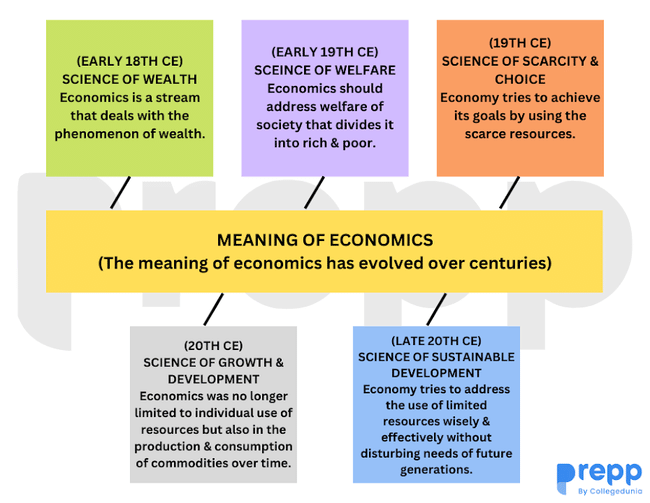
Due to its vastness, the meaning of economics has changed over the course of time. Let us see the evolution of the meaning of economics from the late eighteenth century.
Science of Wealth
- The late eighteenth-century classical thinkers viewed that economics deals with the phenomenon of wealth.
- This includes the nature and causes of wealth and the creation of wealth by individuals and nations.
Science of Welfare
- In the early nineteenth century, scholars felt that economics should address the welfare of society as only wealth divided the society into rich and poor.
- Welfare is both quantitative and qualitative. The quantitative aspects involve consumption of goods and services, increase in per capita income, etc.
Science of Scarcity and Choice
- The welfare definition only explains the material goods aspects of welfare and not the non-material services aspects.
- Since resources available in society to individuals are scarce, we try to achieve our goals by alternatively using resources and using them appropriately.
- For instance, consider an example where cloth and wheat are produced with fixed limited resources.
- When the demand for Wheat is increased either we ignore the demand and produce the same quantities of cloth and wheat or allocate more resources to wheat production by cutting from cloth production to meet the demand.
Science of Growth and Development
- In the twentieth century, the role of government to ensure the growth and development of the entire economy gained momentum.
- Therefore economics was no longer limited to individual decision-making and use of resources but included production and consumption of commodities over time.
- It is well acknowledged that in order for an individual to be able to fulfil his or her desires, the entire economy must grow and appropriate mechanisms must be found to transfer the advantages of growth among individual residents.
- As a result, the economy's performance is critical in terms of resource utilisation, production, and distribution of products and services.
- The economy must distribute its resources across numerous alternative activities, assure their efficient utilisation, and figure out how to grow them for future economic development.
Science of Sustainable Development
- In the late twentieth century, economists talked about the welfare of future generations and the protection of the environment.
- To achieve high growth and development the natural environment is exploited.
- Increased consumption leads to wastage and it should be noted that many minerals are available in limited quantities which we may not leave behind for future generations.
- It is our moral obligation to use the limited resources available wisely and efficiently in order to secure the well-being of future generations.
- Nobel Laureate Prof. Samuelson has spelt out Economics as follows: “Economics is the study of how men and society choose, with or without the use of money, to employ scarce productive resources which could have alternative uses, to produce various commodities over time, and distribute them for consumption now and in the future among various people and groups of society”.
Sustainable Development
|
|
|
|
|---|---|
| Branches of Economics | Macro Economics |
| Micro Economics | Difference Between Macroeconomics and Microeconomics |
Branches of Economics
The study of economics is separated into two branches: microeconomics and macroeconomics.
Microeconomics
- The term "micro" refers to something that is extremely little. As a result, microeconomics refers to the study of economics on a very tiny scale.
- In other words, microeconomics studies the behavior of individuals and firms when allocating scarce resources and how they interact.
- It explains why and how different goods have different values, how individuals and businesses conduct and benefit from efficient production and exchange, and how people best coordinate and cooperate with one another.
- Example: Concepts of Law of Demand and Supply, Market Equilibrium, etc.,
*Click Here to read more about Microeconomics.
Macroeconomics
- The term "macro" refers to something that is extremely enormous. The society, country, or economy as a whole is enormous in relation to one individual. As a result, macroeconomics is concerned with economic decisions made at the national level.
- In other words, macroeconomics studies the behavior of the overall economy.
- It includes the behavior of markets, businesses, consumers, and governments.
- Macroeconomic factors include inflation, price levels, economic growth rate, national income, GDP, unemployment, etc.
- Example: Aggregate Demand and Supply, Keynesian Economics, etc.
*Click Here to read more about Macroeconomics.
Conclusion
Economics is a social science that studies how products and services are produced, distributed, and consumed. Human behaviors thus play a central focus in economics, which is founded on the notion that humans act rationally, seeking the highest amount of benefit or value. In today’s time, a nation’s prosperity is totally dependent on Economic Development, thus understanding the science of economics is very important.
|
|
|
|---|---|
| Indian Economy Notes | Sectors of Indian Economy |
| Capitalist Economy | Socialist Economy |
| Mixed Economy | Difference between Capitalist and Socialist economic systems |
FAQs
Q1: What is economics?
Answer: Economics is the social science that studies how individuals, businesses, and governments make choices about allocating scarce resources to satisfy their needs and wants.
Q2: What are the two main branches of economics?
Answer: The two main branches are microeconomics, which focuses on individual and business decision-making, and macroeconomics, which examines the economy as a whole.
Q3: Why is the concept of scarcity important in economics?
Answer: Scarcity implies that resources are limited, leading to the need for choices, trade-offs, and prioritization in resource allocation.
Q4: How do supply and demand influence market prices?
Answer: Supply and demand determine market prices through their interaction; when demand exceeds supply, prices rise, and when supply exceeds demand, prices fall.
Q5: What is the role of government in economics?
Answer: Governments intervene in the economy to regulate markets, provide public goods, address externalities, and promote economic stability and growth.
MCQs
- What does economics primarily study?
a) Environmental issues
b) Resource allocation
c) Political systems
d) Social issues
Answer: (B) See the Explanation
- Which branch of economics focuses on the economy as a whole?
a) Microeconomics
b) Macroeconomics
c) Behavioral economics
d) Development economics
Answer: (B) See the Explanation
- What is scarcity in economics?
a) Abundance of resources
b) Limited resources relative to wants
c) High demand
d) Low demand
Answer: (B) See the Explanation
- Which factor is NOT typically considered a determinant of demand?
a) Price of the good
b) Consumer income
c) Production costs
d) Consumer preferences
Answer: (C) See the Explanation
- What is the purpose of government intervention in the economy?
a) To eliminate all competition
b) To regulate markets and promote fairness
c) To increase taxes only
d) To control inflation
Answer: (B) See the Explanation
GS Mains Questions and Model Answers
Q1: Discuss the importance of economics in understanding societal issues.
Answer: Economics is essential for understanding societal issues as it provides frameworks to analyze how resources are allocated and utilized. By studying economic principles, policymakers can identify effective strategies for resource distribution, poverty alleviation, and economic growth. Moreover, economics helps in understanding market dynamics, consumer behavior, and the impact of government policies. This understanding is crucial for addressing challenges like unemployment, inflation, and income inequality, enabling informed decision-making that promotes social welfare and economic development.
Q2: Analyze the relationship between microeconomics and macroeconomics.
Answer: Microeconomics and macroeconomics are interrelated branches of economics that collectively provide a comprehensive understanding of economic phenomena. Microeconomics focuses on individual and business decision-making, examining how they interact within markets to determine prices and resource allocation. In contrast, macroeconomics looks at the economy as a whole, analyzing aggregate indicators such as GDP, inflation, and employment. The interplay between the two is crucial; macroeconomic trends influence microeconomic decisions, and collective microeconomic behavior shapes macroeconomic outcomes. Understanding this relationship is vital for effective economic policy formulation.
Q3: Evaluate the role of supply and demand in shaping economic outcomes.
Answer: Supply and demand are fundamental concepts that shape economic outcomes by determining prices and resource allocation in markets. The law of demand states that as prices decrease, quantity demanded increases, while the law of supply indicates that higher prices incentivize greater supply. The interaction between supply and demand establishes market equilibrium, where the quantity supplied equals the quantity demanded. Disruptions in this equilibrium, due to changes in consumer preferences, resource availability, or external factors, can lead to market inefficiencies, price volatility, and economic fluctuations. Understanding these dynamics is crucial for businesses and policymakers to make informed decisions.
Previous Year Questions on What is Economics
1. UPSC CSE Prelims 2020
Question: Which of the following statements about economics is correct?
Answer: The correct statement is Economics deals with the allocation of scarce resources to satisfy unlimited wants. This statement encapsulates the essence of economic study, emphasizing the central problem of scarcity and choice in resource allocation.
2. UPSC CSE Mains 2018
Question: Explain the significance of understanding economic principles in policy-making.
Answer: Understanding economic principles is crucial in policy-making as it equips policymakers with the tools to analyze issues systematically and make informed decisions. Economic theories provide insights into how various factors influence behavior, guiding the design of policies that address societal challenges such as unemployment, inflation, and poverty. Effective policy-making relies on empirical evidence derived from economic analysis, allowing for the implementation of strategies that optimize resource allocation and promote sustainable growth. Additionally, a sound understanding of economics helps anticipate the potential impacts of policies, ensuring that they achieve intended outcomes while minimizing unintended consequences.
Download the PREPP App and attempt FREE IAS Exam Mock Tests and get complete study material!

Full Test - 04: UPSC CSE Prelims CSAT (Paper-II)
Full Test - 03: UPSC CSE Prelims CSAT (Paper-II)
UPSC CSE Prelims 2026 GS Paper 1 Question Paper (24-May-2026)
UPSC CSE Prelims 2026 CSAT Paper 2 Question Paper (24-May-2026)

17 February 2025 | The Hindu Must Read Articles | Current Affairs

16 February 2026 | The Hindu Must Read Articles | Current Affairs

13 February 2026 | The Hindu Must Read Articles | Current Affairs









Comments