Mixed Economy - Indian Economy Notes
A mixed economy is an economic system that has elements of both capitalism and socialism. A mixed economy protects private property and permits some economic freedom in the use of capital, but it also permits government intervention in the economy to achieve social objectives. India is an example of a nation that has a mixed economic system. The topic “Mixed Economy” is one of the important concepts in the UPSC/IAS 2023 Economy syllabus which is discussed in this article in detail.
|
Table of Contents |

What is a Mixed Economy?
- A mixed economy means a market system for allocating resources, doing business, and conducting trade in which government intervention coexists with free markets.
- A mixed economic system thus combines the positive sides of both capitalism and socialism while avoiding its negative aspects.
- As a result, it adheres to both the pricing mechanism and central economic planning and supervision.
- Both private corporations and governmental or state-owned enterprises own the means of production.
- While market forces determine pricing, demand, supply, and other factors, the government maintains some control to avoid monopolization and discrimination.
- It values the principle of private property and resource ownership as well as the freedom that comes with it. At the same time, it recognizes the dangers of unchecked capitalism.
- As a result, it advocates government control and economic planning to ensure that the poorest citizens are not discriminated against.

Mixed Economy
| Other Relevant Links | |
|---|---|
| Capitalist Economy | Socialist Economy |
| Primary Sector | Difference between Capitalist and Socialist economic systems |
| Secondary Sector | Tertiary Sector |
| Quaternary Sector | Quinary Sector |
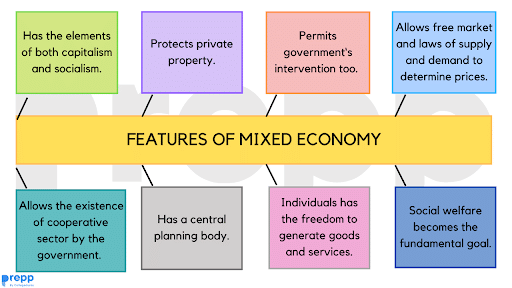
Features of Mixed Economy
- Coexistence of All Sectors: In a mixed economy, all three sectors, namely the private, public, and joint sectors, coexist in peace. The government and private enterprises administer the joint sector together, with the government owning at least 51 percent of the company.
- Cooperative Sector: Another sector exists in a mixed economy i.e., the cooperative sector. The primary goal of forming this sector is for the government to offer financial aid to cooperative societies in the warehouse, agricultural, and dairy industries, among other industries.
- Individuals have the freedom to generate goods and services, own property, pick their careers, and choose or demand the products/services they desire. However, the state retains some supervision over monopolistic behaviors and discrimination against the poorer classes.
- Economic Planning: A mixed economy generally has a central planning body. To reach various aims and goals, all sectors of the economy follow the state's economic plan. The plan is not set in stone, but rather serves as a basic guideline for the country's economic progress and prosperity.
- Social Welfare: Social welfare is one of the fundamental goals of a mixed economy. Its goal is to close the wealth gap in the country and combat societal inequities. Poverty and unemployment are to be reduced. Simultaneously, increase social security, public health care, and public education system, among other things.
Mixed Economy - Benefits
- Private Sector Encouragement: The most important benefit of a mixed economy is that it encourages the private sector and gives it the opportunity to flourish. It causes the country's capital creation to rise.
- Freedom: In a mixed economy, there is both economic and occupational freedom as in a capitalist system. Every individual has the freedom to pursue any employment of his or her own choice. Similarly, each producer has the freedom to make judgments about production and consumption.
- Optimal Resource Utilization: In this system, both the commercial and public sectors collaborate to make the most effective use of resources possible. The public sector works for the common good, whereas the private sector makes the best use of these resources in order to maximize profit.
- Economic Planning Benefits: In a mixed economy, economic planning has all of its benefits. The government takes steps to address economic instabilities and other economic ills.
- Lower Economic Disparities: Capitalism exacerbates economic inequalities, but in a mixed economy, inequalities are more easily addressed by government initiatives.
- Rivalry and Efficient Production: The degree of efficiency stays high due to competition between the private and governmental sectors. In the prospect of profit, the components of production operate efficiently.
- Social Welfare: Under this system, social welfare is prioritised through sound economic planning. The government has complete authority over the private sector. The private sector's production and pricing practices are geared toward maximizing societal welfare.
- Economic Development: Under this system, the government and the private sector work together to construct socio-economic infrastructures. In addition, the government enacts several legislative measures to protect the interests of the poor and vulnerable. As a result, for any developing country, a mixed economy is the best option.
Mixed Economy - Demerits
- Instability: According to some economists, mixed economies are the most unstable in nature. The public sector reaps the greatest rewards, while the private sector is kept under check.
- Sector Inefficiency: Under this arrangement, both sectors are inefficient. The private sector does not have complete independence, and as a result, it is rendered ineffectual. As a result, the public sector becomes ineffectual. Both industries are, in a way, not just competitive, but also complimentary.
- Ineffective Planning: In a mixed economy, there is no such thing as comprehensive planning. As a result, the government has no authority over a significant portion of the economy.
- Lack of Efficiencies are lacking in this system, and both sectors suffer as a result. In the public sector, this is because government officials do not carry out their responsibilities carefully, but in the private sector, efficiency suffers because the government imposes too many limitations in the form of controls, permissions, and licenses, among other things.
- Delays in Economic Choices: In a mixed economy, certain decisions are usually delayed, especially in the public sector. This type of lag always creates a significant obstacle to the proper functioning of the economy.
- Resource Waste: Another issue with the mixed economic system is resource waste. A portion of the funding given to various public-sector programs ends up in the pockets of middlemen. As a result, resources are squandered.
- Corruption and Black Marketing: This system is rife with corruption and black marketing. Political parties and self-interested individuals benefit unduly from the public sector. As a result, numerous evils develop, such as black money, bribes, tax evasion, and other illicit acts. All of these things add to the system's red tape.
Why India Adopted Mixed Economy?
- After independence, India's socioeconomic situation made it difficult for either the public or private sectors to shoulder the burden of development alone.
- To deal with issues such as per capita income, a large portion of the population working in the primary sector, a high birth rate, severe unemployment, low capital formation, unequal wealth distribution, illiteracy, a lack of technical knowledge, poor human resource quality, and so on, it became critical to adopt an economic system.
- This system was promising to bring about growth that was conducive to or in relation to the prevailing environment. Thus, India adopted a mixed economy.
Conclusion
A mixed economic system is one of the most important economic systems existing in the world. A mixed economy, as the name implies, is a mixture of both command and a market economy. Thus, the goal of a mixed economy is to address the flaws of both a capitalist and a socialist economy in order to create a unique system.
| Other Relevant Links | |
|---|---|
| Indian Economics Notes | Economic Systems |
| Sectors of Indian Economy | What is Economics |
| Macro Economics | Micro Economics |
FAQs
Question: What is a mixed economy?
Answer: A mixed economy is an economic system that combines elements of both capitalism and socialism. It features a dual structure where both private and public sectors coexist. In a mixed economy, the government intervenes in economic activities to promote social welfare while allowing private enterprises to operate for profit. This system aims to balance individual economic freedom with government regulation to address inequalities and provide essential services.
Question: What are the key characteristics of a mixed economy?
Answer: Key characteristics of a mixed economy include: (1) Coexistence of private and public sectors, (2) Government intervention in economic activities, (3) Freedom of choice for consumers and producers, (4) Regulation of monopolies to ensure fair competition, and (5) Provision of public goods and services by the government to ensure social welfare.
Question: How does a mixed economy differ from a purely capitalist or socialist economy?
Answer: A mixed economy differs from a purely capitalist economy, where the market dictates all economic activities with minimal government intervention, leading to inequalities. In contrast, a socialist economy is characterized by government ownership of resources and means of production, aiming for equitable distribution but often resulting in inefficiencies. A mixed economy strikes a balance between these two extremes, allowing for private enterprise while ensuring that the government plays a role in regulating and providing essential services.
Question: What is the role of the government in a mixed economy?
Answer: In a mixed economy, the government plays several crucial roles, including: (1) Regulating economic activities to prevent monopolies and ensure fair competition, (2) Providing public goods and services such as education, healthcare, and infrastructure, (3) Implementing policies to reduce economic inequalities, and (4) Intervening in the market during economic crises to stabilize the economy and protect consumers and workers.
Question: Can you give an example of a mixed economy?
Answer: India is a prominent example of a mixed economy. It incorporates a significant private sector alongside government enterprises. The Indian government regulates various sectors, such as agriculture, manufacturing, and services, while also encouraging private entrepreneurship. This blend aims to foster economic growth while addressing social welfare needs and reducing poverty.
MCQs
1. Which of the following best describes a mixed economy?
A. A system with complete government ownership
B. A system with no government intervention
C. A blend of private and public sector activities
D. A system based solely on barter trade
Answer: (C) See the Explanation
A mixed economy is characterized by a blend of both private sector and public sector activities, allowing for government intervention to promote social welfare alongside private enterprise.
2. What is a primary function of the government in a mixed economy?
A. To eliminate all private enterprises
B. To provide public goods and services
C. To control all prices
D. To promote monopolies
Answer: (B) See the Explanation
In a mixed economy, one of the primary functions of the government is to provide public goods and services, ensuring that essential needs are met for all citizens.
3. Which of the following economies is primarily capitalist?
A. India
B. China
C. United States
D. Sweden
Answer: (C) See the Explanation
The United States primarily represents a capitalist economy, where market forces dictate economic activities with minimal government intervention compared to mixed or socialist economies.
4. How does a mixed economy address economic inequalities?
A. By eliminating the private sector
B. Through government regulations and welfare programs
C. By enforcing higher taxes on the rich
D. By promoting monopolies
Answer: (B) See the Explanation
A mixed economy addresses economic inequalities through government regulations and welfare programs that aim to provide support and resources to disadvantaged sections of society.
5. What is a disadvantage of a mixed economy?
A. Complete freedom for producers
B. Inefficiencies in resource allocation
C. Total government control
D. High levels of competition
Answer: (B) See the Explanation
A disadvantage of a mixed economy can be inefficiencies in resource allocation, as government interventions might not always align with market dynamics, leading to misallocation of resources.
GS Mains Questions and Model Answers
1. Evaluate the advantages and disadvantages of a mixed economy in the context of India's economic development.
Answer: A mixed economy, as exemplified by India, offers several advantages, including the ability to balance economic growth with social welfare. The coexistence of private and public sectors fosters competition and innovation while ensuring that essential services are provided to all citizens. However, disadvantages include the potential for bureaucratic inefficiencies and the risk of government overreach, which can stifle private enterprise. Despite these challenges, India's mixed economy has facilitated significant economic growth while addressing social inequalities through targeted welfare programs.
2. Discuss the role of the government in regulating economic activities in a mixed economy.
Answer: In a mixed economy, the government plays a vital role in regulating economic activities to maintain a balance between free market principles and social welfare objectives. This includes setting regulations to prevent monopolies, protecting consumers, and ensuring fair competition. Additionally, the government intervenes during economic crises to stabilize markets and may provide subsidies or support to critical sectors. Such regulation is essential for ensuring that the benefits of economic growth are equitably distributed among all segments of society.
3. Analyze the impact of globalization on mixed economies like India.
Answer: Globalization has significantly impacted mixed economies by increasing trade and investment opportunities while exposing local markets to international competition. In India, globalization has spurred economic growth and technological advancement, contributing to the rise of a robust service sector. However, it has also posed challenges, such as widening income disparities and cultural homogenization. The government must navigate these complexities, implementing policies that harness the benefits of globalization while protecting domestic industries and maintaining social equity.
Previous Year Questions on Mixed Economy
1. UPSC CSE Prelims 2018
Question: Which of the following best defines a mixed economy?
A. Economy with only government-owned enterprises
B. Economy with no government intervention
C. Economy combining private and public sectors
D. Economy based solely on agriculture
Answer: C
Explanation: A mixed economy is defined as one that combines both private and public sectors, allowing for government intervention while encouraging private enterprise.
2. UPSC CSE Mains 2020 (GS Paper 3)
Question: "Examine the implications of a mixed economy on social justice and economic development in India." Discuss.
Answer: A mixed economy in India has implications for both social justice and economic development. By allowing government intervention, it aims to address inequalities through social welfare programs while facilitating economic growth through private enterprise. However, the effectiveness of such interventions can vary, and bureaucratic inefficiencies may hinder progress. Thus, while a mixed economy presents opportunities for inclusive development, it also poses challenges that need to be managed effectively to achieve social justice.
Download the PREPP App and attempt FREE IAS Exam Mock Tests and get complete study material!

Full Test - 04: UPSC CSE Prelims CSAT (Paper-II)
Full Test - 03: UPSC CSE Prelims CSAT (Paper-II)
UPSC CSE Prelims 2026 GS Paper 1 Question Paper (24-May-2026)
UPSC CSE Prelims 2026 CSAT Paper 2 Question Paper (24-May-2026)

17 February 2025 | The Hindu Must Read Articles | Current Affairs

16 February 2026 | The Hindu Must Read Articles | Current Affairs

13 February 2026 | The Hindu Must Read Articles | Current Affairs









Comments