Capitalist Economy – Indian Economy Notes
Capitalist Economy or Capitalism means an economic system in which the factors of production such as land, labour, entrepreneurship, and capital are controlled and regulated by private players. In a capitalist economy, the government has no active involvement. The topic “Capitalist Economy” is one of the important concepts in the UPSC/IAS 2023 Economy syllabus which is discussed in this article in detail.
|
Table of Contents |
What is Capitalism?
- Capitalism, often known as the capitalist economy, is an economic system in which private firms control and govern the factors of production such as capital goods, labour, natural resources, and entrepreneurship.
- It is defined as a system characterised by private ownership and the profit-making utilisation of both artificial and natural capital.
- The production of all goods and services in a capitalist economy is based on demand and supply in the market, often known as a market economy.
- It differs from the central planning system, which is also referred to as a command or planned economy.
- The primary feature of a capitalist economy is the objective to make money.
- The availability of open markets and the government's lack of involvement in corporate regulation are also characteristics of the capitalist economy.
- The origins of capitalism may be traced back to 18th-century England, which was in the midst of the industrial revolution.
- This form of economy is also known as a free-market economy because there is no government intervention.
- The capitalist economy is also called a liberal economy because the free market decides demand, supply, and price.
| Other Relevant Links | |
|---|---|
| Socialist Economy | Mixed Economy |
| Primary Sector | Difference between Capitalist and Socialist economic systems |
| Secondary Sector | Tertiary Sector |
| Quaternary Sector | Quinary Sector |
Characteristics of Capitalist Economy
The capitalist economy is bound to have some of the following characteristics.
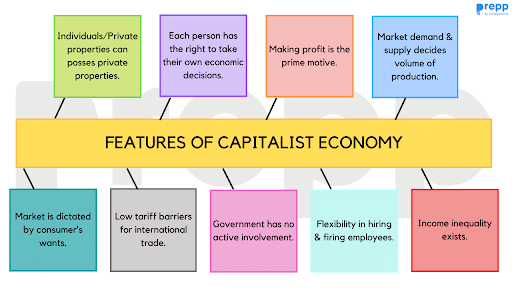
- Private property: Private property is one of the most important features of capitalism. This is because, in a capitalist economy, private persons or organisations can have private properties such as factories, machinery, and equipment.
- Individual liberty: Under this system, each person has the freedom to make their own economic decisions without anyone’s interference. Both producers and consumers can benefit from this.
- Profit motive: One of the most fundamental motives of a capitalist economy is the desire to make money. In this system, all businesses strive to maximise their profits by producing and selling their goods to consumers.
- Price mechanism: In a capitalist economy, market demand and supply decide the volume of production and, as a result, the price is established for the products, with no interference from the government.
- Customer sovereignty: In this economic model, the market is dictated by customers’ needs and wants. It governs the degree of production carried out by businesses, although the consumer is free to choose which things to buy.
- Free trade: In this system, low tariff barriers exist that promote international trade.
- Government interference: In a capitalist economy, the government is not involved in the day-to-day operations of the firm. Customers and producers are free to make their own choices when it comes to products and services.
- Flexibility in labour markets: Capitalism allows for a degree of flexibility in the hiring and firing of employees.
- Ownership freedom: Under this system, an individual can possess any amount of property and use it as he/she sees fit. By right of inheritance, the same property is passed on to his successors after his death.
Types of Capitalism
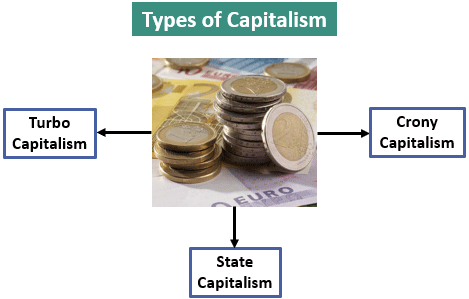
Turbo Capitalism
- In 1989, Edward Lattwak first used the term "Turbo Capitalism."
- In this type of society, there are no appropriate regulatory measures or authorities.
- Instead, it results in increasing financial deregulation, less taxation, and increased privatisation.
- This type of capitalism, often known as unfettered capitalism or free-market capitalism, lacks mechanisms to sustain its growth if any.
Crony Capitalism
- In this type of economy, although there is some degree of free market activity, most choices about new rules or laws, tax incentives, government grants, permits, subsidies, etc. are influenced by the power of a small group on the government.
- These influencers frequently work for powerful corporations, affluent individuals, or politicians who represent their interests.
- This type of capitalism is more common in underdeveloped nations, where it fuels widespread corruption and bribery.
State Capitalism
- In a state capitalist economy, the state engages in commercial economic activity, as the name suggests.
- In essence, it is a monopolistic market that the government controls.
- To increase its profits, it also manages market forces.
- Singapore is a well-known illustration of a state capitalist society where the government controls and runs the big firms and has favourable laws to promote commerce and industry.
Examples of Capitalist Economies
The countries that have capitalist economies are:
- Canada
- Switzerland
- United Kingdom
- United States
- Ireland
- Hong Kong
- United Arab Emirates
- Singapore
- New Zealand
- Australia
Advantages of Capitalist Economy
- Innovation and Entrepreneurship: Capitalism fosters a culture of innovation, as individuals and businesses compete to introduce new products, technologies, and services to the market.
- Efficient Resource Allocation: Market forces determine the allocation of resources based on supply and demand, leading to optimal utilization and reduced waste.
- Consumer Choice: A wide range of products and services are available to consumers, catering to diverse preferences and needs.
- Economic Growth: Capitalist economies often experience robust economic growth due to the incentive for businesses to expand and invest.
- Efficiency: Competition encourages efficiency and cost-effective production methods, leading to better utilization of resources.
- Job Creation: Private sector growth and entrepreneurship lead to job opportunities and reduced unemployment rates.
- Freedom of Choice: Individuals have the freedom to choose their careers, investments, and consumption patterns.
- Wealth Creation: Capitalism enables wealth accumulation, allowing individuals to invest and generate financial returns.
Disadvantages of Capitalist Economy
- Income Inequality: Private ownership and profit motive can lead to unequal distribution of wealth and income among different segments of society.
- Market Failures: Markets may fail to address public goods, externalities, and natural monopolies, requiring government intervention.
- Monopolies and Oligopolies: Unregulated capitalism can lead to the concentration of market power in the hands of a few companies, reducing competition.
- Social Welfare Gaps: In pursuit of profit, essential services like healthcare and education might become inaccessible or unaffordable for some individuals.
- Exploitation: The profit motive can sometimes lead to exploitation of workers and disregard for labor rights.
- Boom and Bust Cycles: Unregulated markets can experience economic cycles of boom and bust, causing instability and volatility.
- Short-Term Focus: Businesses driven by profit motives might prioritize short-term gains over long-term sustainability and social well-being.
- Environmental Concerns: Capitalism's focus on growth and profit can lead to overexploitation of natural resources and environmental degradation.
Conclusion
The capitalist economy, driven by private ownership, competition, and market dynamics, shapes modern societies' economic landscape. India's foray into capitalism showcases the transformative power of embracing market-oriented principles while addressing the challenges it brings. As nations navigate the complexities of capitalism, they seek a balance between innovation, growth, and ensuring that the benefits of prosperity are widely shared among their citizens.
| Other Relevant Links | |
|---|---|
| Indian Economics Notes | Economic Systems |
| Sectors of Indian Economy | What is Economics |
| Macro Economics | Micro Economics |
FAQs
Q1: What is a capitalist economy?
Answer: A capitalist economy is a system where private individuals or businesses own capital goods, and production is driven by profit and market competition.
Q2: What are the key features of a capitalist economy?
Answer: Key features include private ownership, free markets, minimal government interference, and profit motives as the primary driver.
Q3: How does capitalism promote innovation?
Answer: By encouraging competition, businesses strive to innovate, develop new products, and improve efficiency to gain market advantages.
Q4: What are the challenges of a capitalist system?
Answer: It may result in wealth inequality, monopolies, and economic instability if unchecked by regulations.
Q5: Is India a capitalist economy?
Answer: India follows a mixed economy model, incorporating both capitalist and socialist elements to balance growth with social welfare.
MCQs
- What is the primary goal in a capitalist economy?
a) Equal wealth distribution
b) Profit maximization
c) Full government control
d) Social welfare
Answer: (B) See the Explanation
- Who is considered the father of modern capitalism?
a) Karl Marx
b) John Keynes
c) Adam Smith
d) Milton Friedman
Answer: (C) See the Explanation
- Which economic system is primarily based on free markets?
a) Capitalism
b) Communism
c) Feudalism
d) Socialism
Answer: (A) See the Explanation
- Which of the following countries follows a capitalist model?
a) North Korea
b) Cuba
c) USA
d) Venezuela
Answer: (C) See the Explanation
- What type of economy does India follow?
a) Pure capitalism
b) Mixed economy
c) Socialism
d) Command economy
Answer: (B) See the Explanation
GS Mains Questions and Model Answers
Q1: How does capitalism contribute to economic growth?
Answer: Capitalism drives economic growth through competition, which promotes efficiency and innovation. Businesses invest in new technologies and expand operations to gain a competitive edge, which increases productivity and employment.
Q2: What are the challenges of regulating a capitalist economy?
Answer: The challenges include curbing monopolies, addressing income inequality, and managing market failures. Regulatory frameworks need to balance market freedom with ensuring fairness, preventing exploitation, and stabilizing the economy.
Q3: How does India balance capitalism with social welfare?
Answer: India follows a mixed economy model, allowing private enterprises to thrive while implementing welfare policies to reduce poverty and inequality. Government schemes in education, healthcare, and employment help achieve social objectives.
Previous Year Questions on Capitalist Economy
1. UPSC CSE Prelims 2021
Question: What role does competition play in a capitalist economy?
Answer: Competition is central to capitalism as it encourages businesses to innovate and offer better goods and services. Firms compete for market share by improving quality, lowering prices, or introducing new products, driving economic growth and consumer benefits. However, excessive competition can also lead to monopolies or the exploitation of resources.
2. UPSC CSE Mains 2018
Question: Analyze the impact of globalization on capitalism in India.
Answer: Globalization has reinforced capitalist tendencies in India by encouraging private investment and foreign trade. Sectors like IT and manufacturing have expanded due to market liberalization, leading to economic growth. However, it has also widened the income gap, marginalized local industries, and increased dependency on global markets. India’s mixed economy approach attempts to mitigate these challenges by promoting both economic liberalization and social welfare policies.
Download the PREPP App and attempt FREE IAS Exam Mock Tests and get complete study material!

Full Test - 04: UPSC CSE Prelims CSAT (Paper-II)
Full Test - 03: UPSC CSE Prelims CSAT (Paper-II)
UPSC CSE Prelims 2026 GS Paper 1 Question Paper (24-May-2026)
UPSC CSE Prelims 2026 CSAT Paper 2 Question Paper (24-May-2026)

17 February 2025 | The Hindu Must Read Articles | Current Affairs

16 February 2026 | The Hindu Must Read Articles | Current Affairs

13 February 2026 | The Hindu Must Read Articles | Current Affairs









Comments