Inclusive Growth – Indian Economy Notes
Inclusive growth refers to a form of economic growth that benefits all segments of society, particularly the marginalized and vulnerable groups, by ensuring that the benefits of development are shared equitably. “Inclusive Growth” is one of the important components of Amrit Kaal Vision as mentioned in 2023-24 budget. Poverty Reduction, equal distribution of Income, agricultural development, rural economy, and reduction in regional disparities are some examples of inclusive growth. It is an important topic in the UPSC/IAS 2023 Economy syllabus.

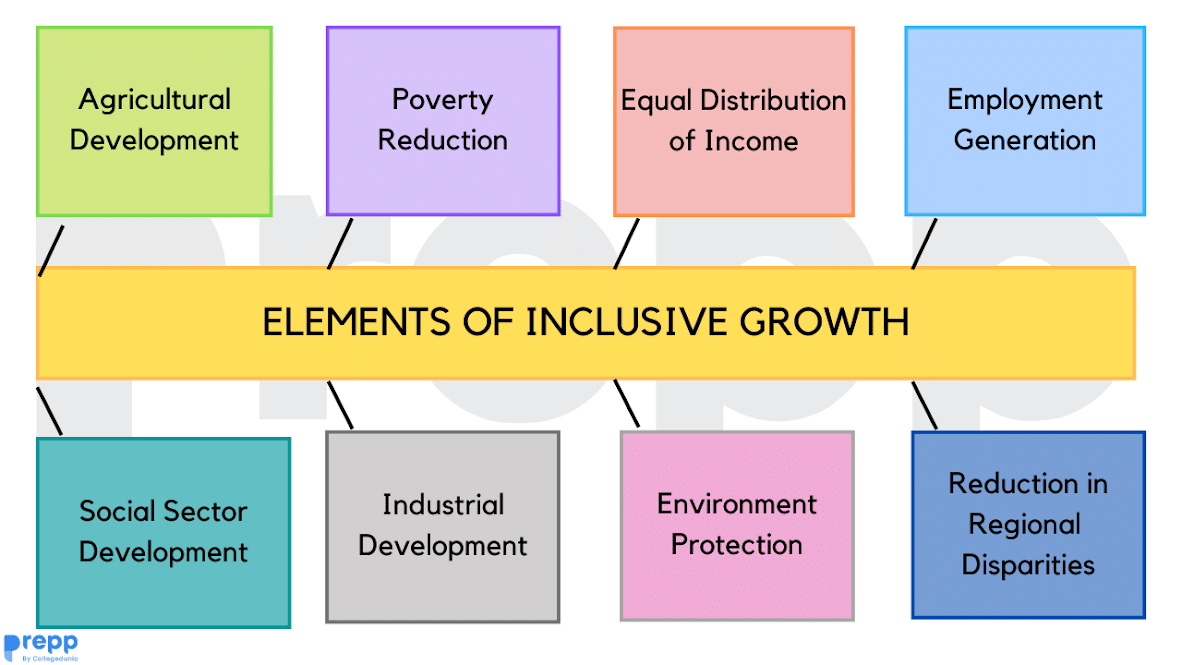
Elements of Inclusive Growth
What exactly is Inclusive Growth?
- Inclusive growth is defined as economic growth that generates employment opportunities and helps in poverty reduction.
- The United Nations Development Program (UNDP) defines Inclusive Growth as "the process and result of all groups of people participating in the organization of growth and benefiting equally from it."
- It goes beyond measuring economic progress solely through indicators like Gross Domestic Product (GDP) and focuses on creating opportunities, reducing inequalities, and improving the well-being of all citizens.
- Inclusive growth aims to address social disparities, reduce poverty, and promote sustainable development that leaves no one behind.
- Inclusive growth thus involves a fair distribution of resources with benefits reaped by all segments of society.
- But when allocating resources, consideration must be given to the planned short- and long-term advantages for society, such as the accessibility of consumer products, the employment of people, the standard of living, etc.
- It entails ensuring equitable opportunity for everybody, as well as empowering people via education and skill development.
- It also includes a method of growth that is environmentally sustainable, aspires to good governance, and aids in the creation of a gender-conscious society.
- According to the OECD (Organisation for Economic Co-operation and Development), inclusive growth is defined as economic growth that is evenly dispersed across society and generates opportunity for everyone.
Article of the Indian Constitution related to Inclusive Growth
|
|
|
|
|---|---|
| Human Development Index | Sustainable Development |
| Human Capital and Human Development | Sources of Human Capital |
Elements of Inclusive Growth
Financial Inclusion
- Financial inclusion is the process of ensuring that marginalized populations have inexpensive access to financial services.
- Financial inclusion is essential for inclusive growth because it promotes a saving culture, which kicks off a virtuous cycle of economic progress.
Technological Advancement
- The world is rapidly approaching the fourth industrial revolution. Depending on how these technological breakthroughs are implemented, they have the potential to reduce or worsen inequality.
- The government has made several initiatives, like the Digital India Mission, to ensure that technologically literate people can take use of technology's limitless possibilities.
- Technology can also assist in the fight against other issues, such as:
- Agriculture - Modern technology can help to improve the efficiency and competitiveness of an agro-value chain from farmer to consumer.
- Manufacturing - Technology can handle issues like financing, obtaining raw materials, acquiring land, and establishing connections with the user market. GST was only possible thanks to cutting-edge technology.
- Education - New types of adaptive and peer learning can be created using innovative digital technologies, which provide access to trainers and mentors while also delivering relevant data in real-time.
- Health-related technologies have the potential to change the way public health services are delivered.
- Governance - Technology has the potential to reduce delays, corruption, and inefficiency in the delivery of public services.
Economic Growth
- India is one of the world's fastest-growing major economies. However, the Indian economy is currently slowing due to both cyclical and structural issues.
- However, India's goal of having a $5 trillion economy by 2024-25 can help the country reduce inequality, expand social spending, and provide jobs for everyone.
Social Development
- Social Development includes the empowerment of all marginalized groups, such as SC/ST/OBC/Minorities, women, and transgender people.
- Empowerment can be achieved by upgrading social institutions such as hospitals, particularly basic care in rural regions, schools, and universities.
- Investment in social structures will not only stimulate GDP (via fiscal stimulus) but will also produce a healthy and capable workforce for the future.
Agricultural Development
- Agricultural development is an essential component of an inclusive growth approach.
- The procedure that establishes the prerequisites for the realization of agricultural potential is known as agricultural development.
- The three main roles agriculture can play in promoting inclusive growth - stimulating economic growth, reducing poverty, and creating employment.
Poverty Reduction
- Between 1993 and 2011, the percentage of the population living below the official poverty level decreased from 45.3% to 21.9%.
- The incidence of poverty among a small number of groups has hardly changed at all, and this number is still high.
- In addition, the rate of poverty decline has not increased in tandem with GDP growth.
- It is unacceptable that poverty continues to exist on such a large scale.
- Therefore, a key component of the New India vision should be to significantly reduce poverty and increase economic opportunities for all segments of the people.
- Since it is a tool for achieving a steady increase in employment and incomes for many of our people, rapid economic development is necessary to achieve this result.
- Some of the most underdeveloped regions have yet to see any major growth, and economic growth has not been evenly distributed across regions.
Equal Distribution of Income
- Equitable income distribution guarantees that welfare is distributed fairly and gives all participants in the economy the same chance to amass wealth.
- To guarantee a fair distribution of wealth, the government redistributes tax revenue.
- Low-wage workers should receive sufficient assistance that eases cost-of-living pressures without compromising the motivation to work hard and build wealth.
- Thus, equal distribution of income is essential for achieving inclusive growth as it gives all participants in the economy the same chance to engulf wealth. and kicks off a virtuous cycle of economic progress.
Employment Generation
- Employment Generation is the prerequisite for achieving inclusive growth in India.
- Despite the fact that half of India's population is under the age of 26, there are not enough new economic opportunities being created to satisfy the growing demand for employment.
- According to estimates, India needs 12–15 million new employees annually, leaving between 4–7 million unfilled positions.
- The 300 million people of working age who are not in the labour market only make matters worse.
- Thus, employment generation will not only stimulate GDP (via fiscal stimulus) but will also produce a healthy and capable workforce for the future.
Skill Development
- The working-age population's employability, as well as their health, education, vocational training, and skills, will all play a role in capturing the demographic dividend. Here, skill development is crucial.
- In terms of skill development, India is up against two obstacles:
- There is a scarcity of highly skilled workers.
- There is a lack of employment opportunities for conventionally educated teenagers.
- According to the Economic Survey 2017, nearly 30% of India's youngsters are unemployed (Not in education, employment or training).
- Similarly, according to UNICEF 2019, at least 47 percent of Indian adolescents will not have the education and skills required for employment in 2030.
Challenges in Achieving Inclusive Growth
Poverty
- According to the 2018 Multidimensional Poverty Index (MPI), India moved 271 million people out of poverty between 2005-06 and 2015-16, with the poorest regions, groups, and children experiencing the greatest reduction in poverty. At the subnational level, India exhibits the clearest pro-poor tendency.
- Despite the enormous achievements, 373 million Indians continue to suffer from severe poverty.
- Furthermore, 8.8% of the population is living in severe multidimensional poverty, while 19.3 percent is vulnerable to multidimensional poverty.
Unemployment
- According to the NSSO's Periodic Labour Force Survey (PLFS), the unemployment rate for the urban workforce was 7.8%, while the rural workforce had a rate of 5.3 percent, bringing the total unemployment rate to 6.1 percent.
- Because of illiteracy and over-dependence on agriculture, India's employment quality and quantity are low.
- The lack of quality employment is a concern because more than 80% of individuals work in the informal sector and are not covered by social security.
Agriculture Backwardness
- Agriculture employs almost 44 percent of Indians, although it only accounts for 16.5 percent of the country's GDP, resulting in widespread poverty.
- The following are some of the issues in agriculture:
- Land availability per capita is dwindling.
- A gradual decrease in the employment share.
- Labor productivity is low.
- Agriculture yields are declining as a result of climate change, soil degradation, and water scarcity.
- Growth differences between regions and crops
Issues with Social Development
- One of the most important concerns for inclusive growth is social development.
- It has some issues, such as:
- Regional, societal, and gender differences are all significant.
- Public spending, notably in health and education, is at a low level and growing slowly.
- The delivery system's poor quality.
- OBC, SC, ST, and Muslims have considerably lower social indicators.
- Children's malnutrition - India is ranked 107 on the Global Hunger Index.
Regional Disparities
- India's regional differences are a key source of concern.
- Factors such as the caste system, the wealth gap, and others contribute to regional inequities, resulting in a society in which certain groups enjoy greater privileges than others.
- The following are some of the regional disparity issues:
- Kerala is the most literate state in the country, with a literacy rate of 93.1 percent; whereas, Bihar's literacy rate is only 63.82 percent.
- In terms of per capita income, Goa has a per capita income of Rs 4,67,998, whereas Bihar has a per capita income of merely Rs 43,822.
Measuring Inclusive Growth
Inclusive Development Index (IDI)
- India was placed 62nd out of 74 emerging countries in the World Economic Forum's Inclusive Development Index (IDI), and was among the least inclusive countries in the Group of 20 (G-20).
- The IDI is based on the assumption that most people measure their country's growth by their personal level of living rather than GDP.
- It gives a measure of inequality based on three parameters: :
- Growth and development
- Inclusion
- Inter-generational equity and sustainability.
- India was also not among the top ten most inclusive emerging and developing economies, a list that included Nepal, China, and Sri Lanka.
- India ranked 44th in terms of "intergenerational equity and sustainability," which can be ascribed to the country's demographic dividend.
Social Progress Index (SPI)
- It is a composite index that includes the following social and environmental indicators:
- Basic human need
- Foundation of well being
- Opportunity
Global Slavery Index
- The Walk Free Foundation of Australia has released it.
- Slavery in the modern sense refers to a scenario in which one person has taken away another's freedom in order to control their body and exploit them.
- Factors that contribute to modern slavery include:
- Absence of rights
- Lack of physical safety
- Access to necessities such as health care, education, food, etc
- Pattern of migration
Measures Taken in India to Achieve Inclusive Growth
The government is implementing a number of measures to promote equitable growth, including the following:
- Mahatma Gandhi National Rural Employment Guarantee Act Scheme (MGNREGA)
- Prime Minister’s Employment Generation Programme (PMEGP)
- Mudra Bank scheme
- Pt. Deen Dayal Upadhyaya Grameen Kaushalya Yojana (DDU-GKY)
- Deendayal Antyodaya Yojana-National Urban Livelihoods Mission (DAY-NULM)
- Sarva Siksha Abhiyan (SSA)
- National Rural Health Mission (NRHM)
- Bharat Nirman
- Swachh Bharat Mission
- Mission Ayushman
- Pradhan Mantri Jan Dhan Yojana
Conclusion
Inclusive growth is a holistic approach that requires policy interventions, institutional reforms, and strategic investments. It aims to transform societies by creating an environment where everyone can participate in and benefit from economic development. It also aligns with the Sustainable Development Goals (SDGs) set by the United Nations, particularly Goal 10, which aims to reduce inequalities within and among countries.
|
|
|
|---|---|
| Indian Economics Notes | Human Development |
| Monetary Policy | Human Capital |
| Economic Growth vs Economic Development | Sustainable Development |
FAQs
Question: What is inclusive growth?
Answer: Inclusive growth is a development strategy that ensures benefits of economic growth are shared across all sections of society, focusing on poverty reduction and equal opportunities.
Question: How does inclusive growth differ from economic growth?
Answer: While economic growth focuses on increasing GDP, inclusive growth emphasizes equitable distribution of wealth, job creation, and improving the quality of life for marginalized communities.
Question: What are key factors for achieving inclusive growth in India?
Answer: Key factors include poverty alleviation, job creation, financial inclusion, education, and healthcare development, along with focused policies on rural and backward areas.
Question: What role does financial inclusion play in inclusive growth?
Answer: Financial inclusion ensures that everyone has access to basic financial services like banking, credit, and insurance, enabling marginalized sections to contribute to and benefit from economic growth.
Question: Which government programs promote inclusive growth in India?
Answer: Programs like MGNREGA, Jan Dhan Yojana, Ayushman Bharat, and Skill India Mission promote inclusive growth by improving access to jobs, financial services, healthcare, and skill development.
MCQs
1. What is the primary goal of inclusive growth?A) Reducing inflation
B) Increasing GDP
C) Equitable distribution of wealth
D) Boosting exports
Answer: C See the Explanation
Explanation: Inclusive growth focuses on ensuring that the benefits of economic growth are shared equitably across society, reducing inequality.
A) Jan Dhan Yojana
B) MGNREGA
C) Ayushman Bharat
D) Pradhan Mantri Awas Yojana
Answer: B See the Explanation
Explanation: MGNREGA is a government program aimed at providing rural employment and ensuring livelihood security.
A) Rapid industrialization
B) Financial inclusion
C) Urbanization
D) Increase in imports
Answer: B See the Explanation
Explanation: Financial inclusion is crucial for inclusive growth, ensuring that marginalized sections have access to banking and financial services.
A) Growth in foreign exchange reserves
B) Ensuring access to financial services for all
C) Reducing government expenditure
D) Promoting stock market growth
Answer: B See the Explanation
Explanation: Financial inclusion refers to providing basic financial services to all, particularly to the underserved and marginalized communities.
A) IT and services
B) Agriculture
C) Manufacturing
D) Real estate
Answer: B See the Explanation
Explanation: Agriculture remains a critical sector for inclusive growth in rural India, supporting livelihoods for the majority of the rural population.
GS Mains Questions and Model Answers
Q1: Analyze the role of government policies in promoting inclusive growth in India.
Answer: Government policies in India, such as MGNREGA, Jan Dhan Yojana, and Skill India Mission, are designed to promote inclusive growth. MGNREGA provides job security in rural areas, Jan Dhan Yojana ensures financial inclusion, and Skill India promotes employability. These programs focus on reducing inequality, enhancing access to services, and promoting sustainable livelihoods. However, challenges like corruption, inefficiency, and limited reach still hinder the full realization of inclusive growth objectives.
Q2: Discuss the challenges to achieving inclusive growth in India and suggest measures to overcome them.
Answer: Key challenges to inclusive growth in India include regional disparities, inequality, lack of infrastructure, and low financial inclusion in rural areas. Measures to overcome these include enhancing rural infrastructure, ensuring effective implementation of welfare schemes, promoting digital inclusion, and expanding access to quality healthcare and education. Increased investment in agriculture and small enterprises can further drive inclusive growth.
Q3: Evaluate the significance of financial inclusion in achieving inclusive growth in India.
Answer: Financial inclusion is essential for inclusive growth as it brings marginalized populations into the economic mainstream. Programs like Jan Dhan Yojana have expanded access to banking, enabling people to save, invest, and access credit. By providing affordable financial services, financial inclusion empowers individuals, reduces poverty, and supports economic stability. The expansion of digital banking and micro-finance institutions is crucial to achieving financial inclusion in remote areas.
Previous Year Questions on Inclusive Growth
1. UPSC CSE Prelims 2021
Question: Which of the following programs aims to promote financial inclusion in India?
A) Ayushman Bharat
B) Jan Dhan Yojana
C) Swachh Bharat Mission
D) Digital India
Answer: B
Explanation: Pradhan Mantri Jan Dhan Yojana focuses on promoting financial inclusion by ensuring that every household has access to a bank account and financial services.
2. UPSC CSE Mains 2019
Question: Discuss the role of inclusive growth in India’s economic development, with reference to financial inclusion and social welfare programs.
Answer: Inclusive growth is critical for India’s economic development, ensuring that the benefits of growth are shared equitably. Programs like Jan Dhan Yojana and MGNREGA aim to integrate marginalized communities into the economy by providing access to financial services and livelihood opportunities. Financial inclusion reduces poverty and improves economic participation, while social welfare programs ensure that vulnerable populations receive necessary support. For inclusive growth to be successful, it is essential to address challenges like inequality, unemployment, and regional disparities.
Download the PREPP App and attempt FREE IAS Exam Mock Tests and get complete study material!

Full Test - 04: UPSC CSE Prelims CSAT (Paper-II)
Full Test - 03: UPSC CSE Prelims CSAT (Paper-II)
UPSC CSE Prelims 2026 GS Paper 1 Question Paper (24-May-2026)
UPSC CSE Prelims 2026 CSAT Paper 2 Question Paper (24-May-2026)

17 February 2025 | The Hindu Must Read Articles | Current Affairs

16 February 2026 | The Hindu Must Read Articles | Current Affairs

13 February 2026 | The Hindu Must Read Articles | Current Affairs









Comments