Sustainable Alternative Towards Affordable Transportation (SATAT- Initiative) - Environment Notes
Sustainable Alternative Towards Affordable Transportation (SATAT Initiative) is a project established in October 2018 by the Ministries of Petroleum and Natural Gas. It is an initiative that seeks Expressions of Interest from potential entrepreneurs in order to build up Compressed Biogas production units and make it available in the market for use in vehicle fuels. It is intended to build 5,000 compressed biogas facilities in India during the next four years.
This article explains about Sustainable Alternative Towards Affordable Transportation (SATAT- Initiative) which is important for UPSC IAS exam preparation.
Table of Contents
SATAT Initiative
- The Sustainable Alternative Towards Affordable Transportation (SATAT) initiative would benefit both farmers and enterprises. It is recommended that compressed biogas facilities be established mostly by independent entrepreneurs.
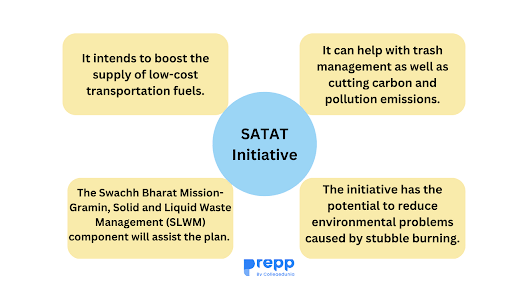
- The scheme would be supported under the Swachh Bharat Mission-Gramin (SBM-G) Solid and Liquid Waste Management (SLWM) component to benefit households in designated villages through Gram Panchayats.
- The SATAT programme aims to increase the availability of more cheap transportation fuels, improve the utilisation of agricultural leftovers, cow dung, and municipal solid waste, and offer farmers with an alternative cash stream.
- SATAT was developed in collaboration with Public Sector Undertakings and Oil Marketing Companies, including Indian Oil Corporation Ltd, Bharat Petroleum Corporation Ltd., and Hindustan Petroleum Corporation Ltd.
- The Compressed Biogas facilities are envisaged to be established mostly by independent entrepreneurs.
- It is intended to build 5,000 compressed biogas facilities in India during the next four years.
SATAT Initiative - Objective
- The objective of the project is to provide a Sustainable Alternative to Affordable Transportation as a developmental endeavour that will benefit both car owners and farmers and enterprises.
- The SATAT programme has enormous potential for effective municipal solid waste management as well as addressing the issue of filthy urban air caused by farm stubble-burning and carbon emissions.
SATAT Initiative - Features
- It is useful in waste management and in lowering carbon and pollution emissions.
- Farmers now have a new source of income.
- Entrepreneurship, job creation, and the rural economy all have a favourable influence.
- National initiatives and pledges to attaining climate change targets are supported.
- Crude or natural oil and natural gas oil imports are being curtailed.
- Protect yourself from fluctuations in crude oil and natural gas prices.
SATAT Initiative - Significance
- The SATAT programme has the ability to alleviate environmental issues caused by stubble burning.
- It will aid in the proper management of municipal solid trash as well as the reduction of polluted urban air and carbon emissions.
- CBG - Compressed Biogas - is used. SATAT will assist reduce reliance on crude oil imports while also increasing farmer income, rural employment, and entrepreneurship.
- This plan is intended to create 75,000 direct jobs and produce 50 million tonnes of bio-manure for crops.
- In terms of composition and energy potential, compressed biogas is identical to commercially available natural gas.
- The programme allows for more efficient utilisation of agricultural leftovers, livestock manure, and urban solid waste. Given the country's biomass production, CBG has the potential to replace Compressed Natural Gas (CNG) in automotive, industrial, and commercial applications in the future years.
- To increase supply to home and retail consumers, compressed biogas networks can be linked with city gas distribution (CGD) networks.
- The 2018 National Policy on Biofuels also promotes the active promotion of advanced biofuels such as CBG.
- Previously, the Indian government created the GOBAR-DHAN (Galvanising Organic Bio-Agro Resources) project to convert cow dung and solid waste in farms to CBG and compost.
Compressed Biogas (CBG)
Benefits of CBG
|
SATAT Initiative - Way Forward
- Agricultural residue, municipal solid waste, sugarcane press mud, distillery wasted wash, animal manure, and sewage treatment plant waste can all be used to make compressed biogas.
- Other waste streams that may be utilised to create biogas include rotten potatoes from cold storage, rotten vegetables, dairy plants, chicken/poultry litter, food trash, horticulture waste, forestry residues, and processed organic waste from industrial effluent treatment plants (ETPs).
- As a result, India's potential for compressed biogas generation from diverse sources is projected to be over 62 million tonnes per year.
- To increase supply to home and retail consumers, compressed biogas networks can be linked with city gas distribution (CGD) networks.
- It may also be pumped into municipal gas distribution pipelines for efficient distribution and improved access to a cleaner and more cheap fuel.
Conclusion
In addition to natural gas, the "Sustainable Alternative Towards Affordable Transportation" (SATAT) effort has been launched to extract economic value from biomass waste in the form of Compressed BioGas (CBG) and bio-manure. Municipal solid waste, sugar industry waste (press mud), and agricultural residue all have great output potential. Our oil and gas CPSEs have stepped out to encourage the usage of CBG by providing a floor price for CBG offtake for the first ten years through upfront commercial agreements. Given the country's availability of biomass, CBG has the potential to help the development of alternative clean fuel in automotive, industrial, and commercial applications in the next few years.
FAQs
Question: What is the SATAT initiative?
Answer: The SATAT (Sustainable Alternative Towards Affordable Transportation) initiative aims to promote compressed biogas (CBG) as an alternative, sustainable source of energy in transportation. It is designed to address energy security, reduce pollution, and provide economic opportunities in rural areas.
Question: What are the key objectives of the SATAT initiative?
Answer: The key objectives of the SATAT initiative are to reduce dependence on fossil fuels, promote sustainable energy sources like compressed biogas, reduce carbon emissions, and create economic benefits for rural India through biogas production and utilization in transportation.
Question: How does the SATAT initiative help in reducing pollution?
Answer: By promoting compressed biogas (CBG) as a fuel source for transportation, the SATAT initiative helps reduce harmful emissions from traditional fuels like petrol and diesel, thus improving air quality and reducing the carbon footprint of the transportation sector.
Question: How is the SATAT initiative implemented?
Answer: The SATAT initiative is implemented through partnerships with private and public sector companies. It involves the establishment of compressed biogas plants, the promotion of biogas as a fuel for vehicles, and creating a market for CBG through the sale and distribution networks.
Question: What are the benefits of the SATAT initiative for rural India?
Answer: The SATAT initiative generates employment opportunities in rural India by promoting the production of biogas from agricultural and organic waste. It also helps in waste management, improves energy access, and creates new income streams for farmers and local entrepreneurs.
MCQs
1. What is the main goal of the SATAT initiative?
A) Promoting electric vehicles
B) Reducing dependency on imported fossil fuels
C) Promoting compressed biogas as a fuel source
D) Developing renewable energy solutions for the industrial sector
Answer: (C) See the Explanation
The primary goal of the SATAT initiative is to promote compressed biogas (CBG) as a sustainable and affordable fuel alternative for transportation, reducing dependency on traditional fossil fuels like petrol and diesel.
2. Which of the following sectors is most directly impacted by the SATAT initiative?
A) Education
B) Healthcare
C) Agriculture and rural economy
D) Urban infrastructure
Answer: (C) See the Explanation
The SATAT initiative primarily impacts the agriculture and rural economy sectors, as it promotes the use of agricultural waste for biogas production and creates employment opportunities in rural areas.
3. Which of the following is a benefit of the SATAT initiative?
A) Creation of pollution-free cities
B) Sustainable energy production from waste
C) Reducing reliance on nuclear power
D) Promoting tourism in rural areas
Answer: (B) See the Explanation
One of the major benefits of SATAT is the sustainable energy production from agricultural waste, helping reduce dependence on traditional fuels while also addressing waste management in rural areas.
4. What does CBG stand for in the context of the SATAT initiative?
A) Compressed Biogas
B) Clean Biofuel Gas
C) Compressed Biomass Gas
D) Clean Biomass Gas
Answer: (A) See the Explanation
CBG stands for Compressed Biogas, a renewable fuel produced from organic waste, which is used as an alternative fuel for transportation under the SATAT initiative.
5. Which of the following is a key factor in the success of the SATAT initiative?
A) Availability of funding from foreign investors
B) Government policy support for biogas infrastructure
C) Extensive research on electric vehicle batteries
D) Global collaboration for fuel imports
Answer: (B) See the Explanation
Government policy support for biogas infrastructure, including subsidies, incentives, and the establishment of CBG plants, plays a critical role in the success and scalability of the SATAT initiative.
GS Mains Questions and Model Answers
Q1: Discuss the role of the SATAT initiative in achieving India's energy security and sustainability goals.
Answer: The SATAT initiative plays a vital role in India's energy security and sustainability goals by promoting compressed biogas (CBG) as a renewable alternative to fossil fuels. This initiative not only helps reduce carbon emissions and air pollution but also supports waste management, particularly in rural areas. By fostering the production of biogas from agricultural waste, it creates an environmentally sustainable energy source while providing economic opportunities in rural India. Moreover, SATAT aligns with India’s broader renewable energy targets, contributing to cleaner energy and reducing dependence on imported fossil fuels. However, its success depends on continued infrastructure development and government support.
Q2: Analyze the economic and environmental benefits of the SATAT initiative for rural India.
Answer: The SATAT initiative provides both economic and environmental benefits to rural India. Economically, it promotes rural entrepreneurship by creating opportunities for farmers and small businesses in biogas production. This can increase income levels and reduce poverty in rural areas. Environmentally, the initiative helps manage agricultural waste effectively, reducing methane emissions and preventing open-field burning. By utilizing organic waste for biogas production, SATAT not only provides an eco-friendly fuel alternative but also contributes to carbon emission reduction, improving air quality and addressing climate change. These combined benefits make SATAT a key component of sustainable rural development.
Q3: How can the SATAT initiative be scaled to ensure its long-term success in India?
Answer: Scaling the SATAT initiative requires a multifaceted approach. Firstly, increasing investments in biogas infrastructure and technology is essential to expand production capacity. Encouraging private sector participation through subsidies and incentives will stimulate growth in CBG production. Additionally, creating an efficient supply chain for biogas and expanding its use in public and private transport fleets will enhance demand. Providing farmers with more access to information, resources, and support for organic waste collection is also crucial. Lastly, long-term success will depend on strong policy frameworks, public awareness campaigns, and continued collaboration between the government, industries, and local communities.
Previous Year Questions on SATAT Scheme
1. UPSC CSE Prelims 2021:
Question: The SATAT initiative aims to promote which of the following as an alternative fuel?
A) Compressed Biogas (CBG)
B) Hydrogen fuel
C) Solar power
D) Electric vehicles
Answer: (A)
Explanation: The SATAT initiative focuses on promoting Compressed Biogas (CBG) as an alternative fuel for transportation, contributing to cleaner energy and reducing reliance on traditional fossil fuels.
2. UPSC CSE Mains 2020 (GS Paper 3):
Question: "Evaluate the role of the SATAT initiative in reducing India's carbon emissions and promoting sustainable rural development."
Answer: The SATAT initiative plays a significant role in reducing India's carbon emissions by promoting the use of compressed biogas (CBG), a renewable energy source, instead of fossil fuels. This helps lower harmful emissions in the transportation sector. Moreover, by encouraging biogas production from organic waste, the scheme fosters sustainable rural development by generating income and employment opportunities for farmers and rural entrepreneurs. This dual impact on the environment and economy aligns with India’s sustainable development goals and contributes to energy security and climate change mitigation.
Download the PREPP App and attempt FREE IAS Exam Mock Tests and get complete study material!
UPSC IAS : CSAT - Mini Live Test

Live Test : UPSC CSE Prelims CSAT (Paper-II) (Oct 20 - 23)
Full Test - 04: UPSC CSE Prelims CSAT (Paper-II)
Full Test - 03: UPSC CSE Prelims CSAT (Paper-II)
UPSC CSE Prelims 2026 GS Paper 1 Question Paper (24-May-2026)
UPSC CSE Prelims 2026 CSAT Paper 2 Question Paper (24-May-2026)

17 February 2025 | The Hindu Must Read Articles | Current Affairs

16 February 2026 | The Hindu Must Read Articles | Current Affairs

13 February 2026 | The Hindu Must Read Articles | Current Affairs









Comments