Global Methane Pledge - Environment Notes
Global Methane Pledge was introduced at COP26 in November 2021 to accelerate efforts to reduce methane emissions. The Pledge, which is led by the United States and the European Union, now has 111 country members, accounting for 45% of worldwide human-caused methane emissions. Countries that sign the Pledge agree to work together to reduce methane emissions by at least 30% below 2020 levels by 2030. This article explains that the Global Methane Pledge is important for UPSC IAS exam preparation.
Table of Contents
Global Methane Pledge
- The Global Methane Pledge was established during the UN COP26 climate meeting in Glasgow. Over 90 countries have signed the pledge, which is led by the United States and the European Union.
- The goal of this project is to reduce worldwide methane emissions.
- The Pledge seeks to catalyse global action and improve support for current international methane emission reduction programmes in order to develop technical and policy work that will serve as the foundation for Participants' domestic measures.
- Participants who sign the Pledge promise to take voluntary activities to contribute to a collaborative effort to cut global methane emissions by at least 30% from 2020 levels by 2030, potentially avoiding more than 0.2 degrees Celsius of warming by 2050.
- This is a worldwide aim, not a national one.
- How would the project be beneficial - If adopted globally, it would reduce global warming by 0.2 degrees Celsius by the 2040s as compared to expected temperature increases.
- The Earth is currently 1.2 degrees Celsius hotter than it was before the Industrial Revolution.
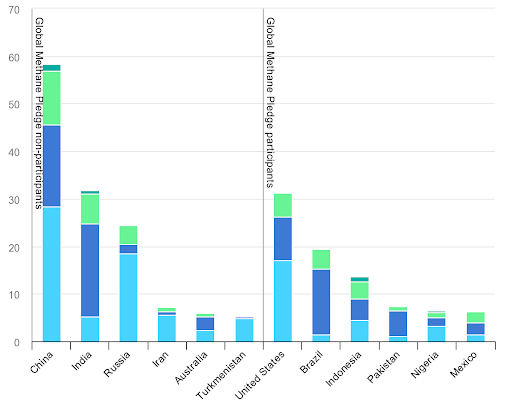
- India, the third-largest producer of methane emissions, is currently not a signatory.
Global Methane Pledge - Significance
- The Global Methane Pledge aim has the potential to have a massive influence on climate change, akin to the whole global transportation industry adopting net zero emission technology.
- Action will be especially critical in the period leading up to 2030 since dramatic reductions in methane emissions can provide a net cooling impact in a very short period of time.
- This might keep the door open to a 1.5 °C stability in global average temperatures as the world pursues long-term CO2 reductions.
- The Global Methane Pledge has brought together several key international parties, including large consumers such as the European Union, Japan, and Korea, as well as big producers like Iraq and Saudi Arabia.
- For other nations, the Global Methane Pledge is the first substantial policy commitment on methane, either domestically or internationally.
- The Pledge also recognises and appreciates the critical contributions that the corporate sector, development banks, financial institutions, and philanthropy play in supporting the Pledge's implementation.
What is Methane?
- After carbon dioxide, it is the second most prevalent greenhouse gas in the atmosphere.
- It is the most basic hydrocarbon, with one carbon atom and four hydrogen atoms (CH4).
- It is a colourless and odourless gas that is extremely combustible.
Sources of Methane
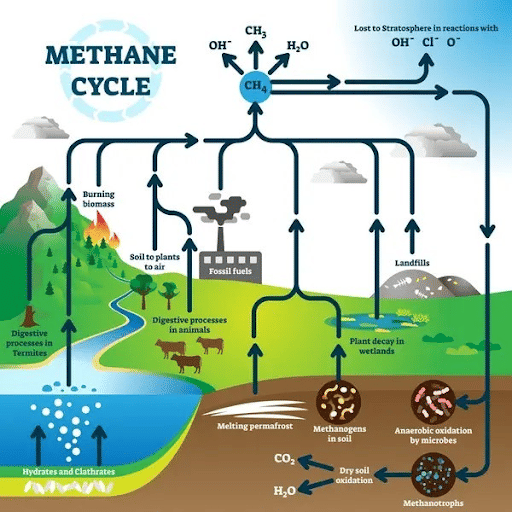
- These include both human/anthropogenic and natural sources. Approximately 40% of methane emissions come from natural sources, with the remaining 60% coming from human-influenced sources.
- Landfills, oil and natural gas networks, agricultural operations, coal mining, wastewater treatment, and some industrial processes are all anthropogenic sources of methane.
- Human-caused methane emissions account for 60% of worldwide methane emissions.
- The oil and gas industries are major contributors to human sources.
- Natural sources include plant degradation in wetlands, gas seepage from subsurface deposits, and cow digestion of meal.
Why is dealing with methane crucial for climate change?
- Methane is the second-most prevalent greenhouse gas in the atmosphere after carbon dioxide, therefore efforts to reduce its emissions are crucial.
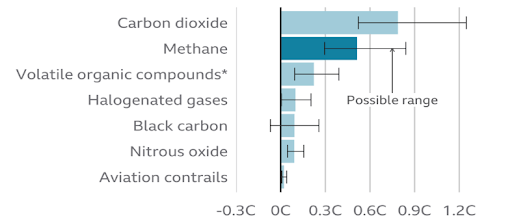
- According to the most recent Intergovernmental Panel on Climate Change study, methane is responsible for over half of the 1.0 degree Celsius net rise in global average temperature from the pre-industrial period.
- Rapidly lowering methane emissions is supplementary to action on carbon dioxide and other greenhouse gases, and is seen as the single most effective option for reducing global warming in the short term and keeping the goal of limiting warming to 1.5 degrees Celsius within reach.
- According to the International Energy Agency (IEA), while methane has a significantly shorter atmospheric lifespan (12 years versus millennia for CO2), it is a lot more effective greenhouse gas simply because it absorbs more energy when in the atmosphere.
- The UN emphasises in its methane fact sheet that methane is a formidable pollutant with a global warming potential 80 times that of carbon dioxide, around 20 years after it is released into the atmosphere.
- Significantly, the average methane leak rate of 2.3% "erodes much of the climate advantage gas has over coal."
- According to the IEA, more than 75% of methane emissions may be reduced with current technology, and up to 40% of this can be accomplished at no additional cost.
Why India Refused To Sign The Methane Pledge?
- India refused to sign the 'Global Methane Pledge,' a proposal by the United States and the European Union to reduce global methane emissions by 30% by 2030 compared to 2020 levels.
- The administration recently explained in detail to Parliament why it declined to sign the methane promise.
Reasons
In India, methane emissions are survival emissions
- Methane emissions are fundamentally survival emissions, not 'luxury' emissions, as in the case of the West.
- In India, the two main sources of methane emissions are:
- Enteric fermentation (methane from animal intestines)
- rice agriculture (from standing water).
- These emissions are the product of agricultural operations carried out by small, marginal, and medium farmers across India, whose livelihoods are jeopardised by the aforementioned pledge.
- This can have an influence on agricultural productivity, particularly paddy yield, in addition to farmers' revenue. India is one of the world's major rice producers and exporters.
- In contrast, industrial agriculture dominates agriculture in wealthy countries.
- As a result, this pledge. has the potential to have an impact on India's trade and economic prospects.
Agriculture is not included in India's emission intensity target
- According to India's pre-2020 voluntary pledges, agriculture is not included in the emission intensity objective.
Indian cattle contribute little to global methane emissions
- Furthermore, India boasts the world's biggest cow population, which provides a living for a substantial portion of the people.
- Because Indian livestock consume huge amounts of agricultural byproducts and unusual feed material, their contribution to the world pool of enteric methane is quite modest.
Methane Pledge Outside of the UNFCCC and the Paris Agreement
- While India is a signatory to the United Nations Framework Convention on Climate Change (UNFCCC) and the Paris Agreement, the government claims that the Methane Pledge falls beyond the scope of the UNFCCC and its Paris Agreement.
Indian Efforts to Reduce Methane Emissions
- The Indian Council for Agricultural Research's (ICAR) National Innovations in Climate Resilient Agriculture (NICRA) initiative has created numerous technologies with the potential to reduce methane emissions.
- System for Rice Intensification: It has the ability to increase rice output by 36-49 percent while using about 22-35 percent less water than traditional transplanted rice.
- Direct seeded rice: It minimises methane emissions since it eliminates the need for nurseries, puddling, and transplanting. Unlike transplanted paddy farming, this approach does not retain standing water.
- Crop Diversification Programme: Methane emissions are reduced by shifting rice to other crops such as pulses, oilseeds, maize, cotton and agroforestry.
- Seaweed-Based Animal Feed: The Central Salt & Marine Chemical Research Institute (CSMCRI) created a seaweed-based animal feed additive formulation that seeks to minimise methane emissions from cattle.
- Harit Dhara: The Indian Council of Agricultural Research (ICAR) developed an anti-methanogenic feed additive called 'Harit Dhara' (HD), which can reduce cow methane emissions by 17-20%.
Wayforward
- Mitigation of methane and other short-lived climate pollutants is critical for meeting decarbonisation targets.
- Creating national action plans or strategies that specify particular steps to encourage emission reductions, set timetables, and estimate required resources.
- Proposing new rules or laws to reduce methane emissions, such as leak detection and repair programmes, technology and equipment standards, flaring and venting restrictions, and measuring and reporting requirements;
- Adopting national reduction objectives, whether economy-wide or sector-specific, to demonstrate government commitment, convey expectations, and allow for better planning.
- Participating in a super-emitter fast response system based on satellite detections, which would establish communication channels to guarantee significant emissions occurrences are dealt with as soon as possible.
- Providing grants, targeted funds, or other incentives to promote research and development on abatement and measurement technology, as well as assistance for verified mitigation initiatives.
- Participants of the Pledge also needs to agree to use the highest tier IPCC good practise inventory methodologies, as well as to work continuously to improve the accuracy, transparency, consistency, comparability, and completeness of national greenhouse gas inventory reporting under the UNFCCC and Paris Agreement, and to provide greater transparency in key sectors.
Conclusion
Methane is a potent yet transient climate pollutant that is responsible for around half of the net rise in global average temperature during the pre-industrial period. Rapidly reducing methane emissions from energy, agriculture, and waste can achieve near-term gains in our efforts for decisive action this decade, and is regarded as the single most effective strategy for keeping the goal of limiting warming to 1.5 degrees Celsius within reach while yielding co-benefits such as improved public health and agricultural productivity.
FAQs
Question: What is the Global Methane Pledge?
Answer: The Global Methane Pledge is an international initiative aimed at reducing global methane emissions by 30% by 2030, to curb climate change and enhance environmental sustainability.
Question: Which countries are part of the Global Methane Pledge?
Answer: Over 100 countries, including major emitters like the United States, European Union, and India, have joined the Global Methane Pledge.
Question: Why is methane reduction important for climate change?
Answer: Methane is a potent greenhouse gas, with a global warming potential significantly higher than carbon dioxide. Reducing methane emissions can drastically slow down global warming and improve air quality.
Question: How does the Global Methane Pledge aim to reduce methane emissions?
Answer: The pledge focuses on reducing methane emissions in key sectors like agriculture, energy, and waste management, through policy reforms, technological advancements, and international collaboration.
Question: What are the benefits of the Global Methane Pledge?
Answer: The benefits include mitigating climate change, improving public health, boosting energy efficiency, and supporting the achievement of international climate goals, such as those outlined in the Paris Agreement.
MCQs
1. What is the primary goal of the Global Methane Pledge?
A) To eliminate carbon emissions
B) To reduce methane emissions by 30% by 2030
C) To increase the use of fossil fuels
D) To create awareness about climate change
Answer: (B) See the Explanation
Explanation: The primary goal of the Global Methane Pledge is to reduce global methane emissions by 30% by 2030, which is vital for mitigating climate change.
2. Which sector is a major focus for reducing methane emissions under the Global Methane Pledge?
A) Agriculture
B) Transportation
C) Education
D) Technology
Answer: (A) See the Explanation
Explanation: The agricultural sector is a major source of methane emissions, especially from livestock and rice paddies. The Global Methane Pledge targets this sector to reduce emissions.
3. Which of the following countries is NOT a part of the Global Methane Pledge?
A) United States
B) China
C) India
D) Australia
Answer: (B) See the Explanation
Explanation: While over 100 countries are part of the Global Methane Pledge, China has not officially joined the initiative, despite being a significant emitter of methane.
4. What is one of the main benefits of reducing methane emissions?
A) Reducing global temperature
B) Increasing fossil fuel usage
C) Promoting industrial growth
D) Reducing air pollution and improving public health
Answer: (D) See the Explanation
Explanation: Reducing methane emissions not only helps mitigate climate change but also reduces air pollution, which can lead to improved public health.
5. How can technological advancements contribute to methane reduction?
A) By promoting fossil fuel use
B) By enhancing methane capture technologies
C) By increasing methane production
D) By reducing renewable energy use
Answer: (B) See the Explanation
Explanation: Technological advancements, such as methane capture technologies and leak detection systems, can significantly reduce methane emissions in industries like oil and gas.
GS Mains Questions and Model Answers
Q1: Explain the significance of the Global Methane Pledge in the context of climate change mitigation.
Answer: The Global Methane Pledge is a vital step in the fight against climate change. Methane is a potent greenhouse gas with much higher warming potential than carbon dioxide. By targeting the reduction of methane emissions by 30% by 2030, the pledge can significantly slow the pace of global warming. It focuses on sectors like agriculture, energy, and waste management, addressing key sources of methane emissions. This initiative aligns with global climate goals, including those set by the Paris Agreement, and serves as a global commitment to reduce emissions across borders, fostering international cooperation.
Q2: What are the major challenges in implementing the Global Methane Pledge?
Answer: One of the major challenges in implementing the Global Methane Pledge is the lack of a global enforcement mechanism to ensure compliance. Each country has different capacities to monitor and regulate methane emissions. Moreover, the agricultural sector, particularly livestock farming, poses significant challenges due to methane’s natural emissions from ruminants. Furthermore, technological and financial barriers in developing countries make it harder to adopt methane-reducing technologies. Coordination among developed and developing nations, coupled with consistent political will, is crucial to overcome these challenges.
Q3: How can India contribute to the goals of the Global Methane Pledge?
Answer: India can contribute to the Global Methane Pledge by focusing on sectors with high methane emissions, such as agriculture, waste management, and energy. In agriculture, promoting sustainable farming practices, reducing rice paddy emissions, and improving livestock management could be effective. The waste sector can benefit from better management of landfills and organic waste. India’s robust renewable energy initiatives can also play a role in reducing methane emissions from fossil fuel industries. Collaborative efforts between government bodies, private sector, and research institutions are crucial for India to meet the methane reduction target by 2030.
Previous Year Questions on Environment and Climate Change
1. UPSC CSE Mains 2020 (GS Paper 3):
Question: "Discuss the role of international cooperation in addressing global environmental issues like climate change and methane emissions."
Answer: International cooperation is essential in addressing global environmental challenges such as climate change and methane emissions, as these issues transcend national borders. The Paris Agreement and initiatives like the Global Methane Pledge exemplify the importance of global partnerships in setting ambitious targets. Collaborative efforts in technology transfer, funding for developing countries, and shared knowledge help achieve common environmental goals. Effective cooperation can significantly reduce greenhouse gas emissions, protect ecosystems, and promote sustainable development globally.
2. UPSC CSE Mains 2019 (GS Paper 3):
Question: "What are the sources of methane emissions and the potential solutions to reduce them?"
Answer: The primary sources of methane emissions include agriculture (livestock, rice paddies), waste management (landfills), and the oil and gas industry (leaks and flaring). Solutions to reduce methane emissions include better agricultural practices, advanced waste treatment technologies, and stricter regulations on methane leaks in the energy sector. Implementing methane capture technologies, transitioning to renewable energy, and international agreements like the Global Methane Pledge are crucial in mitigating methane emissions.
Download the PREPP App and attempt FREE IAS Exam Mock Tests and get complete study material!
UPSC IAS : CSAT - Mini Live Test

Live Test : UPSC CSE Prelims CSAT (Paper-II) (Oct 20 - 23)
Full Test - 04: UPSC CSE Prelims CSAT (Paper-II)
Full Test - 03: UPSC CSE Prelims CSAT (Paper-II)
UPSC CSE Prelims 2026 GS Paper 1 Question Paper (24-May-2026)
UPSC CSE Prelims 2026 CSAT Paper 2 Question Paper (24-May-2026)

17 February 2025 | The Hindu Must Read Articles | Current Affairs

16 February 2026 | The Hindu Must Read Articles | Current Affairs

13 February 2026 | The Hindu Must Read Articles | Current Affairs









Comments